.svg)


.svg)
- Most 2026 workplace tech trends are real, but the adoption playbook is broken
- AI copilots work only when connected to unified workplace data
- 74% of companies collect utilization data; only 7% feel confident using it
- Hybrid coordination tools matter more than hybrid policies
- Unified platforms are replacing fragmented point solutions fast
40% of enterprise apps will have built-in AI agents by 2026, up from less than 5% two years ago. That stat gets dropped into every workplace technology trends 2026 roundup as if it settles something. It doesn't. The question worth asking is: which technologies are worth the organizational cost of adopting, integrating, and using at scale?
I've spent the last six months watching workplace teams sprint toward shiny tools and then stall on implementation. The pattern is consistent: the technology that delivers ROI in 2026 isn't the flashiest. It's the most connected.
AI is embedding itself into workplace operations, but most deployments are going sideways
Here's the uncomfortable truth about AI in the workplace right now. Companies are deploying it faster than they can govern it. The AI market is expected to exceed $750 billion in 2026, and that number masks an enormous amount of waste.
The productive use cases are narrow and specific. AI copilots that pull from your workplace data (your booking patterns, your badge swipe history, your room utilization rates) surface things like "Floor 3 has averaged 14% occupancy on Fridays for six straight months" without anyone needing to build a dashboard. Productivity gains average 11.5% where AI adoption is focused and measured.
The unproductive use cases are everywhere else. Shadow AI is the polite term. What it means in practice: teams buying or building AI tools without telling IT, without connecting them to real data sources, and without any governance. That's not innovation. That's a security incident waiting for a calendar invite.
What to adopt
AI that sits on top of unified workplace data. Not standalone chatbots. Not generic productivity assistants. The value comes from AI that can answer a specific question like "which of our four offices had the highest cost-per-occupied-desk last quarter?" in seconds, because it's connected to your booking system, your access control, your HR platform, and your spending data simultaneously.
What to skip
Any AI tool that requires manual data entry or lives in its own silo. If your workplace AI can't tell you something you didn't already know, it's a search bar with better marketing.
The data confidence gap is a bigger obstacle than most teams realize
74% of organizations now collect workspace utilization data. Only 7% feel confident using it to make decisions. That gap represents a trust and integration problem, not a technology one.
The issue isn't sensors or badge readers or WiFi analytics. Most companies have those. The data lives in six different systems, formatted six different ways, owned by six different teams. Facilities has badge data. IT has WiFi logs. HR has headcount by location. Finance has lease costs per square foot. Nobody has the full picture.
When the facilities team at a 500-person company sees Floor 3 hitting 12% occupancy every Friday, they don't need a consultant to tell them what to do. They need that data point next to the lease cost for that floor, next to the team distribution from HR, next to the booking patterns from their desk reservation system. Context turns data into decisions.
The shift worth making
Consolidate your workplace analytics into a single layer that pulls from HR, access control, WiFi, and booking systems. This isn't a nice-to-have anymore. The workspace management software market is projected to grow from $3.02B in 2026 to $10.30B by 2035, and the growth is being driven by companies that got tired of spreadsheet reconciliation.
Hybrid work isn't a trend anymore; it's infrastructure
Stop calling hybrid a trend. It's the operating system. 90% of hybrid employees report being as productive or more productive than before, and adopting hybrid schedules reduced quit rates by 33%. The debate is over. What's left is the execution.
And the execution is where most companies are struggling. The average office sees peak occupancy Tuesday through Thursday and ghost-town conditions Monday and Friday. Employees are averaging 2.9 to 3.2 office days per week. These patterns are predictable, well-documented, and still catching workplace teams off guard because they don't have real-time coordination tools.
The hard part isn't getting people to come in. It's getting the right people in on the same days. A product manager books a desk on Tuesday. Their engineering lead comes in Wednesday. The designer shows up Thursday. They're all "hybrid" and none of them are collaborating.
Intentional presence requires coordination technology
The workplace technology that matters here is visibility, not policy enforcement. Can your team see who's planning to be in the office before they book their own desk? Can a manager see that six of their eight direct reports are coming in Thursday and suggest the other two join? Can a distributed team member in another city book a coworking space near a colleague who's traveling?
These aren't luxury features. They're the difference between hybrid as a cost structure and hybrid as a collaboration strategy.

Most workplace teams are drowning in data from disconnected systems. Learn how leading companies are consolidating their analytics stack.
Read more
Digital employee experience has a real price tag when it's bad
Half of digital workplace leaders will deploy a DEX tool by the end of 2026, up from 30% in 2024. That adoption curve tells you something important: the pain got loud enough that even budget-conscious companies started paying attention.
Think about what your employees do when they want to come into the office:
- Check their calendar
- Open a desk booking tool
- Switch to a different app for the meeting room
- Text a colleague to see if they're coming in
- Open the visitor management system to register a client
- Check a facilities portal for parking
That's six tools for one workday. Each tool has its own login, its own interface, its own notification preferences.
The compounding cost of tool sprawl
Every additional tool adds friction. Friction reduces adoption. Low adoption means the data in each tool is incomplete. Incomplete data means your analytics are unreliable. Unreliable analytics mean your real estate decisions are based on gut feel. Gut feel at $85 per square foot per year in a major metro is an expensive habit.
The companies getting this right are collapsing their workplace stack into fewer, more integrated platforms. One app for desk booking, room scheduling, visitor check-in, and on-demand coworking. Connected to Outlook, Slack, Teams, and your HRIS. Gable takes this approach, connecting people, offices, flex spaces, and events through integrations across HR, calendar, chat, access control, and WiFi, so employees don't need to learn five systems and admins don't spend hours reconciling data.
Physical and digital spaces are merging, and privacy is the design constraint
Sensors, badge swipes, WiFi connections, and booking confirmations are converging into real-time occupancy intelligence. A facilities manager can now see that the east wing of their second floor has 40 desks but averages 11 occupied on any given day. They can see it by the hour. They can see which teams cluster and which desks go untouched for weeks.
This is powerful. It's also where things get politically complicated.
The line between "workplace optimization" and "employee surveillance" isn't always obvious. A heat map showing aggregate occupancy by zone? Useful and generally accepted. A dashboard showing that Sarah from marketing was at her desk for only 3.2 hours last Tuesday? That's a different conversation entirely.
Privacy-first data as a competitive advantage
The workplace technology trends 2026 landscape is splitting into two camps. One camp collects as much individual-level data as possible and figures out governance later. The other designs for aggregate, zone-level insights from the start, with 12 to 18 month retention windows and GDPR/CCPA compliance baked in.
The second camp is winning, because employees opt into systems they trust. And systems people opt into produce better data. A booking tool that 90% of your workforce uses voluntarily gives you more accurate occupancy insights than a badge system that 100% of your workforce resents.
The office is becoming activity-based, not assignment-based
Rows of assigned desks are disappearing. Not everywhere, not overnight, but the trajectory is clear. Space and desk management captured 29% of the workspace management software market share in 2025, making it the largest segment. Companies are investing in tools that let them redesign space around activities: collaboration hubs, focus zones, social lounges, project rooms.
The math is straightforward. If your office has 200 desks and your average daily occupancy is 120, you're paying for 80 empty desks every day. At $6,000 to $12,000 per desk per year in a major city, that's $480,000 to $960,000 annually in wasted space. Office space optimization isn't a facilities initiative anymore. It's a finance conversation.
What activity-based working requires
- Interactive floor plans that show available desks, rooms, and neighborhoods in real time
- Booking systems that suggest locations based on who else from your team is coming in
- Analytics that reveal which types of spaces are overbooked and which are collecting dust
- A way for employees to signal intent ("I'm coming in for a heads-down coding day" versus "I'm coming in for three client meetings") so the space they book matches the work they're doing
The companies furthest along aren't shrinking their footprint alone. They're upgrading what remains. Fewer desks, better desks. Fewer rooms, more varied rooms. The net result is lower real estate cost and higher employee satisfaction, which is rare in any budget conversation.
See how workplace management platforms consolidate booking, analytics, and coordination into a single experience.
Learn more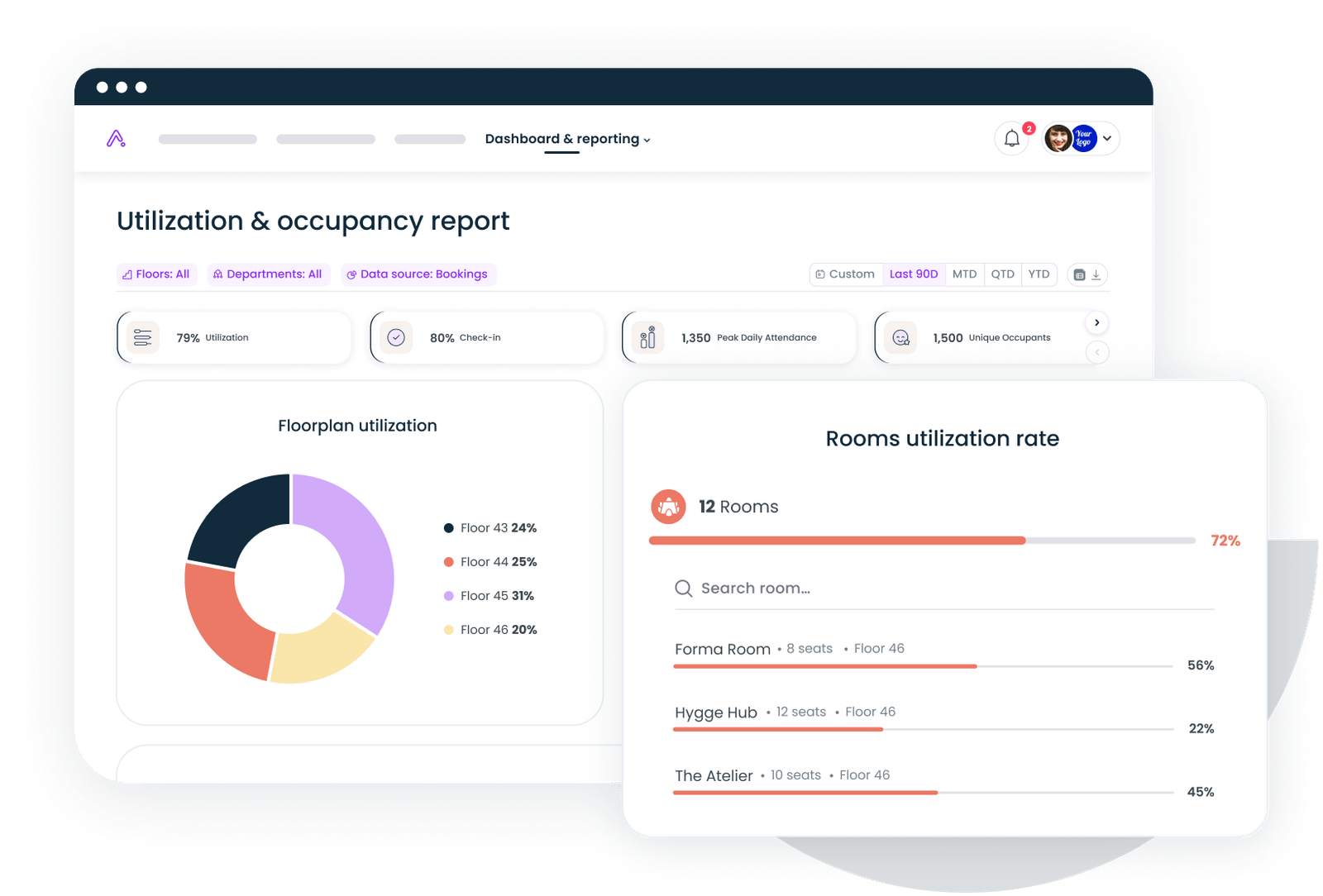
Unified workplace platforms are replacing the tool-of-the-month approach
Every year, workplace teams add another point solution. A visitor management system here, a room booking tool there, a coworking marketplace for the remote team, an event planning app for quarterly offsites. By 2026, the average mid-size company has accumulated five to eight workplace tools that don't talk to each other.
The consolidation wave is here. The workspace management software market's 14.6% CAGR is driven largely by platform buyers: companies choosing one integrated system over multiple best-of-breed tools that require custom integrations and constant maintenance.
The integration test
Ask yourself three questions about your current workplace tech stack:
- Can an employee book a desk, invite a visitor, and schedule a meeting room in under two minutes without switching apps?
- Can your workplace team see total cost-per-person across owned offices and on-demand flex spaces in a single view?
- Can your AI tools access all of this data to surface insights you didn't think to ask for?
If any answer is no, you're operating with gaps that compound over time. The strongest workplace management platforms in 2026 aren't the ones with the longest feature list. They're the ones where every feature shares the same data layer.
Change management is the real adoption blocker
Global employee engagement fell to 21% in 2024, costing $438 billion in lost productivity worldwide. New workplace technology deployed into a disengaged workforce doesn't fix engagement. It adds another login screen to ignore.
The pattern I've seen repeatedly: a workplace team selects a great platform, runs a polished launch, gets 60% adoption in week one, and watches it decay to 30% by month three. The technology wasn't the problem. The rollout treated adoption as a communications exercise instead of a behavioral change program.
What works in practice
Start with the friction your employees already complain about. If the number one complaint is "I come into the office and my team isn't there," lead with the coordination feature, not the analytics dashboard. If the loudest pain is "I can never find a meeting room," lead with room booking, not visitor management.
Survey data from early adopters matters more than executive mandates. When 200 employees at one office report that the new booking tool saved them time finding teammates, that story travels faster through Slack than any all-hands announcement.
Your rollout plan needs to work for the cautious middle, not only the eager early adopters.
The convergence is the trend
Every list of hybrid work trends in 2026 covers AI, analytics, hybrid coordination, and space optimization as separate bullet points. They're not separate. They're layers of the same system.
AI is useless without unified data. Unified data is useless without space management tools generating it. Space management tools are useless without employee adoption. Employee adoption is useless without a digital experience worth adopting. Pull on any single thread and you need the others.
The companies that will look back on 2026 as a turning point won't be the ones that adopted the most technologies. They'll be the ones that connected the fewest tools into the most complete picture, then acted on what that picture showed them. One platform. Real data. Decisions made in days, not quarters.
See how Gable brings offices, on-demand workspaces, events, and AI insights into a single platform trusted by Stripe, Snowflake, and Dropbox.
Get a demo