.svg)


.svg)
- Most AI workplace wins come from boring operational problems, not flashy demos
- Room booking, occupancy forecasting, and visitor screening deliver fastest ROI
- Bad data kills more AI projects than bad algorithms
- Start with one use case, prove value, then expand
- Privacy governance isn't optional; it's the difference between adoption and backlash
AI workplace use cases in 2026 fall into three buckets: space optimization, operational automation, and people analytics. The 12 that follow are the ones actually running in production at workplace teams right now, not the ones stuck in a vendor's demo environment. Each includes the business value, what it takes to implement, and where it tends to fall apart.
Why most AI workplace projects stall before they start
Here's the uncomfortable truth. 79% of organizations face challenges adopting AI, a double-digit increase from 2025. The technology isn't the bottleneck. Data readiness, organizational buy-in, and unclear success metrics are.
The pattern I keep seeing: a workplace team gets excited about AI, picks five use cases at once, realizes their data lives in seven different systems, and shelves the whole initiative. The teams that succeed pick one high-friction workflow, prove ROI in 8 to 12 weeks, then expand. That's the approach behind every use case on this list.
Before diving in, it's worth understanding the broader landscape of AI in the workplace and what's changed since the initial hype cycle. The short version: we've moved from "AI will transform everything" to "AI is pretty good at these specific things."
1. AI-powered room booking and conflict resolution
Meeting rooms are one of the most expensive per-square-foot assets in any office, and they're mismanaged constantly. Someone books a large conference room for a two-person call. Three teams book overlapping rooms for the same cross-functional meeting. A room sits empty because the person who booked it is working from home.
Business value: 40 to 50% reduction in no-shows; 15 to 20% better space utilization. AI handles the matching: right room size for the meeting type, automatic release of rooms when no one shows up, conflict resolution when two teams need the same space at the same time.
Implementation reality: Two to four weeks if you've got clean calendar integration (Outlook, Google Calendar, Teams). The AI needs historical booking data to learn patterns. More on how this works in practice in our deep dive on AI room scheduling.
Common failure modes: Over-reliance on automation without a human override. If the system auto-releases a room while someone's walking to it, you've created a worse problem than the one you solved. Also, garbage calendar hygiene means garbage recommendations.
2. Predictive occupancy forecasting
This is where AI earns its keep in real estate decisions. Instead of guessing how many people will be in the office next quarter, predictive models analyze badge data, booking patterns, calendar density, and seasonal trends to forecast occupancy with surprising accuracy.
Business value: Right-size your portfolio based on data, not gut feel. One floor sitting at 30% occupancy on Mondays and Fridays is a floor you might not need. The math gets real fast when you're paying $80 per square foot. Teams using predictive workplace analytics are making lease decisions months earlier and with far more confidence.
Implementation reality: Six to twelve weeks. You need historical occupancy data, badging data, and booking data unified in one place. The model improves over time, so expect modest accuracy in month one and strong accuracy by month three.
Common failure modes: Garbage in, garbage out. If your badge data doesn't capture tailgating, or your booking data is full of phantom reservations, the forecast will be wrong. Also, models trained on pre-policy-change data won't predict post-policy-change behavior. Recalibrate after any major hybrid policy shift.
3. Visitor screening and pre-registration automation
Your front desk shouldn't be a bottleneck. AI-powered visitor management handles pre-registration, identity verification, NDA routing, and host notification before the visitor even arrives. The visitor walks in, scans a QR code, and they're checked in.
Business value: Faster check-in (under 30 seconds vs. 3 to 5 minutes), reduced front desk admin, and improved security compliance. For regulated industries, automated watchlist screening and audit trails are table stakes.
Implementation reality: Two to three weeks. Integrates with existing access control and calendar systems. The AI layer handles document routing and anomaly flagging. For a deeper look at what's changed this year, see our piece on AI visitor management.
Common failure modes: Employees skip the system and wave guests through. The technology works; the adoption problem is cultural. Also, systems that don't integrate with your access control create a two-step process that nobody follows.
4. Energy and HVAC optimization via occupancy AI
If only 40% of your desks are occupied on a given day, you shouldn't be heating and cooling 100% of your floor plate. Occupancy-aware HVAC systems use sensor data and booking forecasts to adjust climate zones in real time.
Business value: 10 to 15% energy cost reduction. That's meaningful at scale. A 50,000-square-foot office spending $12 per square foot on energy saves $60,000 to $90,000 annually. It's also a tangible ESG reporting win.
Implementation reality: Four to eight weeks. Requires occupancy sensors (or Wi-Fi-based occupancy estimation) plus integration with your building management system. If you're in a multi-tenant building, you'll need landlord cooperation, which can be the hardest part.
Common failure modes: Set-and-forget. The model needs to account for irregular schedules, weather changes, and seasonal patterns. A system optimized for summer will overcool in winter if nobody's watching. Also, employees in under-conditioned zones will complain loudly, and one bad experience can tank adoption of the whole program.

Before picking use cases, get the organizational readiness piece right. This guide covers the data, governance, and change management foundations that separate successful AI rollouts from expensive pilots.
Read the guide
5. Service ticket triage and routing
Facilities teams drown in tickets. "The projector in Room 4B isn't working." "The kitchen fridge smells." "My badge doesn't open the third floor." AI triage classifies incoming tickets by urgency, category, and required skill set, then routes them to the right team automatically.
Business value: 30 to 40% faster resolution times. Reduced escalations for routine issues. Your facilities manager stops being a human router and starts doing actual facilities management.
Implementation reality: Three to six weeks. Integrates with ServiceNow, Jira, or whatever ticketing system you're running. The AI needs a few hundred historical tickets to train on. More tickets, better routing.
Common failure modes: The AI sends tickets to the wrong team, and nobody catches it because everyone assumes the system is handling it. You need an escalation path for edge cases and a feedback loop so the model improves. Without that feedback loop, accuracy plateaus at 70 to 75%, which isn't good enough.
6. Vendor invoice anomaly detection
Workplace teams manage dozens of vendor relationships: cleaning, catering, security, maintenance, supplies. AI scans invoices for duplicates, rate overcharges, contract deviations, and unusual patterns.
Business value: 5 to 8% savings via duplicate detection and rate discrepancy flagging. On a $2 million annual vendor spend, that's $100,000 to $160,000. Not glamorous, but it pays for itself in the first quarter. For teams already thinking about office expense management, this is the natural next step.
Implementation reality: Four to six weeks. Requires historical invoice data and vendor master data. The AI compares each invoice against contract terms, historical rates, and peer invoices.
Common failure modes: High false positive rate. If the system flags 30% of invoices as anomalies, your AP team will start ignoring it. Tune the sensitivity carefully. Also, the system won't catch legitimate price increases unless you feed it updated contract terms.
7. Meeting room cleanup and turnover prediction
Ghost bookings, rooms that are booked but never used, are one of the most persistent space waste problems. AI identifies patterns: which teams consistently no-show, which time slots have the highest ghost rates, and when rooms are likely to free up early.
Business value: Reclaim 15 to 25% of meeting room capacity without adding a single room. Custodial teams get predictive schedules instead of fixed rounds, so they clean rooms that were actually used.
Implementation reality: Two to four weeks. Uses booking data plus optional occupancy sensors. The sensor-free version works on calendar patterns alone (lower accuracy, but zero hardware cost).
Common failure modes: Auto-releasing bookings creates friction if the timing is too aggressive. A five-minute grace period feels reasonable to the system designer and infuriating to the person who's running two minutes late. Also, sensor malfunctions create false negatives: the room looks empty when it's not.
8. Lease abstraction and review (NLP)
Natural language processing can extract key terms from commercial leases: renewal dates, escalation clauses, tenant improvement allowances, operating expense caps. What used to take a paralegal 8 to 10 hours per lease takes the AI 15 minutes.
Business value: Eliminate 80+ hours of manual review per lease portfolio. More importantly, surface buried clauses that cost you money, like an auto-renewal you didn't know was 90 days out. Teams managing complex portfolios should pair this with a solid lease audit process.
Implementation reality: Eight to twelve weeks. Requires document standardization (PDFs need OCR processing). The AI needs a legal review layer because it will miss edge clauses, especially in older leases with non-standard language.
Common failure modes: Over-trusting the output. NLP is good at extracting standard clauses and mediocre at interpreting ambiguous ones. If your lease portfolio is small (under 10 leases), the ROI doesn't justify the setup cost. This is a volume play.
Gable AI analyzes your booking, occupancy, and space data to surface insights you'd miss in spreadsheets, from ghost booking patterns to portfolio right-sizing recommendations.
Learn more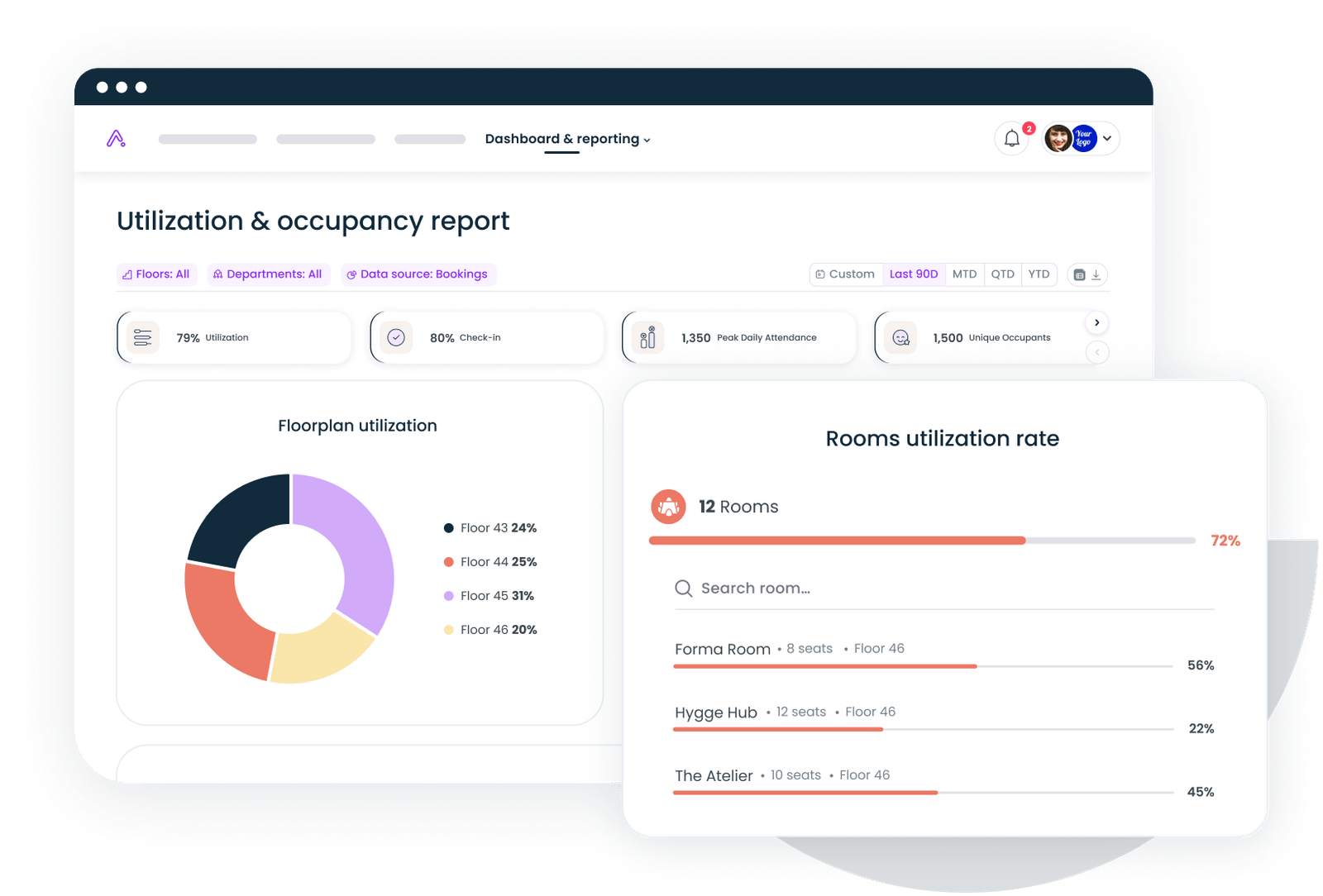
9. Employee FAQ chatbot for workplace services
"What's the Wi-Fi password?" "How do I book a parking spot?" "Where's the nearest printer?" These questions eat 10 to 15 hours per week of your workplace ops team's time. An AI chatbot trained on your workplace policies and procedures handles them instantly.
Business value: 10 to 15 hours saved per week in HR and ops responses. Employees get instant answers instead of waiting for someone to check Slack. The chatbot also surfaces gaps in your documentation: if 50 people ask the same question and the bot can't answer it, you've found a missing policy.
Implementation reality: Two to four weeks. Requires a knowledge base (your intranet, policy docs, FAQ pages) and intent mapping. The bot improves as it handles more queries.
Common failure modes: Bot trained on outdated policies gives wrong answers, and employees lose trust permanently. You need a content owner who updates the knowledge base monthly. Also, no escalation path means frustrated employees who can't get past the bot to a human.
10. Attendance pattern anomaly detection
This one requires careful handling. AI analyzes badge-in data, booking patterns, and calendar activity to identify unusual attendance shifts: a team that suddenly stops coming in on Wednesdays, an individual whose pattern changes dramatically, a location where attendance drops 30% after a policy change.
Business value: Early signal on hybrid policy drift, commute pattern changes, and potential wellness concerns. It's also useful for workplace analytics that inform real estate decisions: if nobody's using Floor 3 on Fridays, that's a data point for your next lease negotiation.
Implementation reality: Four to eight weeks. Integrates badging and calendar data. Requires a clear privacy framework before you start. 66% of AI users say it helps them focus on high-value work, but that goodwill evaporates if employees feel surveilled.
Common failure modes: This is the use case most likely to create a surveillance backlash. If you're flagging individual attendance without clear, communicated policies, you'll lose trust fast. Aggregate the data at the team or floor level. Individual-level alerts should only go to direct managers, and only with the employee's knowledge. Read up on workplace data privacy before deploying this one.
11. Sentiment analysis on employee feedback
Pulse surveys generate mountains of free-text responses that nobody reads. Sentiment analysis categorizes feedback by theme (space quality, commute, collaboration, noise) and tracks sentiment trends over time.
Business value: Real-time culture diagnostics. Instead of reading 500 survey responses, you see that "noise complaints" spiked 40% after the open floor plan redesign. That's actionable. Teams already running workplace satisfaction surveys can layer sentiment analysis on top without changing their survey process.
Implementation reality: Three to six weeks. Integrates with pulse survey tools (Culture Amp, Lattice, or even Google Forms). Requires consent for any analysis of chat or email data.
Common failure modes: Low signal-to-noise ratio. Sarcasm, cultural context, and ambiguity trip up even good models. "The office is fine" could be genuine satisfaction or passive-aggressive resignation. Also, if employees learn their comments are being analyzed by AI, response rates may drop unless you're transparent about how the data is used.
12. CapEx and space forecasting models
The most complex use case on this list, and the one with the highest potential payoff. AI models combine headcount projections, occupancy trends, lease timelines, and market data to forecast when you'll need more space, less space, or different space.
Business value: Data-driven decisions on expansions, consolidations, and relocations. Instead of "we think we'll need another floor in Q3," you get probabilistic scenarios: "There's a 70% chance we'll exceed capacity on Floor 2 by August, assuming current hiring pace." For teams navigating AI space planning, this is the end game.
Implementation reality: Ten to sixteen weeks. Requires multi-source data integration: HRIS for headcount, booking and badge data for utilization, lease management for timelines, market data for cost modeling. This isn't a plug-and-play solution.
Common failure modes: Overfitting to recent history. A model trained on 2025 data won't predict 2026 behavior if you've changed your hybrid policy, acquired a company, or shifted your hiring plan. Scenario modeling (best case, worst case, most likely) is essential. Single-point forecasts are dangerous.
How to pick your first AI workplace use case
Don't try to do all twelve. The teams that succeed start with one use case that meets three criteria: high friction (people complain about it), clean data (you already have what the AI needs), and visible ROI (leadership can see the impact in 8 to 12 weeks).
For most workplace teams, that means starting with room booking, visitor management, or service ticket triage. These are low-risk, fast-to-deploy, and solve problems everyone can feel. Save the forecasting models and sentiment analysis for phase two, after you've built internal credibility.
Only 13% of AI users say they're rewarded for experimenting with AI at work. That's a leadership problem, not a technology problem. If you want your team to adopt these tools, make it safe to experiment and visible when it works.
The workplace teams I talk to who are furthest along share one trait: they treat AI as organizational redesign, not a software rollout. The technology is the easy part. Getting people to trust it, use it, and give feedback so it improves is the actual work.
Whether you're starting with room booking or building a full workplace intelligence layer, Gable brings your space, people, and occupancy data together in one platform.
Get a demo