


.svg)


.svg)
- 92% of CRE teams are exploring AI space planning, but fewer than 1 in 10 have operationalized it
- The gap between pilot and impact comes down to people data, not floor plan software
- AI can cut real estate costs 20–40%, but only with clean occupancy data underneath
- 80% of meetings happen in rooms built for 6 or fewer; boardrooms sit empty 88% of the time
- Space planning that ignores employee behavior is expensive guesswork with a tech veneer
CRE leaders aren't short on AI space planning ambition. They're short on results. JLL's 2025 data shows exploration has surged from under 5% of teams running pilots in 2023 to 92% today, yet most initiatives stall before they reach production. Organizations keep treating AI as a design automation tool when the real opportunity is connecting space decisions to how people work.
The AI space planning reality check: 92% exploration, 8% impact
The headline number is striking, but the details underneath tell the real story. Of those 92% of CRE teams exploring AI, 54% cite compatibility with legacy infrastructure as their top barrier. That means more than half the organizations running pilots can't even connect their new tools to existing building systems, badge data, or HR platforms.
The result is predictable: a proliferation of proofs of concept that produce impressive demos but zero operational change. Internal presentations get nods. Budgets get renewed for another quarter. Nothing ships.
What "operationalized" looks like
The 8% that have moved past pilots share three characteristics. First, they treat AI as a decision layer on top of clean, integrated data, not a standalone product. Second, they've connected occupancy sensors, booking systems, and HR headcount data into a single source of truth. Third, they've assigned clear ownership: someone accountable for translating AI outputs into portfolio actions.
Why most stall in pilot purgatory
Pilot projects tend to focus on the most visible, least impactful problem: generating prettier floor plans faster. That's a nice-to-have. The CRE leaders who break through target high-stakes decisions like lease renewals, floor consolidations, and neighborhood redesigns, where the financial pressure is real enough to justify the integration work.
Organizations with a mature corporate real estate strategy are better positioned because they've already defined what "good" looks like in their portfolio. AI needs a target to optimize toward. Without one, it's pattern recognition with no purpose.
From floor plans to people plans: the mindset shift CRE leaders need
Traditional space planning starts with a question about capacity: "How many desks fit on this floor?" AI-enabled planning starts with a different question: "What are people doing when they come in, and what spaces support that?"
That distinction matters because the answers diverge sharply. CBRE's 2026 data shows 68% of employees cite collaboration with colleagues as their primary reason for coming to the office. If two-thirds of your workforce shows up to work together, optimizing for individual desk density is solving the wrong problem.
Occupancy data changes the math
Square footage is an input. Occupancy is an outcome. When you measure how space is used rather than how it's allocated, you start seeing patterns that reshape planning assumptions. Floors that look full at 9 a.m. on Tuesday are ghost towns by Thursday afternoon. Conference rooms booked for 12 host meetings of 3. Quiet zones get used for phone calls because there aren't enough phone booths.
Workplace analytics make these patterns visible. AI makes them actionable by surfacing recommendations at portfolio scale, across dozens of floors and buildings simultaneously, faster than any human team could process manually.
The collaboration signal hiding in booking data
Consider this data point: 72% of bookings on the Gable platform are for team gatherings, not solo work. That ratio should inform every space planning decision, from the mix of open versus enclosed areas to the size and quantity of meeting rooms. Yet most AI space planning tools are trained on architectural inputs (dimensions, codes, furniture catalogs) rather than behavioral inputs (who shows up, when, with whom, and why).

If 80% of meetings involve 6 or fewer people, your room mix might be working against you. See how smarter booking data changes the equation.
Read the guide
Five decisions AI should inform (but rarely does)
Most AI space planning demos focus on layout generation: drag, drop, optimize, render. That's a narrow application. Here are five decisions where AI creates real financial and operational value when fed the right data.
Desk density and neighborhood design
Neighborhood models, where teams cluster in designated zones rather than assigned desks, require precise calibration. Too few desks and people can't find seats on peak days. Too many and you're paying for empty furniture. AI can model demand curves by team, day of week, and season to recommend the right density per neighborhood. The prerequisite: accurate headcount data integrated with actual office occupancy rate measurements, not estimates.
Meeting room-to-seat ratios
The benchmark data here is damning. Worklytics research shows 80% of meetings happen in rooms designed for 6 or fewer people, while boardrooms with 17+ seats see only 12% utilization. No-show rates hit 40% of booked meetings. AI can ingest booking and sensor data to recommend decommissioning large rooms, splitting them into smaller ones, or converting them to other uses entirely.
Collaboration versus focus zone allocation
Getting this ratio wrong is expensive in both real estate cost and employee satisfaction. AI models can correlate noise complaints, room booking patterns, and employee survey data to identify where the balance is off. The output: specific recommendations for which floors need more focus space and which need more collaboration area.
Right-sizing portfolio decisions
This is where the dollars get serious. CBRE reports that 81% of CRE teams consider portfolio optimization a primary goal, with 72% focused on increasing office utilization. AI scenario planning can model what happens if you consolidate from four floors to three, shift 200 employees to a different building, or renegotiate a lease based on projected headcount changes. The key input: reliable space utilization metrics tracked over time, not a one-week snapshot.
Predictive maintenance and facility optimization
AI can forecast HVAC failures, lighting replacements, and furniture lifecycle needs based on usage intensity. A floor that runs at 90% occupancy four days a week degrades faster than one at 40%. Connecting occupancy data to facility management systems extends asset life and reduces emergency repair costs.
The data stack that makes AI space planning work
AI is a processing engine. It produces outputs proportional to the quality of its inputs. Most CRE teams that stall in pilot mode have a data problem, not a technology problem.
What you need
A functional AI space planning stack requires four data streams flowing into one place:
- Occupancy sensors: Badge swipes tell you who entered the building. Sensors tell you where they sat, for how long, and whether they were alone or in a group.
- Booking data: Desk and room reservations reveal intent. Comparing bookings to actual usage reveals the gap between plans and reality.
- HR and headcount data: Team size, location assignments, hiring projections, and org structure feed demand forecasting.
- Building systems: HVAC, lighting, and access control data provide environmental context for occupancy patterns.
What goes wrong
The most common failure mode is siloed data. Occupancy sensors feed one dashboard. Booking data lives in another system. HR runs on a third platform. Nobody owns the integration, so nobody trusts the aggregate picture. Legacy system compatibility remains the top barrier for over half of CRE teams. That's a polite way of saying their building management software was built in 2011 and doesn't have an API.
Building data discipline before buying AI tools
Data governance sounds boring until you realize it's the difference between a model that recommends consolidating the wrong floor and one that saves you $2M in lease costs. Start by auditing what you have, identifying gaps, and assigning ownership for each data stream. Office space optimization starts with knowing what's true about your current state before modeling a future one.
Gable Offices gives you desk and room booking data, utilization insights, and visitor management in one platform, so AI has something real to work with.
Learn more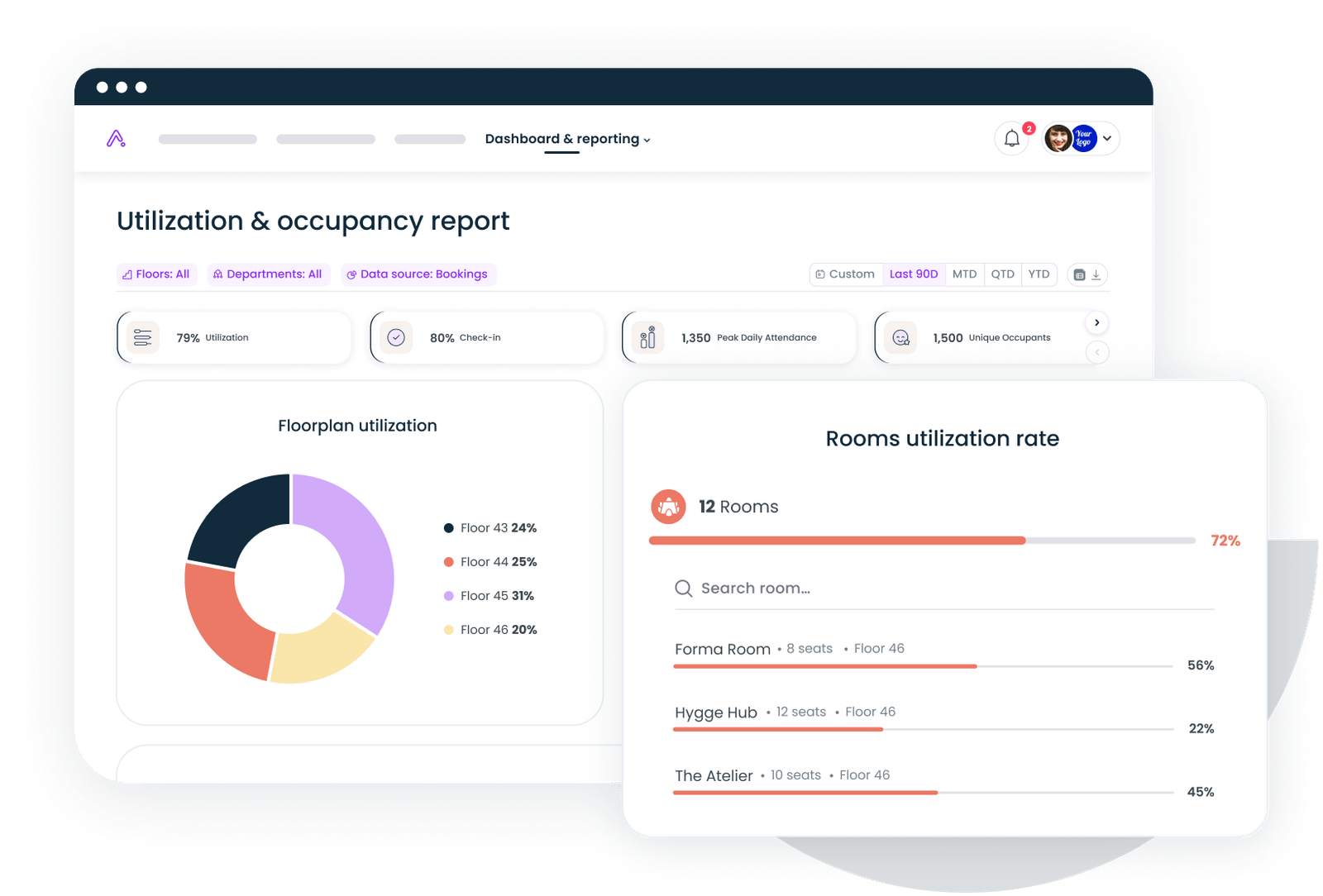
Three scenarios where AI space planning delivers real ROI
Abstract benefits don't survive budget conversations. Concrete scenarios do. Here are three situations where AI space planning moves from interesting to indispensable.
Scenario 1: Portfolio consolidation
A company with 500,000 square feet across six locations discovers through occupancy data that two buildings average 35% utilization. AI scenario planning models three options: close one building and redistribute teams, close both and consolidate into a new lease, or convert underused floors to sublease. Each scenario factors in commute impact, team adjacency requirements, and lease break costs.
The financial stakes are clear. AI-driven portfolio analysis can reduce real estate costs by 20–40% when applied to decisions of this scale. Without AI, this analysis takes a consulting team months. With it, CRE leaders can model dozens of configurations in days and pressure-test assumptions against real occupancy patterns.
For teams evaluating their options, a structured approach to reducing corporate real estate costs provides the framework AI tools need to optimize against.
Scenario 2: Hybrid optimization
A 2,000-person company with a three-day in-office policy sees wildly uneven attendance. Tuesdays and Wednesdays hit 80% capacity. Mondays hover at 45%. Fridays barely crack 20%. AI ingests badge data, booking patterns, and team schedules to recommend differentiated floor plans: high-density collaboration zones staffed Tuesday through Thursday, converted focus or event space on low-traffic days.
This scenario directly addresses the tension most hybrid work models create: policies set uniform expectations, but actual behavior varies dramatically by team, function, and week. AI makes it possible to design for the variability rather than pretending it doesn't exist.
Scenario 3: Experience-driven design
A tech company struggling with voluntary return-to-office rates uses AI to analyze which spaces correlate with repeat visits. The model surfaces that employees who use specific collaborative zones return 40% more frequently than those assigned to open desk areas. The recommendation: invest in more of those collaborative environments and reduce generic hot-desking capacity.
According to CBRE's 2026 data, the majority of CRE leaders now rank portfolio optimization above pure cost reduction as their top priority. Experience-driven design is where optimization and engagement intersect, and AI is the mechanism that identifies which design choices move the needle.
Why your AI space planning initiative will fail (and how to prevent it)
Failure in AI space planning is common enough that the patterns are well-documented. Knowing them in advance is valuable insurance.
Starting with technology instead of problems
Every failed initiative I've seen started the same way: someone attended a conference, saw a compelling AI demo, and came back asking "How do we get that?" The question should be "What decision are we trying to make better?" If the answer is vague ("optimize our space"), the project will drift. If it's specific ("determine whether to renew the lease on Building C by modeling three utilization scenarios"), AI has a clear target.
Ignoring change management
AI recommendations are worthless if nobody acts on them. A model that says "convert Conference Room 4B into four phone booths" requires facilities to execute, employees to adapt, and leadership to communicate why. VergeSense research emphasizes that real-time occupancy insights need organizational readiness to translate into action. Without change management, recommendations pile up in dashboards nobody checks.
Treating AI as a cost-cutting tool only
Cost reduction is a valid outcome, but it's a narrow lens. Organizations that frame AI space planning solely around cutting square footage miss opportunities to improve employee experience, increase collaboration frequency, and reduce friction in hybrid schedules. The organizations seeing strong results use AI to do both: reduce waste and increase the quality of space that remains.
Poor data governance
Garbage in, garbage out applies with particular force to spatial AI. Sensor data with 30% gaps, booking systems nobody uses, and HR records updated quarterly produce models that recommend confidently and incorrectly. Data governance (ownership, quality standards, refresh cadences, and integration protocols) must precede any AI deployment.
Building the business case: from pilots to scaled operations
CFOs don't fund experiments indefinitely. Scaling AI space planning requires translating pilot learnings into a business case with numbers attached.
Quantifying the opportunity
The benchmarks provide a starting range:
- Real estate cost reduction: 20–40% for organizations that apply AI to portfolio decisions
- Planning speed: What took design teams weeks now takes days with AI scenario modeling
- Utilization improvement: CBRE data shows 72% of CRE teams targeting utilization gains as a primary objective
Building a phased roadmap
Scaling doesn't mean doing everything at once. A practical sequence:
- Quarter 1: Audit existing data sources, identify gaps, assign ownership
- Quarter 2: Integrate occupancy, booking, and HR data into a single platform
- Quarter 3: Run AI models against one high-stakes decision (lease renewal, floor consolidation)
- Quarter 4: Measure outcomes, refine models, expand to additional sites
Office space planning provides the structural foundation, but the AI layer is what turns static plans into adaptive, continuously improving strategies.
The maturity spectrum
Not every organization needs the same level of AI sophistication. Here's a practical framework:
- Level 1 (Reactive): Manual space planning, spreadsheet-based allocation, no occupancy data
- Level 2 (Informed): Occupancy sensors deployed, booking data collected, but analyzed manually
- Level 3 (Analytical): Data integrated across systems, dashboards provide visibility, decisions still human-driven
- Level 4 (Predictive): AI models forecast demand, recommend configurations, surface anomalies
- Level 5 (Adaptive): AI continuously adjusts space recommendations based on real-time feedback loops
Most organizations sit at Level 1 or 2. The jump to Level 3 is the hardest because it requires data integration. The jump from Level 3 to 4 is where AI adds clear, measurable value.
The case for acting now, not next year
The gap between AI space planning leaders and laggards is widening. Organizations that operationalized in 2024 and 2025 have 12–18 months of behavioral data feeding their models, giving them a compounding advantage in portfolio decision-making.
What the leaders are doing differently
These organizations are making faster, better-informed portfolio decisions. They're renegotiating leases with utilization evidence. They're designing spaces employees choose to visit.
Meanwhile, teams still debating which pilot to run are accumulating another year of lease costs on underused space. The cost of inaction isn't zero; it's the delta between what you're paying for and what you're using, multiplied by every month you delay.
The technology is ready. The data infrastructure challenges are solvable. The real question is whether your organization is willing to invest in the unglamorous work of data integration, governance, and change management that separates the 8% from the 92%. That's where the results live.
Gable helps workplace teams collect, visualize, and act on the occupancy and booking data that AI space planning depends on.
Get a demo


