.svg)


.svg)
- Define who owns each expense category before you try to control costs
- Set approval thresholds by dollar amount, not by gut feel
- Three-way matching catches invoice errors before they become budget problems
- Tie cost allocation to actual occupancy, not headcount assumptions
- Run monthly variance analysis or you're flying blind on spend
Office expense management is the process of tracking, approving, allocating, and reporting on the operating costs that keep your workplace running: cleaning, utilities, catering, AV, supplies, maintenance, and vendor contracts. It rests on four pillars: category ownership, procurement workflow, invoice review, and cost allocation. Get those four right and you have a system. Get them wrong and you have a spreadsheet that nobody trusts.
Why office expense management breaks down at scale
Most companies don't start with bad processes. They start with no process at all, and it works fine when you're 30 people in one office. The office manager handles vendor relationships, approves invoices, and reconciles everything in a spreadsheet. Then you hit 150 people, open a second location, and suddenly three departments are ordering supplies from different vendors at different prices.
The numbers make the case for getting this right. Manual invoice processing costs $12.90 per invoice on average, compared to $2.07 for automated processes. At 200 invoices a month, that's the difference between $2,580 and $414. And that's just processing cost; it doesn't account for the errors, duplicate payments, and missed discounts that come with manual handling.
Hybrid work made this harder. When occupancy fluctuates daily, your catering spend, cleaning contracts, and utility costs should flex too. But most companies still budget these line items based on headcount or square footage, not actual usage. If you're managing workplace spend benchmarks against static assumptions, you're overpaying somewhere.
This playbook walks through each of the four pillars, then covers the monthly close cadence, system integrations, and the process failures that trip up growing companies. It's written for the ops manager who's past the spreadsheet stage but not yet running enterprise procurement software.
Pillar 1: Build your expense category and ownership matrix
Before you can manage office expenses, you need to agree on what counts as an office expense. That sounds obvious. It isn't.
The most common source of confusion is the boundary between workplace ops, facilities, IT, and HR. Cleaning contracts might sit with facilities. AV equipment might sit with IT. Catering for a team event might sit with HR. And the office manager ends up processing invoices for all of them without clear authority over any of them.
Start by listing every recurring expense category and assigning a single owner. Here's a framework that works for most mid-sized companies:
Workplace ops owns: cleaning and janitorial, office supplies, pantry and snacks, mail and shipping, general maintenance, reception and front desk services.
Facilities owns: HVAC and mechanical systems, building security, fire safety, elevator maintenance, structural repairs, lease-related costs like CAM charges and property tax pass-throughs.
IT owns: AV equipment and maintenance, network infrastructure, access control hardware, conference room technology, software licenses for workplace systems.
HR owns: catering for company events, employee perks and amenities, wellness room supplies, onboarding kits.
The point isn't that this exact split works for every company. The point is that every expense has one owner, and that owner controls the budget, approves invoices, and answers for variances. Shared ownership means no ownership.
Document this matrix and share it with finance. When your accounting team codes an invoice to the wrong cost center because they didn't know who owned it, that's a symptom of a missing ownership matrix, not a data entry problem.
Pillar 2: Design your procurement and approval workflow
A procurement workflow answers two questions: who can spend money, and how much can they spend before someone else needs to approve it?
Set approval thresholds by dollar amount. Most companies land on something like this:
- Under $500: direct manager approval only
- $500 to $5,000: manager plus department head
- $5,000 to $25,000: department head plus VP of Finance
- Over $25,000: CFO or executive committee
These thresholds should reflect your risk tolerance, not your org chart's ego. If your VP of Workplace has a $50K annual supplies budget and needs CFO approval for a $2,000 order, you've created a bottleneck that slows everything down without meaningfully reducing risk.
Require purchase orders for anything above your lowest threshold. A PO creates a paper trail that makes invoice matching possible later. Without it, you're comparing an invoice to someone's memory of what they ordered. POs don't need to be complex; they need to exist.
Standardize vendor onboarding. Before a new vendor sends their first invoice, collect: W-9 or equivalent tax documentation, certificate of insurance, payment terms agreement, and a primary contact for billing disputes. This takes 20 minutes upfront and saves hours of back-and-forth later.
Define how invoices enter your system. Email attachments scattered across five inboxes is not a system. Route all invoices to a single intake point, whether that's a shared AP email, a vendor portal, or an OCR-enabled upload. The goal is that no invoice lives only in someone's personal inbox.
For companies scaling across multiple office locations, this workflow needs to account for location-level approvers. A regional office manager should be able to approve routine purchases without routing everything through HQ.

Office expenses are one piece of a larger cost picture. This guide covers strategic approaches to cutting real estate spend across your entire portfolio.
Read the guide
Pillar 3: Implement invoice review, three-way matching, and dispute resolution
Approving an invoice isn't the same as verifying it. Approval means someone with budget authority says "yes, pay this." Verification means someone confirmed the invoice is accurate. You need both.
Three-way matching is the foundation. For every invoice, compare three documents: the purchase order (what you agreed to buy), the receiving confirmation (what you actually got), and the invoice (what the vendor is charging). If all three align within your tolerance threshold (typically 1 to 2%), the invoice is clean. If they don't, it goes to exception review.
What to verify on every invoice:
- Vendor name and invoice number match your records (catches duplicate submissions)
- Line items match the PO quantities and unit prices
- Delivery or service completion is confirmed
- Tax calculations are correct
- Payment terms match your vendor agreement
CAM reconciliation deserves special attention. If you're in a leased space, your landlord passes through common area maintenance charges, property taxes, and insurance. These pass-throughs are estimated monthly and reconciled annually. BOMA benchmarks show that total operating expenses vary dramatically by city, from $12.95 per square foot in New York to under $5.00 in smaller markets. If your landlord's reconciliation statement shows a 15% jump in operating expenses, don't just pay it. Request the backup documentation and compare it against published benchmarks. A lease audit can catch overcharges that compound year after year.
Set escalation rules for exceptions. Not every mismatch needs the same response. A $12 discrepancy on a $3,000 cleaning invoice probably isn't worth disputing. A $1,200 discrepancy on the same invoice absolutely is. Define dollar and percentage thresholds that trigger formal dispute documentation versus a quick email to the vendor.
Track dispute resolution. When you dispute an invoice, log the date, the issue, the vendor's response, and the resolution. This creates a pattern record. If the same vendor consistently overbills by 3 to 5%, that's not a clerical error; it's a pricing problem that belongs in your next contract negotiation.
Pillar 4: Establish cost allocation rules
Cost allocation determines who pays for what. It sounds like an accounting exercise, but it directly shapes how departments think about office expenses. If marketing doesn't see the cost of the conference rooms they book, they have no incentive to release rooms they won't use.
Three common allocation models:
HQ-charged (centralized). All office expenses hit a single corporate cost center. Departments don't see individual charges. This is simple to administer but creates zero accountability at the department level. It works for small companies where the CEO can eyeball total spend.
Department-charged (direct allocation). Each department pays for the resources it uses. Catering for the engineering team's lunch comes out of engineering's budget. This creates accountability but requires tracking infrastructure. You need to know who used what.
Cost-center allocation (hybrid). Shared costs like utilities, cleaning, and building maintenance are allocated by formula (usually headcount or square footage), while direct costs like catering and supplies are charged to the requesting department. This is the most common model for companies with 200 or more employees.
Occupancy-based allocation is the 2026 upgrade. Instead of allocating by headcount (which assumes everyone uses the office equally), allocate by actual occupancy. If the sales team uses 40% of desk-days in a given month, they absorb 40% of shared costs. This requires occupancy data from badge systems, booking platforms, or sensors. Gable Offices provides this kind of daily occupancy data, which makes allocation models based on actual usage possible without manual counting.
Map every expense category to a GL code. Your chart of accounts should have enough granularity to distinguish between cleaning, supplies, catering, maintenance, and utilities, but not so much granularity that coding becomes a guessing game. Ten to fifteen office expense GL codes is usually the right range. More than that and you'll spend more time classifying expenses than managing them.
Monthly close cadence: Reports, variance analysis, and exception review
A monthly close cadence turns raw expense data into decisions. Without it, you're collecting invoices but not learning anything from them.
Week 1 (days 1 to 5 after month-end): invoice cutoff and accruals. Confirm all invoices for the prior month have been received and entered. For any known expenses without invoices (a cleaning service that bills on the 15th, for example), create accrual entries so your month-end numbers reflect reality.
Week 2 (days 6 to 10): variance analysis. Pull a budget-versus-actual report by category and by location. Flag any line item that exceeds budget by more than 10% or more than $5,000 (adjust these thresholds to your scale). For each flagged item, determine whether the variance is a timing issue (invoice arrived late), a volume issue (higher occupancy drove higher catering costs), or a price issue (vendor raised rates without notice).
This is where space utilization data becomes valuable. If your cleaning costs went up 12% but occupancy went up 15%, the variance is explained. If cleaning costs went up 12% and occupancy dropped, you have a problem worth investigating.
Week 2 to 3 (days 8 to 15): exception review meeting. Bring together the expense category owners (from your Pillar 1 matrix) for a 30-minute review. Agenda: flagged variances, open disputes, upcoming contract renewals, and any one-time expenses expected next month. This meeting replaces the ad hoc Slack messages and email threads that otherwise consume everyone's week.
Week 3 to 4 (days 15 to 20): forecast update. Based on variance trends and known changes (a new office opening, a vendor contract renewal, seasonal patterns), update your rolling forecast. If you only update the forecast quarterly, you're always reacting to surprises instead of anticipating them.
Key reports to generate monthly:
- Spend by category (cleaning, catering, supplies, utilities, maintenance, AV)
- Spend by location (for multi-site companies)
- Spend by vendor (identifies concentration risk)
- Budget versus actual with variance percentages
- Open POs and aging invoices
- Cost per occupied desk (total office opex divided by occupied desk-days)
That last metric, cost per occupied desk, is the single most useful number for office operations leaders. It normalizes your spend against actual usage and makes month-over-month comparisons meaningful even when occupancy fluctuates.
Integrating with your accounting system
Your expense management workflow needs to talk to your accounting system. Otherwise you're maintaining two sets of records, which means neither is accurate.
NetSuite. Supports custom approval workflows, multi-subsidiary cost allocation, and automated GL coding rules. The key configuration: set up vendor bills to auto-populate from PO data, so AP isn't re-entering line items. Use saved searches to generate the monthly variance reports described above.
QuickBooks. Works for companies under 200 employees with straightforward allocation needs. Limitations: approval workflows are basic, multi-location allocation requires workarounds, and reporting is less flexible. If you're on QuickBooks and growing fast, plan your migration to a mid-market ERP before your process breaks, not after.
Workday Financials. Enterprise-grade with strong cost allocation engines and approval routing. The challenge is configuration complexity. Budget 8 to 12 weeks for initial setup of office expense workflows, including GL mapping, approval hierarchies, and integration with your workplace management tools.
Integration principles that apply regardless of system:
- Automate GL coding where possible. If every invoice from your cleaning vendor hits the same GL code, that rule should be automatic, not manual.
- Sync vendor master data between your workplace management platform and your ERP. Duplicate vendor records cause duplicate payments.
- Build audit trails. Every approval, edit, and payment should be traceable to a person and a timestamp.
- Test your integration with real invoices before going live. The demo always works. The first real invoice with a missing PO number is where things break.
For companies evaluating workplace technology, include accounting system integration as a non-negotiable requirement in your RFP. A tool that can't push data to your ERP creates more manual work than it eliminates.
Desk booking, room scheduling, and utilization data in one platform, with the integrations to feed your accounting system clean allocation data.
Learn more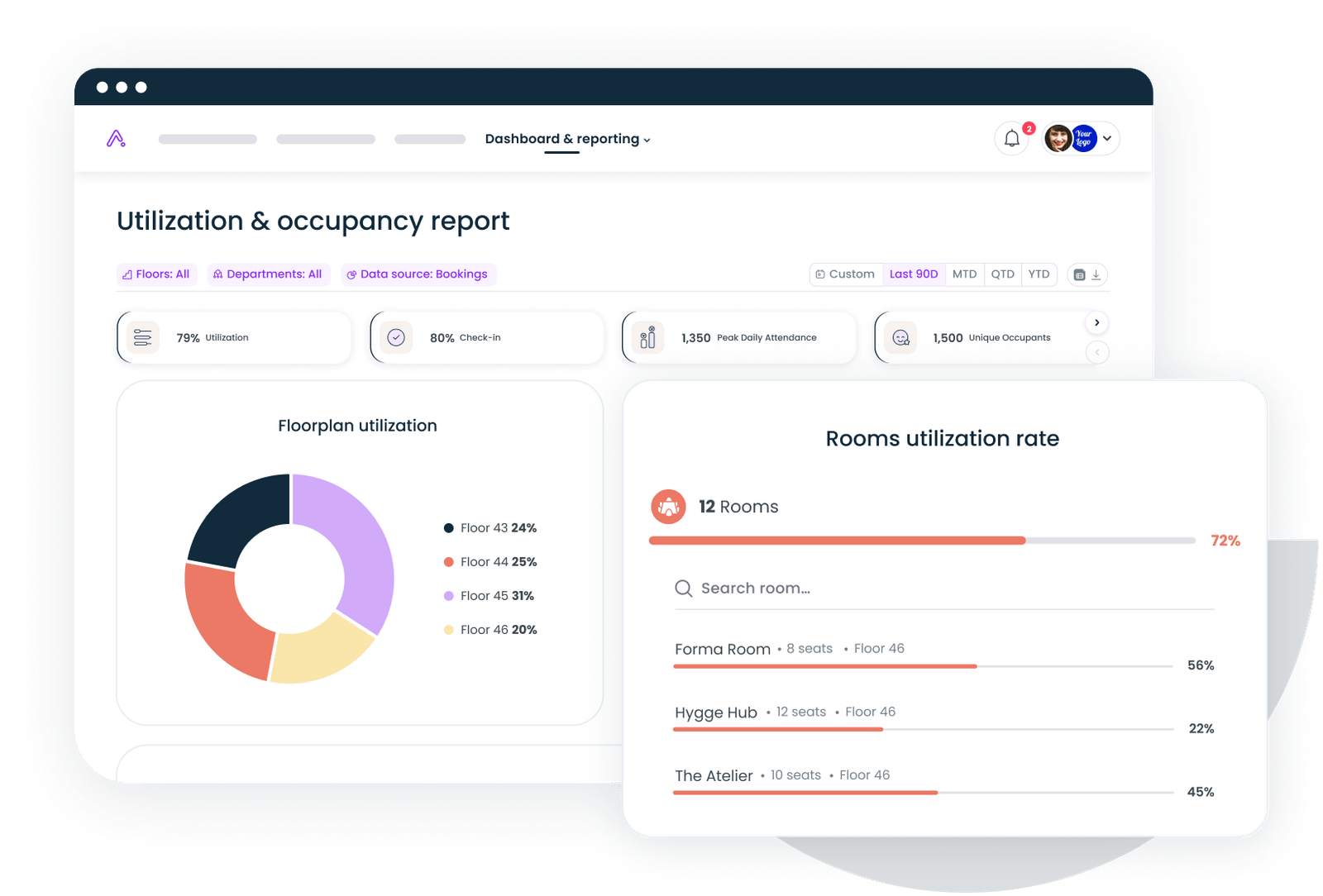
Common process failures and how to prevent them
Every office expense management process works on paper. Here's where they fail in practice.
Approval bottlenecks. Companies miss roughly $7 in early-payment discounts for every $1,000 spent when approval cycles exceed a week. For a mid-sized company, that translates to roughly $18,000 in missed discounts and late fees annually. The fix: set SLAs for approval response times (48 hours is reasonable), configure automatic escalation when approvers miss the deadline, and designate backup approvers for every threshold level.
Missed renewal deadlines. Vendor contracts auto-renew 60 or 90 days before expiration. If nobody's tracking those dates, you're locked into another year of a contract you might have renegotiated or terminated. Build a contract calendar with alerts at 120, 90, and 60 days before renewal. Assign each contract to the category owner from your Pillar 1 matrix.
No variance tracking. If you're not comparing actual spend to budget monthly, you won't catch problems until they're too expensive to fix. A 5% monthly overspend on cleaning compounds to 60% annually. The monthly close cadence described above exists specifically to prevent this.
Duplicate payments. These happen more often than anyone admits. The vendor sends the invoice twice (once by email, once by mail). Two different people enter it. Nobody catches the duplicate because there's no matching logic. Prevention: require invoice number matching before payment, and run a monthly duplicate detection report.
Shadow processes. This is the most insidious failure. Someone decides the procurement workflow is too slow, so they put a $4,000 catering order on a corporate card and expense it after the fact. Now you have spend that bypassed approval, wasn't matched to a PO, and shows up in a different GL category. The fix isn't to eliminate corporate cards; it's to make the procurement workflow fast enough that people don't feel the need to work around it.
Scaling without updating thresholds. The approval thresholds you set at 100 employees won't work at 500. As your company grows, review thresholds annually. What felt like a significant purchase at $5,000 might be routine at your current scale, and routing it through three approvers just slows everyone down.
Putting it all together: Your implementation sequence
If you're building this from scratch, don't try to implement all four pillars simultaneously. Here's the sequence that works:
Month 1: Category ownership matrix. List every recurring expense, assign owners, get finance to sign off. This is a document, not a system. It takes a week of conversations, not a software implementation.
Month 2: Procurement workflow. Define thresholds, create PO templates, onboard your top 10 vendors (by spend volume) into the new process. Let smaller vendors continue on the old process temporarily.
Month 3: Invoice review process. Implement three-way matching for your top 10 vendors. Train AP on exception handling and dispute documentation. Start the monthly close cadence.
Month 4: Cost allocation. Configure your accounting system for the allocation model you've chosen. Run a parallel month where you calculate allocations both the old way and the new way to validate the results.
Month 5 and beyond: Optimize. Expand the procurement workflow to all vendors. Refine variance thresholds based on what you've learned. Start connecting occupancy data to allocation models. Build the contract renewal calendar.
This isn't a six-week project. It's a six-month transformation that gets incrementally better each month. The companies that try to do it all at once usually end up with a half-implemented system that nobody trusts, which is worse than the spreadsheet they started with.
The real goal isn't control; it's visibility
Office expense management isn't about creating bureaucracy. It's about knowing where your money goes so you can make better decisions about where it should go.
When you can see that catering costs $14 per occupied desk on Tuesdays but $22 on Fridays (because fewer people show up but the catering order doesn't flex), you can fix that. When you can see that one location's cleaning costs are 30% higher per square foot than another's, you can investigate whether that's justified or whether it's time to rebid the contract. When you can tie every dollar of office spend to a category, an owner, a location, and an occupancy rate, you stop guessing and start managing.
The four pillars, the monthly cadence, the system integrations; they're all just infrastructure for that visibility. Build them in order, refine them over time, and you'll spend less time processing invoices and more time making the office worth showing up to.
From desk booking to utilization analytics, Gable gives workplace ops teams the data they need to manage space and spend with confidence.
Get a demo