.svg)


.svg)
- Reorganization beats relocation when your lease has three or more years left
- Baseline occupancy data is the non-negotiable starting point for any redesign
- Phase the work in zones so you never displace the entire office at once
- Communicate early, communicate often, and build in real feedback loops
- Measure five metrics for six months post-launch before declaring success
Office reorganization is the process of reconfiguring your existing office layout, furniture, and zones to match how people actually work today, without moving to a new building. If your hybrid patterns have stabilized but your floor plan still reflects 2019 headcount assumptions, reorganization is likely the faster, cheaper, and less disruptive path forward. This guide walks through every step, from deciding whether reorganization is the right call to measuring whether it worked.
When office reorganization beats relocation
Relocation is expensive. Lease termination penalties, build-out costs for a new space, moving logistics, and the productivity hit of uprooting an entire workforce add up fast. Reorganization gives you most of the benefit at a fraction of the cost.
The math is straightforward. If your current lease has three or more years remaining, breaking it early carries a penalty that often exceeds the cost of reconfiguring the space you already have. Reorganization lets you maximize the value of that remaining lease term while deferring the relocation decision until market conditions improve or your headcount picture clarifies.
There are a few clear signals that reorganization is the right move:
- Utilization is consistently low. If your office occupancy rate hovers around 40-50% most days, you're paying for space nobody uses. That's a layout problem, not a location problem.
- Peak days create bottlenecks. Tuesday and Wednesday are packed while Monday and Friday feel empty. Your space needs to flex, not expand.
- Collaboration spaces are wrong-sized. You have 20-person conference rooms that host 4-person meetings, or you're short on huddle rooms and focus pods.
- Hybrid work has stabilized. The dust has settled on your hybrid work schedule, and you now have enough data to design around real patterns instead of guesses.
Relocation makes sense when you've genuinely outgrown the building, when the location no longer serves your talent base, or when the infrastructure (HVAC, electrical, structural) can't support what you need. For everything else, reorganization is the sharper tool.
Gathering the right data before you redesign
Skipping baseline data collection is the single most common mistake in office reorganization. Without it, you're redesigning based on opinions, and opinions are usually wrong about how space actually gets used.
You need three categories of data before you touch a single piece of furniture.
- Occupancy and utilization metrics. Start with the basics: how many people are in the office each day, which zones they use, and when. Badge swipe data, WiFi connection logs, and booking system records all contribute. You're looking for peak-day capacity, average daily utilization, no-show rates on booked desks and rooms, and the delta between booked and actual usage. If you don't already track space utilization metrics, start now and collect at least 60 days of baseline data before planning any changes.
- Workflow and adjacency mapping. Which teams need to sit near each other? Where do spontaneous conversations happen? Which departments share resources like printers, labs, or specialized equipment? Walk the floor during peak hours and map the actual traffic patterns. You'll often find that the org chart and the collaboration graph are two very different things.
- Employee feedback. Surveys and interviews reveal what the sensors can't: noise complaints, temperature issues, lack of privacy, or frustration with booking systems. Employee workplace feedback is where you learn that the "collaboration zone" everyone avoids is too loud for actual work, or that people hoard conference rooms because they can't find a quiet phone booth. 77% of businesses are rethinking layouts to support evolving workflows. Your employees can tell you exactly which workflows are broken.
Combine all three data streams into a single picture. Sensor data tells you what's happening. Workflow mapping tells you why. Employee feedback tells you what's missing.

Before reorganizing, you need to know exactly how much space you actually need. This guide walks through the data-driven approach to aligning your portfolio with real usage.
Read the guide
Designing your phased reorganization plan
Don't reorganize the entire office at once. Full-floor shutdowns create chaos, displace everyone simultaneously, and leave no room for course correction. Phase the work in zones.
Step 1: Define your zones
Based on your data, divide the office into logical zones: collaboration areas, focus zones, team neighborhoods, social spaces, and flex/hot-desking areas. Map these against the utilization data you collected. If 60% of your meeting rooms are underused while desk areas are packed on Tuesdays, you know where to reallocate square footage.
Step 2: Pick a pilot zone
Choose one area, ideally one that's underperforming and serves a willing team, and redesign it first. A workplace pilot program lets you test assumptions before committing to the full floor plan. Run the pilot for 4-6 weeks and measure everything: utilization, satisfaction, noise levels, booking patterns.
Step 3: Create swing space
During each phase, displaced teams need somewhere to work. Identify temporary areas (underused conference rooms, flex zones, even a reserved section of a coworking partner's space) that can absorb overflow. These don't need to be permanent, but they need to function: power, Wi-Fi, enough seats, and a booking mechanism so people know where to go.
Step 4: Sequence the remaining phases
Order matters. Renovate the least-used areas first (they displace fewer people) and save the highest-traffic zones for last, when you've refined your approach based on earlier phases. A typical reorganization runs 8-16 weeks depending on office size and scope.
Step 5: Choose modular over fixed
Furniture that bolts to the floor is a bet that you've predicted the future correctly. You haven't. Modular desks, movable partitions, and reconfigurable meeting furniture let you adjust as patterns shift. Neighborhood seating setups, where teams cluster in zones but individuals pick their own desk each day, are a good middle ground between assigned seating and full hot-desking.
Realistic timeline by office size:
- Under 10,000 sq ft: 4-8 weeks
- 10,000-50,000 sq ft: 8-12 weeks
- Over 50,000 sq ft: 12-16+ weeks
Build in buffer. Furniture deliveries get delayed. Electrical work takes longer than quoted. The pilot phase will surface problems you didn't anticipate. That's the point.
Communicating reorganization to employees
More than 80% of reorganizations fail to deliver expected value on time. A significant chunk of that failure comes down to communication, not construction. People resist what they don't understand, and they resent what they weren't consulted about.
Here's a phased communication plan that actually works.
Phase 1: Pre-announcement (6-8 weeks before construction)
Share the "why" before the "what." Explain the data that's driving the decision: utilization numbers, employee survey results, the specific problems the reorganization will solve. Be honest about trade-offs. If some people are losing assigned desks, say so. If the goal is partly cost reduction, don't pretend it's purely about "collaboration." Your guide here is communicating office policy changes without eroding trust.
Phase 2: Design input (4-6 weeks before)
Share preliminary layouts and ask for feedback. Not performative feedback where you've already decided everything, but genuine input on adjacencies, zone types, and amenities. Run focus groups with representatives from each team. You won't implement every suggestion, but you'll catch blind spots and build buy-in.
Phase 3: Logistics updates (2-4 weeks before each zone's phase)
Weekly emails or Slack updates covering: what's changing this week, where displaced teams should go, what the timeline looks like, and who to contact with problems. Over-communicate during construction. Noise, dust, and disruption are tolerable when people know they're temporary and on schedule.
Phase 4: Post-move check-ins (2-4 weeks after each phase)
Don't just finish construction and move on. Run quick pulse surveys. Walk the floor and talk to people. The first two weeks in a new layout surface 80% of the issues: the acoustics are wrong, the booking system doesn't reflect the new rooms, the power outlets are in the wrong spots. Fix these fast.
Getting employee buy-in isn't about selling people on the change. It's about making them co-authors of it.
Measuring success after reorganization
You need baselines, and you need patience. Collect 60-90 days of pre-reorganization data across five core metrics, then measure monthly for at least six months post-launch.
1. Space utilization rate. The percentage of available desks, rooms, and zones that are actively used on any given day. This is your headline number. If you reorganized to reduce waste, utilization should climb. Track it by zone, not just as a building-wide average, because a 60% average can hide a zone at 90% and another at 30%.
2. Cost per seat. Total occupancy cost (rent, utilities, maintenance, furniture amortization) divided by the number of usable seats. Reorganization should bring this down, either by reducing total seats while maintaining capacity or by converting wasted space into productive use. For a deeper dive on this metric, see how to calculate cost per desk.
3. Employee satisfaction. Run a workplace satisfaction survey before the reorganization and again 90 days after completion. Ask specific questions about noise, privacy, collaboration ease, and overall comfort. A generic "how do you like the new office?" question tells you nothing actionable.
4. Meeting room and desk no-show rates. If people book spaces and don't show up, your new layout isn't matching real behavior. High no-show rates post-reorganization suggest the booking system doesn't reflect the new floor plan, or that people are hoarding space out of anxiety about availability.
5. Collaboration quality. This one's harder to quantify, but not impossible. Track team overlap rates (how often team members are in the office on the same days), cross-functional meeting frequency, and qualitative feedback on whether spontaneous interactions have increased or decreased.
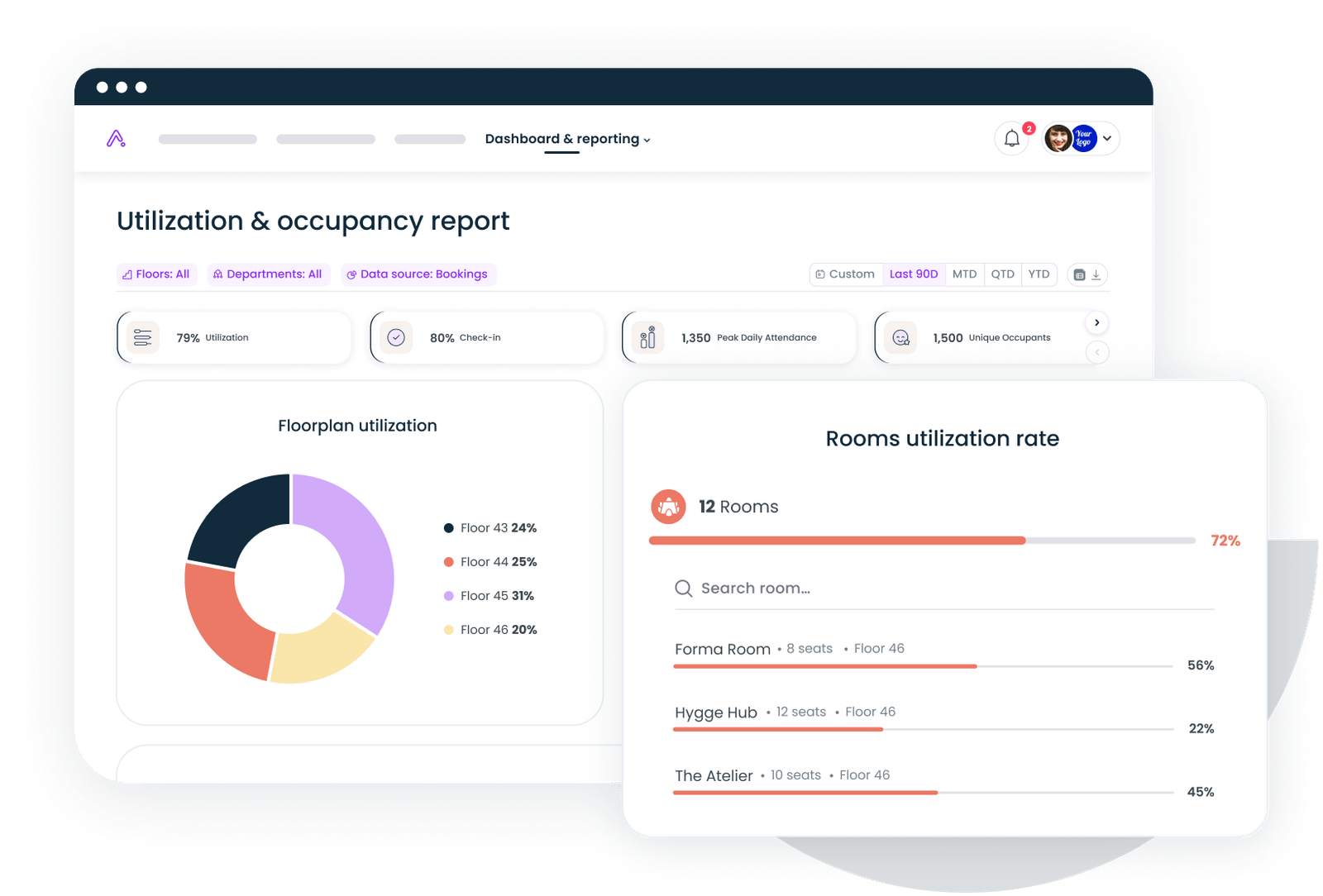
Gable's office management software connects booking data, badge access, and utilization sensors into a single dashboard, which makes tracking these five metrics across phases significantly easier than stitching together spreadsheets from different systems.
Gable Offices gives you real-time visibility into desk bookings, room usage, and occupancy patterns so you can measure what's working and fix what isn't.
Learn more
Common pitfalls to avoid
- Designing for today's headcount, not tomorrow's. Your office reorganization should account for 12-18 months of projected growth or contraction. If you're hiring aggressively, build in flex capacity. If you're stabilizing, don't over-build.
- Ignoring building systems. A redesign that looks great on paper can have unintended consequences. Removing a partition may affect HVAC airflow. Relocating a wall may require moving a fire sprinkler or smoke detector. Converting a private office to a meeting room may change the occupant load calculation for fire code purposes. Involve your facilities team and building management early.
- Treating it as a one-time project. The reorganization isn't done when the furniture is in place. It's done when you've iterated based on post-launch data. Plan for at least two rounds of adjustments in the first 90 days: moving furniture, adjusting acoustic panels, reconfiguring booking zones.
- Skipping the technology layer. A reorganized office without updated floor plans in your booking system is a recipe for confusion. People will wander around looking for rooms that moved, book desks that no longer exist, and give up on the system entirely. Update your digital floor plans before the physical move, not after.
- Under-investing in acoustics. Open plans save space. They also generate noise complaints that drive people back home. If your reorganization increases open seating, invest proportionally in acoustic treatment: sound-masking systems, phone booths, and absorptive materials. Focus rooms aren't a luxury; they're the thing that makes open plans survivable.
Making your reorganization stick
Office reorganization isn't a facilities project. It's a change management project that happens to involve furniture. The companies that get it right treat it as a continuous loop: collect data, redesign, communicate, measure, adjust. The ones that get it wrong treat it as a one-time construction job and wonder why utilization numbers don't improve.
The good news is that reorganization is far more forgiving than relocation. If a zone isn't working, you can reconfigure it in weeks, not months. If employee feedback reveals a problem you didn't anticipate, modular furniture lets you respond without calling the contractors back. The key is building measurement into the process from day one, not bolting it on after the fact.
Start with data. Phase the work. Communicate relentlessly. Measure everything. Adjust fast. That's the whole playbook.
From pre-move utilization baselines to post-launch occupancy tracking, Gable gives workplace leaders the data they need to reorganize with confidence.
Get a demo