.svg)


.svg)
- Neighborhood seating gives teams a home base without locking every person to a desk
- Zone your floor plan by work activity, not just department org charts
- Size neighborhoods to peak attendance, not headcount
- Set crossover policies so empty seats don't go to waste on quiet days
- Track co-location rates and satisfaction, not just raw occupancy
Neighborhood seating is the middle ground most hybrid offices are looking for. Instead of assigning every employee a permanent desk or throwing everyone into a free-for-all hot desking pool, you cluster teams into dedicated zones where desks are shared but the area belongs to the group. This guide walks through how to design, implement, and measure a neighborhood seating office layout that works for hybrid teams.
What is neighborhood seating and why it's replacing the old models
Think of a neighborhood as a team's home turf. The engineering team has their corner. Marketing has theirs. Within each zone, desks aren't assigned to individuals; they're shared among the team members who come in on any given day. The neighborhood also includes the specific amenities that group needs: whiteboards for the design team, phone booths near the sales pod, a large table for the editorial crew's daily standup.
This isn't a new concept, but it's become the dominant model for a reason. 83% of organizations now base sharing ratios on job function, not a one-size-fits-all formula. That's a direct endorsement of the neighborhood approach: different teams work differently, so their space should reflect that.
The alternatives have clear downsides. Hot desking gives you maximum flexibility but kills team cohesion. People end up scattered across the floor, unable to find their teammates. Assigned seating preserves proximity but wastes space when half the team works from home three days a week. Neighborhoods split the difference. Your team knows where to find each other. You don't pay for 40 empty desks on a Wednesday.
Research backs this up. Proximity boosts collaboration quality; when people share paths and common areas, they're more likely to have the unplanned conversations that lead to better work. Neighborhoods engineer those encounters by design.
Step 1: Define your neighborhoods by mapping team dependencies
Before you touch a floor plan, you need to understand which teams actually need to sit near each other. This isn't always obvious from the org chart.
Start by auditing collaboration patterns. Which teams have the most cross-functional meetings? Who shares projects? Who needs to overhear each other's conversations (yes, that's a real design consideration for teams like sales and customer success)? Your calendar data and meeting room booking history will tell you a lot here.
Then decide on your clustering model. You have three options:
Functional neighborhoods group by department. Engineering sits together, finance sits together. Simple, intuitive, works well when teams are relatively self-contained.
Project-based neighborhoods group by initiative. The product launch team sits together regardless of whether they're from engineering, marketing, or design. This works for organizations with heavy cross-functional collaboration, but it requires more frequent reshuffling.
Hybrid neighborhoods use a functional base with flexible overflow zones for project teams. This is what most companies land on.
Size each neighborhood for 30 to 60 people. Smaller than 30 and you lose the energy of a shared space. Larger than 60 and it stops feeling like a neighborhood and starts feeling like an open floor. For a deeper look at how to think about space allocation, the office space planning guide covers the broader framework.
Step 2: Zone your floor plan by work activity
A neighborhood isn't just a cluster of desks. It's a mix of spaces designed around how the team actually works.
Every neighborhood should include three zone types:
Focus zones. Quiet areas with individual workstations, minimal foot traffic, and acoustic separation. Gensler's workplace research found that almost all workers in high-performing offices have access to focused concentration space, compared with just 26% in low-performing ones. If your neighborhoods don't have quiet zones, you're building a low-performing office with extra steps.
Collaboration zones. Open areas with modular furniture, large displays, and writable surfaces. These are where the team does its joint work: standups, brainstorms, design reviews. The key is making these spaces easy to reconfigure. A collaboration zone that only works for one meeting format is a collaboration zone that sits empty half the time. Our guide on designing collaboration spaces goes deeper on furniture, tech, and layout.
Social zones. Casual seating, coffee points, and lounge areas positioned at the edges of neighborhoods where different teams overlap. These are your "collision zones," the places where the engineer bumps into the product manager and they solve a problem in three minutes that would've taken a week of Slack threads.
When laying out zones, think about adjacency. Focus zones should be away from high-traffic paths. Collaboration zones should be central and visible. Social zones work best at the boundaries between neighborhoods, encouraging cross-team interaction. If you're rethinking your physical layout, the guide on creating a floor plan employees love covers the spatial design principles in detail.
Step 3: Assign teams to neighborhoods and set reservation rules
This is where strategy meets execution. You've defined your neighborhoods and zoned your floor plan. Now you need to connect people to places.
Assign employees to their home neighborhood. Every person should have a default zone. When they open the booking system, they see their neighborhood's available desks first. This reduces decision fatigue and reinforces the sense of belonging.
Size seats to peak attendance, not headcount. If your engineering team has 50 people but peak in-office attendance is 35, you need 35 desks in that neighborhood, not 50. 69% of organizations now have more than 40% of their population sharing desks, and the most common target is between 1.01 and 1.49 people per seat. Use your actual attendance data to find the right ratio for each team.
Set booking windows. Let employees reserve desks 1 to 2 weeks in advance. Shorter windows work better for highly flexible teams; longer windows suit teams with fixed in-office days. The goal is giving people enough certainty to plan their commute without locking up seats that won't be used.
Configure permissions. Team members can book freely within their neighborhood. Booking in another team's neighborhood requires either an open crossover policy or a specific invitation. This is where most spreadsheet-based systems fall apart. Gable Offices handles this with zone-level booking and neighborhood configuration, so you can set these rules once and let the system enforce them.
For teams exploring the reservation model more broadly, the office hoteling guide explains how reservation-based seating works at scale.

Neighborhood zones only work if the collaboration areas are designed for real work, not just aesthetics. This guide covers layout, furniture, and tech.
Read the guide
Step 4: Set crossover and overflow policies for flexibility
Rigid neighborhoods defeat the purpose. If the marketing team's zone is half-empty on Thursdays while engineering is overflowing, you've just recreated the waste problem you were trying to solve.
Designate visitor desks. Reserve 10 to 15% of each neighborhood's seats as "open" desks that anyone can book. These serve double duty: they give cross-functional collaborators a place to sit near the team they're working with that day, and they absorb overflow from adjacent neighborhoods.
Create low-occupancy day rules. When a neighborhood drops below a threshold (say, 40% booked), automatically open its remaining seats to the broader office. This prevents ghost-town zones while preserving team priority on busy days.
Define cross-neighborhood booking etiquette. Be explicit about when and how people can sit outside their home zone. Some companies allow it freely; others require a reason (visiting a project team, attending a workshop). The right answer depends on your culture, but the wrong answer is having no policy at all and letting confusion fill the gap.
Plan for surge days. All-hands weeks, quarterly planning sessions, and new hire onboarding cohorts will blow past your normal occupancy numbers. Build a protocol for these events: temporary neighborhood expansion, overflow into shared social zones, or staggered scheduling. The workplace change management playbook has a useful framework for communicating temporary policy shifts without creating confusion.
Step 5: Measure success with the right metrics
Most companies track occupancy. That's necessary but not sufficient. Neighborhood seating succeeds or fails on collaboration quality, not just seat fill rates.
Here are the four metrics that actually matter:
Team co-location rate. What percentage of a team is sitting in their neighborhood on any given day? If you designed a neighborhood for engineering but only 3 of 35 engineers show up on Tuesdays, you don't have a neighborhood; you have a mostly empty zone. Track this weekly and look for patterns by day of week.
Cross-team collision rate. How often are people from different neighborhoods using shared social zones at the same time? This is your proxy for unplanned collaboration. If the social zones between engineering and product are consistently busy, your layout is working. If they're empty, you may need to rethink adjacency or add a draw (better coffee, a popular lunch spot).
Zone utilization by type. Are focus zones being used for focus work? Are collaboration zones hosting actual collaboration, or are people using them as overflow desks? Mismatched usage signals a design problem, not a people problem. The office occupancy rate guide explains how to calculate and interpret these numbers.
Employee satisfaction. Survey quarterly. Ask specifically about ease of finding teammates, access to the right type of space, and sense of belonging to their neighborhood. Utilization data tells you what's happening. Satisfaction data tells you whether it's working.
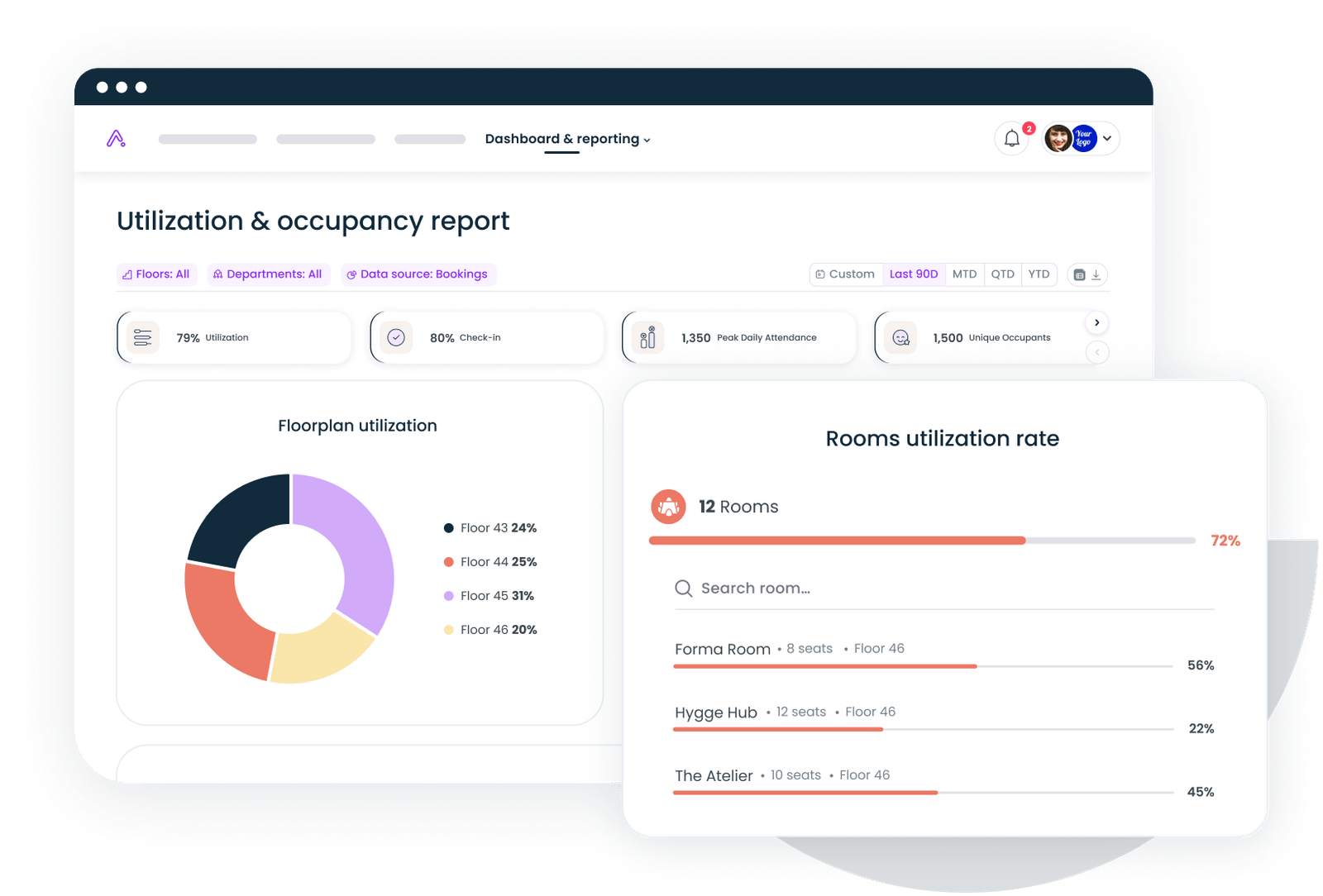
Zone-level booking, interactive floor plans, and utilization analytics give you the tools to design, manage, and optimize team neighborhoods.
Learn more
Common mistakes to avoid
Sizing neighborhoods to headcount. This is the most expensive mistake. If your team has 80 people and average daily attendance is 45, you need space for 45 to 55 (with a buffer), not 80. Use activity-based working principles to right-size each zone type within the neighborhood.
Treating neighborhoods as permanent. Teams change. Projects end. Reorgs happen. Plan to reassess neighborhood assignments quarterly. The companies that get the most value from this model treat it as a living system, not a one-time floor plan exercise.
Ignoring the social layer. Neighborhoods without shared social spaces become silos. The whole point is balancing team cohesion with organizational connectivity. If you skip the collision zones, you'll get cohesion at the cost of cross-pollination.
Over-engineering the rules. If your crossover policy requires three approvals and a Slack message to the facilities team, nobody will bother. Keep it simple. Default to your home neighborhood, book elsewhere if you need to, and let the data tell you if the system needs tightening.
Making neighborhood seating work long-term
Neighborhood seating isn't a floor plan change. It's an operating model. The physical layout matters, but the policies, tools, and measurement practices around it matter more.
The companies doing this well share a few traits: they size to real attendance data instead of headcount, they review and adjust quarterly, they give teams ownership of their zones, and they track collaboration outcomes alongside utilization numbers. The ones struggling are usually the ones that drew some lines on a floor plan, declared victory, and moved on.
The hybrid office keeps evolving. Neighborhoods are the best framework we have right now for giving teams a home base without wasting space or sacrificing flexibility. Get the zoning right, set clear but simple rules, measure what matters, and be willing to iterate.
Gable helps workplace teams design, book, and optimize team neighborhoods with zone-level controls and real-time utilization data.
Get a demo