.svg)


.svg)
- Define your lab's purpose before you pick a single piece of furniture
- Zone the space into distinct areas: ideation, prototyping, presentation, focus
- Proximity matters more than aesthetics; put teams within 20 meters of each other
- Booking and access policies determine whether the lab gets used or collects dust
- Measure cross-team collisions and projects delivered, not just foot traffic
An innovation lab is only as good as the thinking behind its design. Most organizations get excited about writable walls and 3D printers, then wonder six months later why nobody's using the space. Good innovation lab design starts with purpose, moves through spatial zoning and technology, and ends with measurement that proves the investment was worth it. This guide walks through the entire process in six steps.
What is an innovation lab?
An innovation lab isn't a lounge with beanbags and a whiteboard. It's a dedicated space designed to accelerate specific types of work: R&D, co-creation with clients, internal incubation, or rapid prototyping. The common thread is that these activities don't fit neatly into standard office layouts. They need room to be messy, loud, visual, and iterative.
There are a few common models. A design-thinking lab focuses on human-centered problem solving, with lots of sticky notes, journey maps, and user testing stations. A makerspace leans toward physical prototyping, with tools, materials, and workbenches. A research lab prioritizes data analysis and experimentation. An internal incubator gives small teams dedicated space to build new products or business lines.
The type you choose shapes everything downstream: layout, furniture, technology, access policies, and how you'll measure success. Don't skip this step.
Why bother? Because the physical environment directly affects how people work together. Face-to-face interactions improve performance more than any other office activity, and designing for chance encounters between knowledge workers is one of the most reliable ways to spark new ideas. Meanwhile, declining engagement cost $438 billion in lost global productivity in 2024. Giving people a space that signals "your ideas matter here" is one of the more tangible ways to push back against that trend.
If you're rethinking your broader office space planning strategy, an innovation lab is a natural extension of that work.
Step 1: Define your lab's purpose and innovation goals
Start with the business problem, not the floor plan. What kind of innovation does your organization need right now? Are you trying to improve existing products (incremental innovation), explore adjacent markets (adjacent innovation), or build something entirely new (transformational innovation)?
Your answer determines who uses the lab, how often, and what they need from it.
Identify your primary users. A lab designed for a 6-person product team looks nothing like one built for 40-person cross-functional workshops. Talk to the people who'll actually use the space. Ask what's blocking their creative work today. Is it noise? Lack of tools? No place to leave work-in-progress overnight? These constraints become your design brief.
Set success metrics upfront. Before you spend a dollar on construction, define what "working" looks like. Common metrics include:
- Number of projects initiated and completed in the lab
- Cross-team usage (are different departments actually mixing?)
- Time from idea to prototype
- Employee satisfaction with the space
- Utilization rate by zone
Writing these down now prevents the inevitable "was this worth it?" conversation from becoming a guessing game later. If you want a deeper framework for workplace analytics ROI, that's worth reading alongside this guide.
Step 2: Zone the space into functional areas
Innovation isn't one activity. It's a sequence of activities, and each one needs a different kind of space. The biggest mistake I see is treating the lab as a single open room. That works for brainstorming. It's terrible for prototyping, and worse for focused analysis.
Here's how to think about zones:
Ideation zone. This is where ideas start. Round tables (not rectangular ones; hierarchy kills brainstorming), writable walls on every surface, movable furniture so the room can reconfigure in minutes. Keep it bright, open, and slightly chaotic. Taller ceilings foster abstract thinking, so if you have the option, put your ideation zone in the highest-ceilinged part of the building.
Prototyping zone. This is where ideas become tangible. Depending on your industry, this might mean workbenches with hand tools, 3D printers, or simply large tables with power outlets and monitors for software prototyping. The key design principle: make it okay to fail here. Use durable, easy-to-clean surfaces. Provide storage so teams can leave work-in-progress without it getting cleared away overnight.
Presentation and showcase zone. Ideas need an audience. Dedicate a zone for demos, pitch sessions, and stakeholder reviews. Large displays, good acoustics, and flexible seating (theater-style for big groups, roundtable for small ones). This zone doubles as a storytelling space where successful projects get displayed to inspire the next cohort.
Collaboration hub. Not every useful conversation is scheduled. Design a casual zone, think comfortable seating, coffee, and good sightlines, where people from different teams naturally cross paths. Proximity within 20 meters has the strongest influence on knowledge sharing between teams. Beyond that distance, the effect drops off fast.
Focus zone. Innovation requires deep thinking, not just group energy. Include a quiet area with individual workstations, acoustic panels, and minimal visual distraction. Not everyone ideates out loud. Introverts need space too, and their contributions are often the most carefully considered. For more on designing these, see our guide to focus room office strategy.
Storage and resource center. This one gets overlooked constantly. Innovation labs generate physical artifacts: prototypes, materials, printed research, models. Without dedicated storage, the space devolves into clutter within weeks. Include lockable cabinets, labeled shelving, and a materials library.
The zones don't need walls between them. Visual separation (different flooring, lighting levels, or ceiling treatments) often works better than hard partitions. The goal is to signal "this area is for this kind of work" without creating silos.
If you're also designing collaboration spaces elsewhere in your office, the principles overlap, but an innovation lab pushes them further toward experimentation and mess tolerance.

Innovation labs don't exist in isolation. Learn how to design the surrounding collaboration spaces so teams move fluidly between creative work and everyday meetings.
Read the guide
Step 3: Select furniture and physical elements that enable collaboration
Furniture in an innovation lab isn't decorative. It's infrastructure. The wrong table can kill a brainstorming session. The right one can make a three-hour workshop feel effortless.
Modular and reconfigurable. Everything should move. Wheeled tables, stackable chairs, lightweight whiteboards on casters. A team of four working on a prototype Monday morning needs a completely different layout than a 20-person design sprint on Wednesday afternoon. If rearranging the room takes more than 10 minutes, people won't bother.
Writable surfaces everywhere. Whiteboards are obvious. But also consider whiteboard paint on walls, glass partitions you can write on, and large rolls of paper on dispensers. The best ideas often happen when someone grabs a marker and starts drawing mid-conversation. Don't make them walk across the room to find a surface.
Varied seating. Standing-height tables for quick huddles. Low lounge seating for informal conversations. Stools for prototyping workbenches. Standard task chairs for focused work. Variety isn't about aesthetics; it's about supporting different postures for different activities. People think differently when they're standing versus sitting. Use that.
Lighting. Natural daylight is non-negotiable for the ideation and collaboration zones. Supplement with adjustable task lighting in the prototyping area (detail work needs direct light) and softer ambient lighting in the focus zone. Avoid uniform fluorescent lighting across the entire lab. It flattens energy and signals "this is just another office."
Materials and finishes. Raw, honest materials (exposed wood, concrete, metal) signal experimentation better than polished corporate finishes. Plants and natural elements reduce stress and improve cognitive function. Vibrant accent colors on walls or furniture can energize without overwhelming. The space should feel like a workshop, not a boardroom.
For smaller breakout areas within or adjacent to the lab, huddle rooms are a proven format worth considering.
Step 4: Integrate technology and tools
Technology in an innovation lab serves two purposes: enabling the creative work itself, and making the space manageable at scale.
For the creative work:
- High-speed WiFi with enough bandwidth for simultaneous video calls, large file transfers, and cloud-based design tools. This sounds basic. It's the number one complaint in most labs.
- Power everywhere. Floor outlets, table-mounted power strips, USB charging stations. People shouldn't have to choose between sitting where the conversation is and sitting where the outlet is.
- Large interactive displays in the ideation and presentation zones. Touchscreens that multiple people can annotate simultaneously are worth the investment. Standard monitors aren't.
- Video conferencing equipment for hybrid participation. Your lab will have remote collaborators. Plan for them from day one with quality cameras, microphones, and screen-sharing capability.
- Prototyping tools appropriate to your industry: 3D printers, laser cutters, electronics workbenches, or simply powerful laptops with design software pre-installed.
For space management:
- Room and zone booking systems so teams can reserve specific areas in advance. Without this, you'll get scheduling conflicts and underutilization simultaneously.
- Access control (badge, QR, or NFC) to manage who can enter the lab and when. Some organizations keep the lab open to all employees; others restrict access to active project teams. Either approach works, but you need the infrastructure to enforce whichever policy you choose.
- Occupancy sensors or badge data to track actual usage patterns. You can't improve what you don't measure.
- Interactive floor plans so employees can see which zones are available before they walk over.
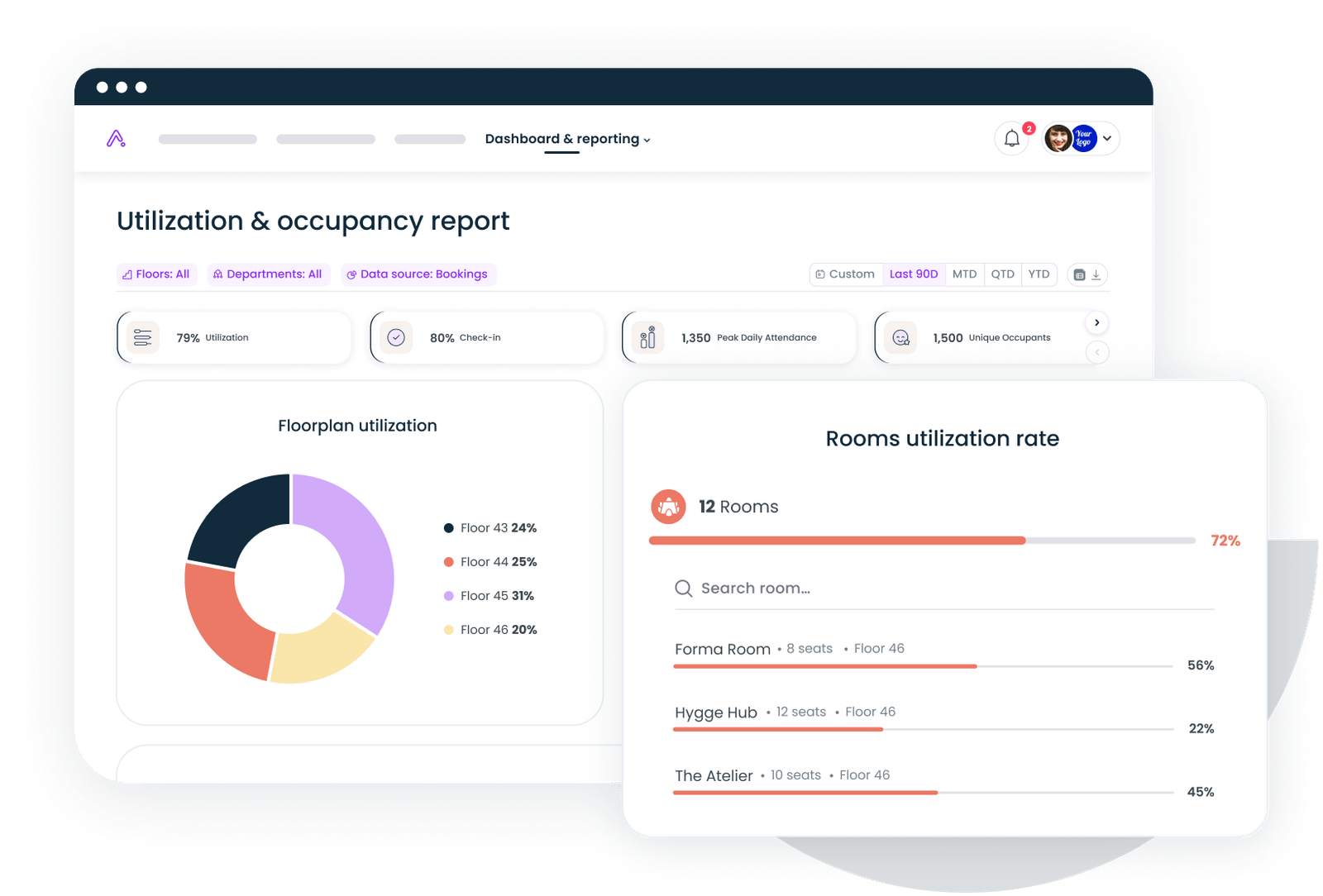
The management layer is where most innovation labs fall short. They invest heavily in the creative tools and forget that a shared space needs an operating system. Gable Offices handles zone-level booking, access control, and utilization tracking in a single platform, which solves the operational side so you can focus on the innovation side.
Step 5: Establish booking, access, and usage policies
A beautifully designed lab with no usage policies becomes either a ghost town or a turf war. You need clear rules, communicated simply, enforced consistently.
Who can use the lab? Three common models:
- Open access. Any employee can walk in and use available space. Works well for labs focused on culture and serendipity. Requires real-time availability displays so people don't show up to a full room.
- Project-based reservation. Teams apply for lab time tied to a specific project. Works well for R&D and incubation labs where continuity matters. Requires an approval workflow and calendar system.
- Hybrid model. Some zones are open (collaboration hub, focus zone), while others require booking (prototyping, presentation). This is the most common approach and usually the most practical.
When is the lab available? Standard business hours? Extended hours for teams on deadline? 24/7 with badge access? Your answer depends on security requirements, building operations, and how much you trust people to clean up after themselves.
How do people book? Self-service booking through a central platform is the minimum. Add "book on behalf" functionality so executive assistants can coordinate cross-functional sessions. Make cancellation easy so unused time gets released back to the pool. If you're evaluating tools for this, our roundup of workplace scheduling software covers the landscape.
What are the house rules? Post them visibly. Common ones include:
- Clean up your workspace at the end of each session
- Label anything left in storage with your name and project
- Don't monopolize shared equipment
- Report broken tools or low supplies immediately
- Respect the quiet zone
Budget controls. If your lab has consumable materials (3D printing filament, electronics components, paper), decide whether departments get charged back or whether there's a central innovation budget. This sounds administrative, but unclear cost allocation kills lab usage faster than bad furniture.
Gable Offices gives you desk and room booking, access control, and real-time analytics for every zone in your innovation lab, so you know exactly who's using what and when.
Learn more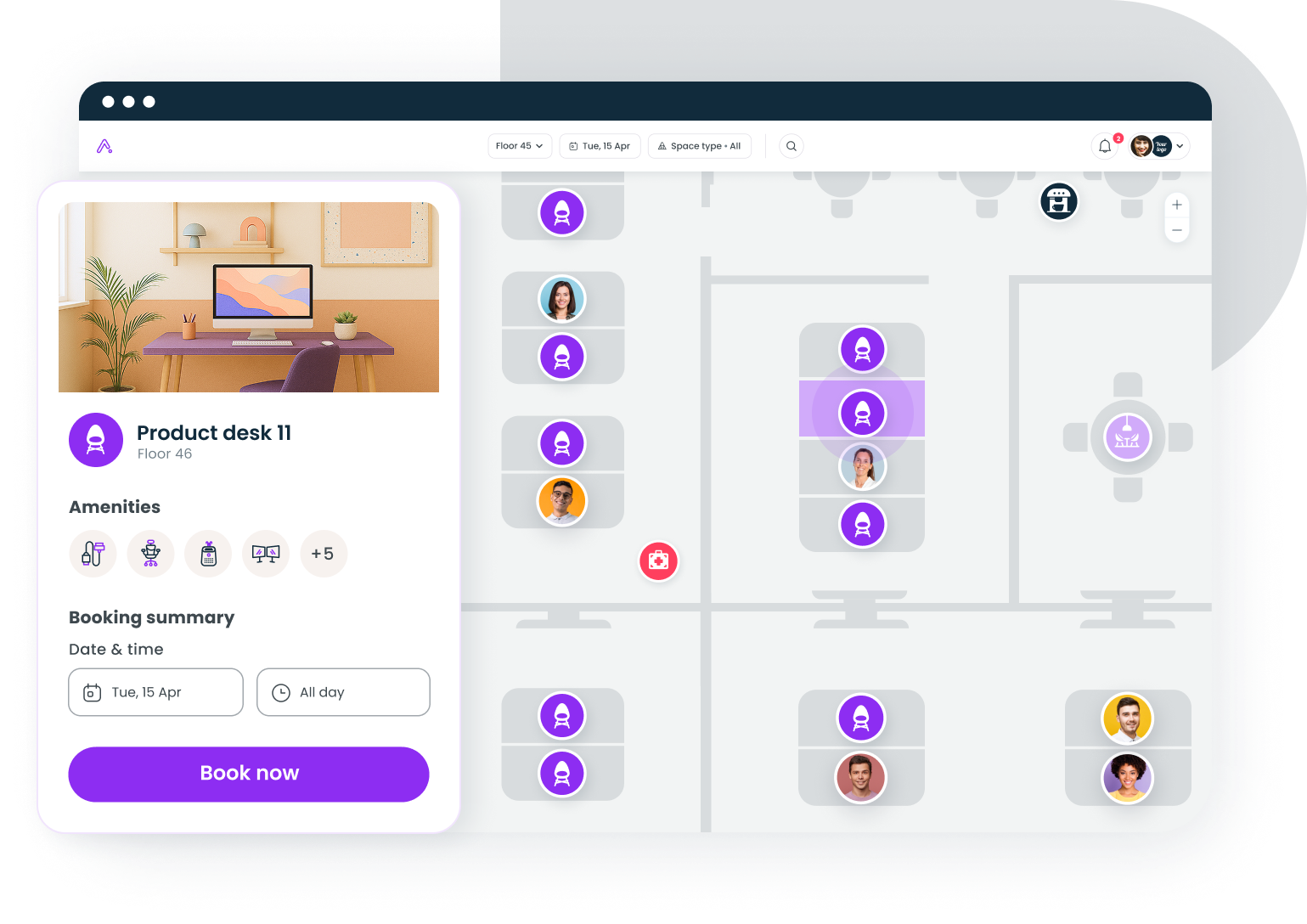
Step 6: Measure, iterate, and scale
Here's where most innovation labs stall. The space opens, there's a burst of enthusiasm, usage tapers off, and leadership asks whether the investment was justified. Without measurement, you can't answer that question.
Track utilization by zone, not just overall. Your ideation zone might be packed every Tuesday while your prototyping area sits empty all week. That's not a lab problem; it's a zoning problem. Maybe you allocated too much square footage to prototyping, or maybe teams don't know the equipment is available. Zone-level data tells you where to intervene. For a deeper dive on the math, see our guide to space utilization.
Measure cross-team collisions. One of the primary reasons to build an innovation lab is to get people from different departments working together. Track which teams are booking the space, and more importantly, which teams are booking it together. If your lab is only used by the product team, it's a product team room, not an innovation lab.
Count projects, not just visits. Foot traffic is a vanity metric. What matters is output. How many projects were initiated in the lab? How many reached prototype stage? How many made it to production? Build a simple intake form so every team that uses the lab logs what they're working on.
Gather qualitative feedback. Numbers tell you what's happening. Conversations tell you why. Run quarterly surveys. Better yet, spend an afternoon sitting in the lab and watching how people actually use it. You'll learn more in three hours of observation than in three months of dashboard reviews.
Iterate the layout. Your first design won't be perfect. Plan for it. Use modular furniture specifically so you can rearrange zones based on what the data tells you. If the focus zone is always empty, shrink it and expand the collaboration hub. If teams keep dragging chairs from the presentation zone into the ideation zone, maybe those zones should be adjacent.
Document and share wins. Innovation labs justify their existence through stories, not spreadsheets. When a team uses the lab to develop a product that ships, or solves a customer problem that's been open for years, tell that story internally. Loudly. It's the best marketing the lab will ever get.
Four innovation lab designs that work
Real examples help more than abstract principles. Here are four approaches I've seen work well, described without naming specific companies.
Large tech company: internal incubation hub. Roughly 5,000 square feet on a dedicated floor. Three distinct zones: a large open ideation area with movable walls, a prototyping workshop with electronics benches and 3D printers, and a "demo theater" with tiered seating for 30. Access is project-based; teams apply for 90-day residencies. The company tracks projects that graduate from the lab into full product teams. Key design choice: the lab has its own entrance, separate from the main office, to signal that this is a different kind of work.
Mid-market professional services firm: client co-creation lab. About 2,000 square feet, designed primarily for workshops with clients. The space converts from a 20-person workshop layout to four separate breakout pods in under 15 minutes. Every wall is writable. There's a "gallery wall" near the entrance displaying current project artifacts. Key design choice: the lab is on the ground floor with street-facing windows, visible to visitors and passersby. It's as much a brand statement as a functional space.
Life sciences R&D organization: modular satellite labs. Instead of one central lab, this company built a network of smaller innovation spaces (800 to 1,200 square feet each) distributed across its campus and satellite offices. Each space has standardized equipment and booking systems, so a researcher in one location can reserve time at any lab. McKinsey documented this approach in the life sciences sector, where leading companies use activity-based design and advanced analytics to dynamically right-size lab and office spaces. Key design choice: standardization across locations so the experience is consistent regardless of which lab you book.
University research center: proximity-optimized collaboration space. A 25,000-square-foot facility organized around a central atrium with café seating, surrounded by small team rooms and individual workstations. The entire layout is designed to maximize chance encounters. Researchers from different departments share the atrium, and the team rooms are intentionally not assigned to specific groups. Key design choice: no department "owns" any space. Everyone books through the same system, which forces cross-disciplinary mixing.
The design principles that connect all of these
Across these examples, a few patterns emerge.
Purpose comes first. Every successful lab started with a clear answer to "what kind of innovation are we trying to accelerate?" The space followed the strategy, not the other way around.
Flexibility is structural, not decorative. Modular furniture isn't a nice-to-have. It's what allows the space to evolve as your innovation needs change. The lab you need in year one won't be the lab you need in year three.
Proximity is the most underrated design variable. The Brookings Institution found that architects designing innovation spaces are increasingly tasked with creating communities and facilitating serendipitous encounters, not just housing activities. Where you place zones relative to each other, and where you place the lab relative to the rest of the office, matters enormously.
Measurement separates labs that last from labs that don't. The organizations that track utilization, cross-team usage, and project outcomes are the ones that can defend the lab's budget when the next round of cost-cutting comes around. The ones that don't track anything are the ones whose labs quietly become storage rooms.
Access policies are design decisions. Who can use the space, when, and how they book it shapes behavior as much as the physical layout does. A lab with no booking system becomes first-come-first-served, which favors the teams physically closest to it. A lab with overly rigid booking becomes underutilized because people can't access it spontaneously.
If you're thinking about how innovation lab design fits into your broader workplace strategy, the same principles apply: start with purpose, design for flexibility, and measure relentlessly.
Making your innovation lab worth the investment
Innovation labs fail when they're treated as one-time construction projects. They succeed when they're treated as living systems that need ongoing attention, data, and iteration. The six steps in this guide, define purpose, zone the space, choose furniture, integrate technology, set policies, and measure outcomes, aren't sequential and done. They're a cycle. You'll revisit each one as you learn how people actually use the space.
The organizations getting the most from their labs are the ones that combine thoughtful physical design with operational rigor: clear booking systems, real utilization data, and a willingness to rearrange the furniture when the data says they should.
From zone-level booking to cross-team utilization reports, Gable gives you the data to prove your innovation lab is working, and the tools to fix it when it's not.
Get a demo