.svg)


.svg)
- Focus questions on the physical environment, not just engagement or culture
- Time surveys around moves, policy changes, and quarterly pulses to capture real reactions
- Anonymity isn't optional; without it, you're measuring politeness, not satisfaction
- Segment results by role, tenure, and commute distance to find patterns that averages hide
- Close the loop publicly, or employees won't bother responding next time
A workplace satisfaction survey is only useful if people tell you the truth. Most companies run some version of an annual engagement survey, but few ask specifically about the physical environment: noise, temperature, meeting rooms, lighting, the stuff that shapes whether someone's day in the office is productive or miserable. This guide walks through six steps to build a survey that captures honest, actionable feedback about your workplace, and turns it into changes people can actually see.
Why most workplace satisfaction surveys miss the point
The typical employee survey lumps everything together. You'll get questions about manager relationships, career growth, and company values sitting next to a single question about "your workspace." That's not enough. Gensler's 2025 global survey found that employees in great workplaces are nearly 3x more likely to stay with their company. The physical environment isn't a footnote to employee experience; it's a driver of retention, productivity, and daily mood.
A dedicated workplace satisfaction survey separates the physical from the cultural. It asks about air quality, not just "atmosphere." It asks about meeting room availability, not just "collaboration." This distinction matters because the fixes are different. A bad manager requires coaching. A bad HVAC system requires a work order. Mixing them together means neither gets the attention it deserves.
If you're building a broader employee experience strategy, the workplace satisfaction survey is where you gather the ground-level data that makes everything else possible.
Step 1: Decide what to ask (and what to leave out)
Your questions should cover the physical dimensions of the office that employees interact with daily. Based on Leesman's workplace research, the categories with the lowest satisfaction scores are noise (35%), temperature control (41%), quiet rooms for focused work (40%), and plants and greenery (47%). Those numbers tell you where to focus.
Here are the categories your survey should cover:
Acoustic environment. Noise is consistently the top complaint in open offices. Ask about ambient noise levels, availability of quiet zones, and whether employees can hold conversations without disturbing others. If you've recently redesigned your floor plan, this is especially important; our guide on making open offices work covers the design side.
Thermal comfort and air quality. Temperature wars are real. Ask whether employees feel too hot, too cold, or just right, and whether they've noticed air quality issues like stuffiness or odors.
Lighting. Natural light, overhead brightness, screen glare. These affect energy levels and headaches more than most people realize.
Furniture and ergonomics. Chairs, desks, monitor height. Especially relevant if you've moved to hot desking or shared workstations.
Meeting and collaboration spaces. Are there enough rooms? Are they the right size? Is the technology reliable? This connects directly to collaboration space design, which is worth auditing alongside your survey.
Focus spaces. Quiet rooms, phone booths, individual pods. Ask whether employees can find a place to do deep work when they need one.
Amenities. Kitchen, break areas, food options, wellness rooms, outdoor space. These shape the overall feel of the office.
Location and commute. This one's often overlooked, but it matters enormously. More on this in the segmentation section below.
What to leave out: manager effectiveness, compensation satisfaction, career development, and company strategy questions. Those belong in your engagement survey. Mixing them in dilutes the signal and makes the survey too long.
15-question starter template
Use a 1 to 5 Likert scale (1 = strongly disagree, 5 = strongly agree) unless noted otherwise.
- The noise level in my workspace allows me to concentrate.
- I can easily find a quiet space when I need to do focused work.
- The temperature in my workspace is comfortable.
- The air quality in my workspace feels fresh and adequate.
- My workspace has sufficient natural light.
- The artificial lighting in my workspace is comfortable (no glare or harshness).
- My desk and chair are comfortable and ergonomically appropriate.
- I can easily book a meeting room when I need one.
- Meeting room technology (screens, video, audio) works reliably.
- The kitchen and break areas are clean and well-stocked.
- I feel the office has adequate wellness or relaxation spaces.
- The office location is convenient for my commute.
- Overall, the physical workspace supports my productivity.
- What is the single biggest improvement you'd make to the physical workspace? (open text)
- Is there anything about the office environment that makes you less likely to come in? (open text)
Questions 14 and 15 are where you'll find the insights that Likert scales miss. Protect them. Don't skip the open-text fields to save time.
Step 2: Time your survey for maximum signal
When you ask matters almost as much as what you ask. A survey sent during a calm, routine week will give you baseline data. A survey sent two weeks after a major office move will give you reaction data. Both are valuable, but they measure different things.
Post-move or post-renovation (6 to 8 weeks after). Give people time to settle in, but don't wait so long that frustrations become normalized. This is your best window for capturing first impressions of a new space. If you're planning a relocation, pair the survey with your office relocation checklist to make sure you're measuring the right things.
Post-policy change (4 to 6 weeks after). Shifted to hot desking? Changed your in-office days? Launched a new booking system? Survey after the adjustment period, not during it.
Quarterly pulse (3 to 5 questions). Pick your lowest-scoring categories from the full survey and track them over time. This keeps the feedback loop tight without exhausting people.
Annual census (full 15-question survey). Once a year, run the complete version. This is your benchmark.
Gensler's WPIx methodology targets 10 to 15 minutes for a comprehensive workplace survey. That's the right range. Anything longer and completion rates drop. Anything shorter and you're not getting enough depth.
Avoid these timing mistakes: Don't survey during holiday weeks, during layoffs, or within two weeks of a major company announcement. The data will be contaminated by emotions that have nothing to do with the office.

Use our workplace experience benchmarks to see where your scores stand relative to industry standards.
Read the guide
Step 3: Set response rate targets and sample size
A survey with a 25% response rate isn't a survey. It's a self-selected sample of your most opinionated employees. You need broad participation to make decisions with confidence.
Response rate benchmarks. Rates above 70% indicate strong engagement with the survey process. Rates below 50% suggest survey fatigue, timing issues, or lack of trust. If you're consistently below 50%, the problem isn't the survey; it's the relationship between leadership and employees.
How to hit 70%+:
- Keep it under 15 minutes
- Send from a senior leader, not HR software
- Give a clear deadline (5 to 7 business days)
- Send exactly two reminders, no more
- Share results within 30 days (this is the single biggest driver of future participation)
Sample size considerations. For companies under 500 employees, aim for a census: everyone takes it. For larger organizations, you can sample, but make sure each segment (department, location, tenure band) has at least 30 respondents. Below that threshold, you can't draw meaningful conclusions about any subgroup.
A note on mandatory vs. voluntary. Making the survey mandatory gets you higher response rates but potentially lower honesty. Making it voluntary gets you more candid answers but risks selection bias. The best approach: make it strongly encouraged by leadership, with time explicitly carved out during the workday to complete it.
Step 4: Build psychological safety through anonymization
This is where most workplace satisfaction surveys fail. You can write perfect questions, time the survey beautifully, and still get useless data if employees don't trust that their answers are safe.
Workers who feel their employer discourages reporting are 2.4 times more likely to experience a work injury. That's physical safety, but the principle applies to feedback too. If people fear consequences, they'll either skip the survey or tell you what you want to hear.
Anonymous vs. confidential: know the difference.
Anonymous means no one, not even the survey administrator, can connect a response to an individual. Confidential means responses are linked to individuals but only reported in aggregate, never in a way that identifies someone.
For workplace satisfaction surveys, anonymous is almost always the right choice. You don't need to know that Sarah in accounting thinks the lighting is bad. You need to know that 68% of the third floor rates lighting as poor.
Practical anonymization steps:
- Use a third-party survey tool, not an internal system tied to employee IDs
- Don't collect demographic data that could identify individuals in small teams (if your London office has three people, don't segment by location and department simultaneously)
- State the anonymity policy clearly at the top of the survey
- Explain exactly who will see the raw data and in what form
- If you're concerned about data privacy compliance, review your approach against GDPR and local regulations before launching
The trust test: if an employee with a unique job title wouldn't feel comfortable giving a score of 1 out of 5, your anonymization isn't strong enough.
Step 5: Segment and analyze by role, tenure, and commute distance
Averages lie. An overall satisfaction score of 3.8 out of 5 sounds fine until you discover that engineers rate noise at 2.1 while salespeople rate it at 4.5. The engineers sit in an open floor near the sales team's call area. The average hid the problem.
Segment by these dimensions:
Role or function. Collaborative roles (sales, marketing, project management) have different needs than focus-intensive roles (engineering, writing, finance). Cross-reference satisfaction scores with role type to spot mismatches between space design and work style.
Tenure. New employees (under 6 months) often rate the office higher because everything is novel. Employees with 2+ years of tenure have calibrated expectations and will flag issues that newcomers haven't noticed yet. Watch for the gap.
Commute distance. This is the most underused segmentation variable. Leesman's research shows that when commutes are under 15 minutes, satisfaction reaches 92%, but drops to just 35% for commutes over two hours. If your survey shows low overall satisfaction, commute distance might be the hidden variable. This is especially relevant if you're evaluating commuter benefits or considering satellite offices.
In-office frequency. Employees who come in five days a week experience the office differently than those who come in twice. Segment accordingly.
How to spot patterns: Build a simple matrix with segments on one axis and question categories on the other. Color-code scores (green for 4+, yellow for 3 to 3.9, red for below 3). The red clusters tell you where to act first.
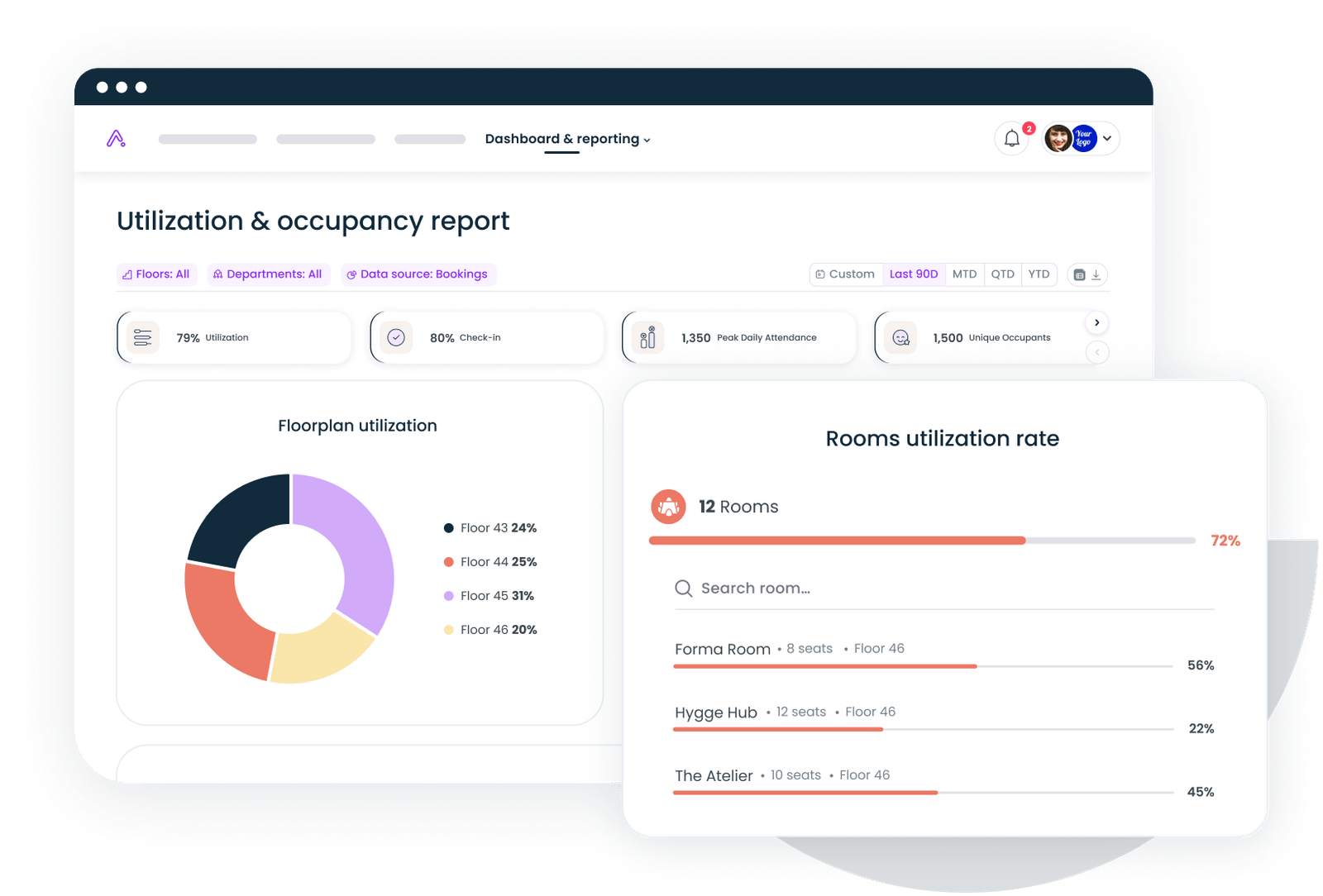
Surveys capture what people say. Occupancy and booking data capture what people do. The most useful analysis combines both. Gable's Insights dashboard layers passive utilization data (which desks get booked, which rooms sit empty, which floors are busiest) on top of survey feedback, so you can see whether the spaces people complain about are also the spaces they avoid.
Gable Insights combines occupancy data with employee feedback to show you what's working and what's wasted.
Learn more
Step 6: Close the loop (or don't bother surveying)
Here's the uncomfortable truth: running a survey and not acting on it is worse than not surveying at all. It teaches employees that feedback goes into a void. Next time, they won't bother.
The 30-60-90 framework:
Within 30 days: Share top-level results with the entire company. Be transparent about what scored well and what didn't. You don't need to have solutions yet. Just acknowledge what you heard.
Within 60 days: Announce 3 to 5 specific actions you're taking based on the feedback. Be concrete. "We're adding four phone booths to the third floor by March" is better than "We're looking into noise concerns." If you need help getting employee buy-in for the changes you're planning, involve a small group of survey respondents in the solution design.
Within 90 days: Implement at least one visible change and send a pulse survey on that specific issue. Did the phone booths help? Is the temperature better since the HVAC adjustment? This micro-feedback loop proves that the survey mattered.
Assign owners, not committees. Every action item needs a single person responsible for it, with a deadline. "The workplace team will look into this" is how improvements die.
Track across cycles. The real value of a workplace satisfaction survey isn't any single snapshot. It's the trend line. Did noise satisfaction improve from 2.8 to 3.6 after you added quiet zones? That's your proof that the investment worked, and it's the data you'll need when you're building a business case for the next round of improvements.
Making your workplace satisfaction survey a habit, not a project
The companies that get the most from workplace satisfaction surveys treat them as infrastructure, not events. They run a full survey annually, pulse quarterly, and trigger ad-hoc surveys after major changes. They segment ruthlessly, act visibly, and measure whether the actions worked.
The hardest part isn't designing the questions or picking the right tool. It's building the organizational muscle to hear uncomfortable feedback and respond to it quickly enough that employees believe the next survey is worth their time. Start with the 15-question template above, commit to the 30-60-90 action loop, and treat every survey cycle as a chance to prove that you're listening.
From space booking to occupancy analytics, Gable gives you the data layer that turns survey insights into workplace decisions.
Get a demo