.svg)


.svg)
- Hybrid workers still commute; 89% of hybrid employers already offer commuter benefits
- Traditional monthly transit passes waste money on variable schedules
- The 2026 IRS pre-tax limit is now $340/month, creating a window to revamp programs
- Stanford research links hybrid commute relief to 33% lower attrition
- Tie commuter subsidies to actual office attendance data, not assumptions
Commuter benefits in hybrid work aren't a relic of the five-day office. They're a retention lever that most companies are using badly. Half of employees say commuting is the biggest barrier to showing up in person, yet the programs designed to ease that friction haven't evolved past the monthly transit pass.
The commuter benefits paradox nobody talks about
Here's the thing that surprises people: hybrid workers still commute. They just do it less predictably. And the data shows employers know this. 89% of hybrid employers currently offer commuter benefits, with 84% of those programs subsidized. Enrollment rates are nearly identical between hybrid and in-person employees (67% vs. 69%).
So the question isn't whether to offer commuter benefits. It's whether the ones you're offering actually match how your people work now.
Most don't. The typical program was designed for someone who takes the same train, five days a week, twelve months a year. That person barely exists anymore. Your Tuesday-Thursday hybrid employee who drives when it rains and bikes when it doesn't? They're stuck choosing between a monthly pass they'll half-use or opting out entirely. Neither option helps you, and neither helps them.
If you're rethinking your broader hybrid workplace strategy, commuter benefits deserve a seat at the table. They're one of the few perks that directly address the number one reason people resist coming in.
How hybrid work reshaped the commute
The commute didn't disappear. It got weird.
Pre-pandemic, commuting was a fixed cost, both financially and mentally. You knew the route, the time, the monthly expense. Hybrid work turned all of that into a variable. Some weeks it's two days in the office, some weeks four. Some days warrant the train; others, a car because of a late meeting or a school pickup. Multimodal commuting (mixing transit, driving, biking, and rideshare across the same week) is now the norm, not the exception.
This variability matters for retention more than most leaders realize. Stanford research found that resignations fell by 33% among workers who shifted from full-time office to hybrid schedules. Women, non-managers, and employees with long commutes saw the biggest retention lift. The implication is clear: when you reduce commute burden, people stay.
But "reduce commute burden" doesn't just mean letting people work from home. It means making the days they do come in feel less punishing. That's where modern commuter benefits come in, and where most programs fall short.
Companies investing in employee retention strategy often overlook this connection. They'll spend on engagement platforms and culture initiatives while ignoring the 45-minute train ride that makes someone dread Tuesdays.
Why one-size-fits-all programs fail hybrid teams
The traditional commuter benefit model has a structural problem: it assumes consistency.
Monthly transit passes are the most common offering. They make sense if you're commuting daily. For a three-day-a-week hybrid employee, they're a bad deal. You're either paying full price for partial use, or you're not enrolling at all because the math doesn't work. Either way, the benefit fails to do what it's supposed to do: remove friction.
The same applies to parking subsidies. 12% of employers offer transit and 10% offer parking subsidies, according to SHRM's 2025 benefits survey. But those numbers don't tell you whether employees actually use them, or whether the structure matches their schedules.
There's a timing opportunity here. The IRS raised the pre-tax limit to $340 per month for 2026, up from $325. That's $180 more per year employees can set aside tax-free for transit, parking, vanpools, and ferries. If you're going to communicate that increase (and you should), it's the perfect moment to redesign the whole program rather than just update a number.
The counterargument is that flexible benefits are harder to administer. That's true. But "easier to administer" isn't a good reason to keep a program that doesn't work. And the tools available now make flexibility far more manageable than it was even two years ago.
Five modern commuter benefit strategies for hybrid teams
Redesigning commuter benefits doesn't require blowing up your entire benefits infrastructure. It requires rethinking a few key assumptions.
1. Flexible spending over fixed passes. Replace locked-in monthly transit passes with flexible debit cards that let employees allocate funds across transit, parking, or rideshare month to month. If someone bikes in July and takes the train in January, the benefit should accommodate both without penalty. This is the single highest-impact change most companies can make.
2. Dynamic subsidies tied to attendance. The most forward-thinking programs scale benefits to actual office days. If Tuesday is your team's collaboration day, employees who commute on Tuesdays get the full subsidy. This creates a natural incentive without a mandate. It does require knowing who's actually coming in, which means connecting your commuter program to office attendance data.
3. Multimodal coverage. Stop treating "commuter benefits" as synonymous with "transit pass." Bundle transit, parking, micromobility (bike-share, scooter-share), rideshare, and carpooling into a single platform. Hybrid commuters switch modes constantly. Your benefit should keep up.
4. Sustainability incentives. Offer parking cash-out options for employees who choose transit or cycling over driving. Reward carpooling. This isn't just a feel-good move; it ties directly to ESG reporting goals and can reduce your Scope 3 emissions in a measurable way.
5. Tech integration with the employee experience. The best commuter benefit in the world fails if enrollment is buried in a PDF on the intranet. Integrate benefits with calendar systems, booking tools, and scheduling platforms so employees see their commute options alongside their office day plans. When the benefit is visible at the moment of decision, usage goes up.

Commuter benefits are one piece of the puzzle. Here's the full framework for designing a hybrid program that balances flexibility, cost, and collaboration.
Read the guide
Measuring the ROI of commuter benefits
"Does this actually save us money?" is the first question finance will ask. The answer is yes, but you have to measure the right things.
Start with the tax math. Employers save roughly 7.65% on payroll taxes for each participating employee when using pre-tax commuter benefits. Employees save 30-40% on commuting costs depending on their tax bracket. At the 2026 limit of $340/month, that's meaningful for both sides.
But the bigger ROI is in retention. Replacing an employee costs 50-200% of their annual salary depending on the role. If commuter benefits contribute to even a modest reduction in turnover among your long-commute cohort (the group Stanford's research shows benefits most from hybrid flexibility), the math gets compelling fast.
Here's what to track:
- Participation rate. The benchmark is 67% for hybrid employees. If you're well below that, your program design is the problem, not employee interest.
- Retention differential. Compare turnover rates between employees who use commuter benefits and those who don't, controlling for commute distance.
- Occupancy lift on subsidy days. If you're tying subsidies to specific days, measure whether attendance actually increases. This connects commuter benefits directly to workplace occupancy metrics.
- Payroll tax savings. Straightforward to calculate, easy to report to finance.
The mistake most companies make is treating commuter benefits as a standalone HR line item rather than connecting them to broader workplace ROI metrics. When you can show that subsidized commute days correlate with higher attendance, better collaboration scores, and lower attrition, the benefit stops being a cost center and starts being a strategic investment.
Gable's workplace intelligence platform connects occupancy, attendance, and space data so you can measure what's actually working, including whether your commuter programs move the needle.
Learn more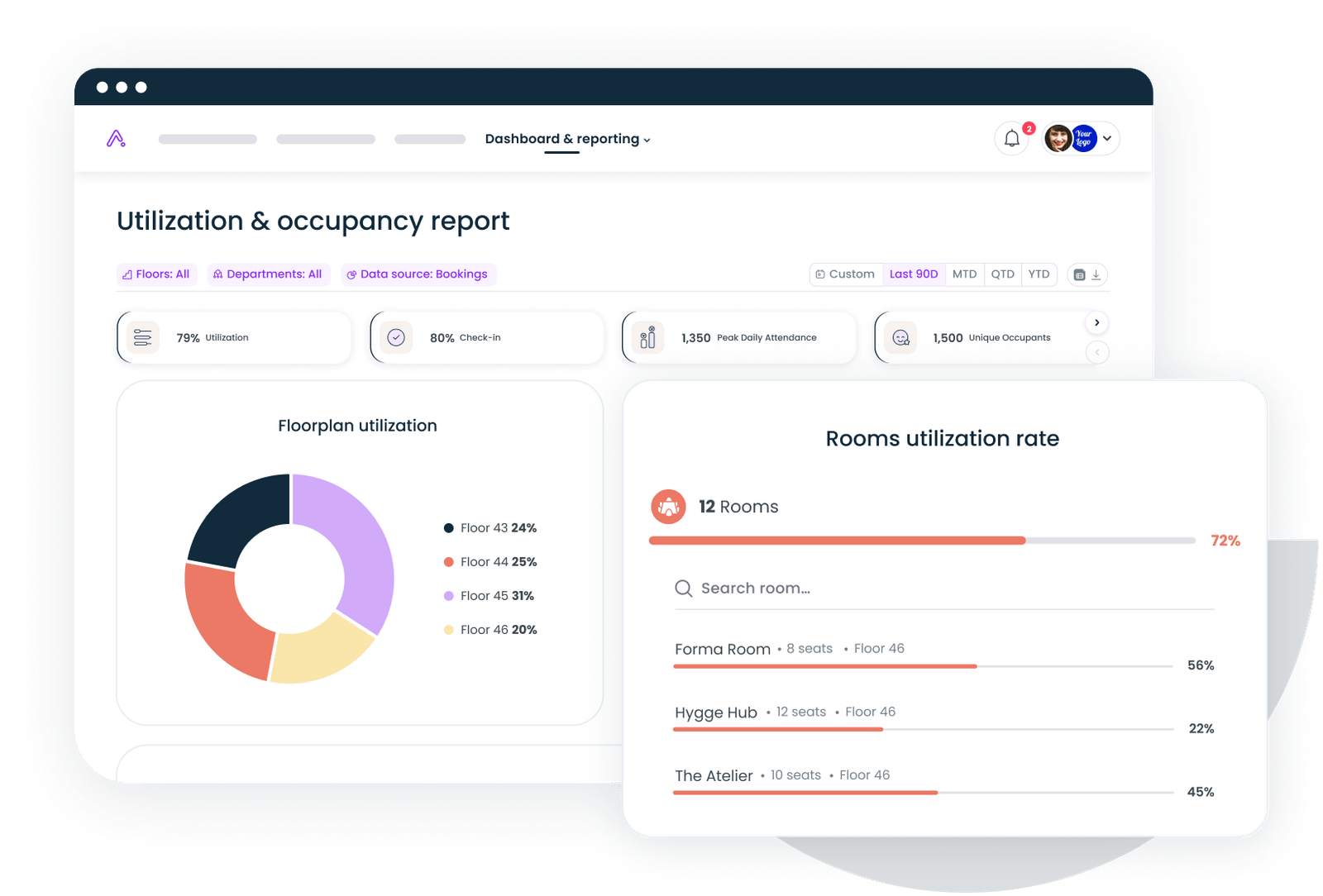
How to align commuter benefits with your hybrid strategy
The biggest gap in most commuter programs isn't the benefit itself. It's the disconnect between the benefit and everything else.
Start with an audit, not assumptions. Survey your employees about their actual commute patterns: modes, frequency, pain points, costs. Don't assume everyone takes the subway because your office is near a station. You'll likely find a mix of driving, transit, cycling, and rideshare that varies by day, season, and personal circumstance.
Sync with your office rhythm. If your teams have designated in-office days, your commuter benefits should reflect that cadence. Offering a flat monthly subsidy when most employees come in two specific days per week is a mismatch. Tie the benefit to the days that matter. This is where having a unified view of scheduling, space booking, and attendance data becomes essential; Gable's platform connects these data streams so workplace leaders can see commute-relevant patterns alongside occupancy and collaboration metrics.
Don't forget compliance. Eight-plus jurisdictions, including New York City, Washington D.C., Seattle, the San Francisco Bay Area, New Jersey, Los Angeles, Portland, and Chicago, now mandate commuter benefits for employers above certain size thresholds. Non-compliance carries real fines. If you're managing multiple office locations, audit each one against local requirements. The rules vary significantly by city and state.
Communicate the change. This is where most redesigns stall. You can build the perfect flexible commuter program, but if employees don't know about it or find enrollment confusing, participation stays flat. The 2026 IRS limit increase is a natural communication hook. Use it to relaunch the program, not just update a number in a benefits portal.
The commute is the experience
Here's the position I'll take: commuter benefits aren't a benefits administration problem. They're a workplace experience problem.
Every conversation about improving workplace experience focuses on what happens inside the office: the furniture, the coffee, the collaboration spaces, the technology. All of that matters. But the experience starts the moment someone decides whether today's commute is worth it. If the answer is "probably not," no amount of office perks will fix your attendance problem.
The companies getting this right treat the commute as part of the employee experience, not separate from it. They connect commuter data to occupancy data. They tie subsidies to the days that matter most for collaboration. They offer flexibility that matches how people actually live and work.
The ones getting it wrong are still offering the same monthly transit pass they offered in 2019, wondering why nobody uses it.
Commuter benefits in hybrid work aren't about generosity. They're about removing the single biggest friction point between your employees and the office days you need them for. The programs that reflect that reality will outperform the ones that don't.
See how Gable helps workplace leaders align scheduling, attendance, and space data to make smarter decisions about where and how teams work.
Get a demo