.svg)


.svg)
- Define your event's purpose before you pick a venue or set a budget
- Budget by category and build in a 10-15% contingency from day one
- Design for participation, not passive attendance
- Measure ROI within 48 hours while feedback is still fresh
- Centralize planning, communication, and analytics in one platform
Company event planning starts with a question most teams skip: why are we doing this? Not "where should we hold it" or "what's the catering budget." Why. The answer to that question shapes every decision downstream, from venue to vendor to how you'll know whether the whole thing worked. This guide walks through the full process, step by step, so you can plan events that actually move the needle on engagement, culture, or whatever outcome you're after.
Why purpose comes before logistics
Most corporate events start backwards. Someone books a venue, picks a date, and then tries to reverse-engineer a reason for the gathering. That's how you end up with expensive happy hours that nobody remembers and nobody can justify to finance.
97% of B2B marketers believe in-person events play a critical role in achieving business outcomes. But belief doesn't translate to results unless you define what "business outcome" means for your specific event. Is it onboarding a new cohort? Strengthening cross-functional relationships? Launching a product internally before it goes external?
Write down one to three measurable objectives before you do anything else. "Build team cohesion" is a feeling. "Increase cross-team collaboration scores by 15% in the next engagement survey" is a goal you can actually track. If you're struggling to articulate the purpose, that's a signal. "We had one last year" isn't a strategy; it's a habit.
This purpose-first approach also makes budget conversations easier. When leadership asks why you need $80,000 for a two-day offsite, "because we always do one in Q3" won't cut it. "Because employee engagement is at 21% globally and we're losing senior engineers to companies that invest in connection" is a different conversation entirely.
Set your timeline and budget framework
Timelines vary dramatically by event type. A 200-person annual conference needs 12 to 18 months of lead time. A quarterly team gathering for 30 people needs 6 to 8 weeks. A lunch-and-learn needs a week. Match your planning window to the complexity, and work backwards from the event date.
Here's a rough budget framework by event size:
These ranges shift based on geography, venue type, and whether you're flying people in. The important thing is to allocate by category, not just set a top-line number. Break your budget into venue (30-40%), catering (20-25%), AV and production (10-15%), travel and lodging (15-20% if applicable), and a contingency buffer of 10-15%.
That contingency isn't optional. Over 65% of event organizers report that inflation and rising costs have significantly impacted logistics budgets. Prices for catering, AV rental, and venue hire have all climbed since 2023, and they haven't come back down. Build the buffer in from the start so you're not scrambling when the caterer's quote comes in 20% higher than last year.
If you're managing workplace spend benchmarks across multiple offices and event types, tracking budget allocation at the category level also gives you better data for next time.
Select your venue and finalize logistics
Your venue should serve your objectives, not the other way around. A product launch needs a stage, good AV, and a layout that focuses attention. A team-building offsite needs breakout rooms, outdoor space, and flexibility. A quarterly all-hands needs reliable WiFi and enough seating that people aren't standing against the wall.
Start your venue search with a requirements list, not a Google search for "cool event spaces near me." That list should include:
- Capacity and layout flexibility. Can the space accommodate your format? Classroom, theater, roundtable, and open floor all require different square footage per person.
- Technical infrastructure. WiFi bandwidth, AV equipment, power outlets, and screen visibility from every seat. Test these during the site visit, not on event day.
- Accessibility. ADA compliance, proximity to public transit, parking availability, and dietary accommodation capabilities in the kitchen.
- Load-in and load-out logistics. How early can your team access the space? Is there a freight elevator? Where do vendors park?
Lock down the venue early. For popular spaces, "early" means 4 to 6 months out for mid-size events and 9 to 12 months for large ones. Check the date against holidays, industry conferences, and your own company calendar. Nothing kills attendance like scheduling your offsite during the week everyone's kids start school.
If you're planning a corporate retreat, the venue decision gets even more complex because you're also choosing lodging, dining, and recreational options as a package.
Build and manage your vendor ecosystem
Vendors make or break your event. The caterer, AV team, photographer, facilitator, transportation provider; each one is a potential point of failure or a force multiplier. Treat vendor management like project management, because that's what it is.
Step 1: Define scope of work before you request quotes. Write down exactly what you need from each vendor category: quantities, quality standards, timing, and deliverables. "We need catering" is not a scope of work. "Plated lunch for 120 people, two dietary options, served between 12:00 and 12:45, with coffee service available from 8:00 AM through 3:00 PM" is.
Step 2: Get at least three quotes per category. Price matters, but it's not the only variable. Evaluate vendors on reliability, flexibility, references from similar events, and how responsive they are during the quoting process. If they're slow to reply now, they'll be slow to reply when you need a last-minute change on event day.
Step 3: Lock in contracts with clear terms. Every vendor contract should specify deliverables, payment schedule, cancellation policy, liability, and a point of contact. Don't rely on email threads as your contract. Get it in writing.
Step 4: Create a single source of truth for vendor communication. Spreadsheets work for small events. For anything with more than three or four vendors, you need a centralized system where you can track contracts, timelines, payments, and communication history. This is where most planning teams start drowning in email chains and version-control nightmares.
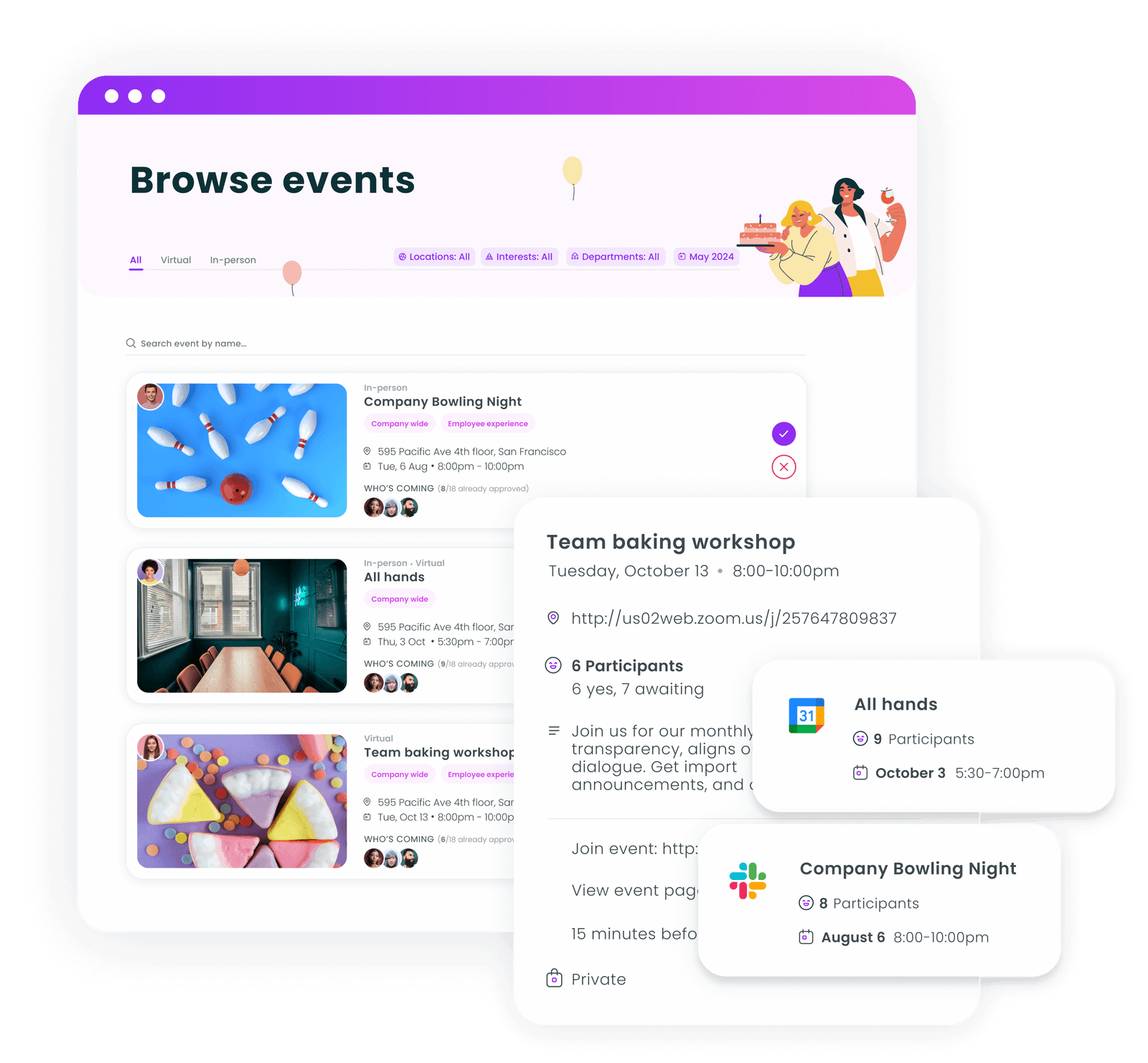
For teams running multiple events per quarter, workplace events platforms like Gable Events consolidate vendor coordination, attendee communication, and logistics tracking in one place, which eliminates the "who has the latest version of the vendor spreadsheet" problem entirely.

Before you start vendor outreach, make sure you've covered every planning phase. Our corporate event checklist walks through each stage from kickoff to post-event wrap.
Read the guide
Design for engagement, not attendance
Getting people to show up is the easy part. Getting them to participate, connect, and leave feeling like the event was worth their time is the actual job.
80% of event organizers report increased attendee participation when they use interactive features like live polls, Q&A sessions, and collaborative workshops. Passive formats (keynote, keynote, panel, lunch, keynote) are the default because they're easy to plan. They're also easy to tune out.
Here's how to design for active participation:
Mix formats within a single event. Alternate between short presentations (15-20 minutes max), small-group discussions, hands-on workshops, and unstructured networking time. The variety keeps energy levels up and gives different personality types a chance to engage in ways that feel natural to them.
Build in movement. People who've been sitting for two hours aren't listening anymore. Schedule breaks, change rooms between sessions, or design activities that require people to physically move. If you're planning offsite activities, outdoor options or team challenges can break up the day and create shared experiences that stick.
Pay attention to pacing and transitions. The gap between sessions matters. A five-minute break that turns into a fifteen-minute delay signals disorganization. A well-timed coffee break with a conversation prompt signals intentionality. These details shape how people perceive the entire event.
Don't neglect the basics. Good food, comfortable temperature, clean restrooms, and clear signage aren't glamorous, but they're the foundation. Nobody raves about the keynote if they spent the whole morning hungry because breakfast ran out at 8:15.
For hybrid events where some attendees are remote, the engagement challenge doubles. You're designing two experiences simultaneously. Our guide on hybrid event planning covers how to avoid alienating the people who aren't in the room.
Execute on-site with precision
Event day is where planning meets reality. Things will go wrong. The question is whether you've built systems to catch problems early and adapt quickly.
Create a detailed run-of-show document. This is your minute-by-minute timeline for the entire event. It includes every session start and end time, every vendor arrival, every AV cue, every meal service window, and every transition. Share it with your team, your vendors, and your venue contact at least a week before the event.
Assign clear roles. Every team member should know exactly what they're responsible for and who to escalate to when something breaks. Common roles include:
- Event lead: Final decision-maker on-site. Handles escalations and vendor issues.
- Registration and check-in coordinator: Manages attendee arrival, name badges, and welcome materials.
- AV and tech lead: Owns all presentation technology, microphones, and streaming (if hybrid).
- Logistics coordinator: Manages catering timing, room setup changes, and vendor load-in/out.
- Communications lead: Sends real-time updates to attendees via app, email, or Slack.
Build contingency plans for the three most likely failures. These are almost always: AV malfunction, catering delay, and speaker no-show. For each one, write down the backup plan before event day. "We'll figure it out" is not a contingency plan.
Communicate proactively with attendees. Send a pre-event email 48 hours before with logistics (address, parking, dress code, agenda). Send a day-of message with any last-minute changes. If you're using an employee experience strategy that treats events as touchpoints in a broader engagement program, this communication is part of the experience, not just logistics.
Measure ROI and capture insights
This is where most event planners drop the ball. The event ends, everyone's tired, and the debrief gets pushed to "next week," which becomes "next month," which becomes never.
Don't let that happen. Your measurement window is narrow.
Send a post-event survey within 24 to 48 hours. Keep it short: five to seven questions maximum. People will complete a two-minute survey. They won't complete a fifteen-minute one. Ask about overall satisfaction, whether the event met their expectations, what they'd change, and one open-ended question about their biggest takeaway.
Track quantitative metrics against your original objectives. If your goal was cross-team connection, measure how many people interacted with colleagues outside their department. If it was knowledge sharing, track session attendance and content engagement. If it was culture building, compare pre-event and post-event engagement scores.
Only 23% of companies can effectively track event ROI. The other 77% are spending money on events without knowing whether they're working. That's not a measurement problem; it's a planning problem. If you defined clear objectives in step one, measurement becomes straightforward.
For a deeper dive into frameworks and formulas, our guide on event ROI measurement walks through exactly how to calculate return on investment for different event types.
Run an internal debrief within one week. Gather your planning team, review the survey data, and document what worked, what didn't, and what you'd do differently. Store this somewhere accessible so the next event planner (even if it's you) doesn't start from scratch.
Gable Events brings venue sourcing, attendee communication, and post-event analytics into one platform, so you're not stitching together five tools and a spreadsheet.
Learn more
Common company event planning mistakes (and how to avoid them)
Mistake 1: Planning the event around a venue instead of an objective. You find a beautiful rooftop space and build the event around it. Then you realize it has no AV, no breakout rooms, and a noise ordinance that kills your evening reception. Start with purpose, then find a venue that serves it.
Mistake 2: Underestimating internal communication. Your event is only as good as your attendance rate. If people don't know why they should come, they won't. Start promoting internally 4 to 6 weeks out for major events. Use multiple channels. Explain the "why," not just the "what." If you need guidance on communicating changes to your team, the same principles apply to event promotion.
Mistake 3: Skipping the post-event debrief. Every event generates institutional knowledge. If you don't capture it, you lose it. The debrief doesn't need to be a formal meeting. A shared document with three sections (what worked, what didn't, what to change) takes 30 minutes and saves hours on the next event.
Mistake 4: Treating every event the same. A quarterly team lunch and an annual company offsite require fundamentally different planning approaches. Scale your process to the event, not the other way around.
Mistake 5: Ignoring the remote attendees. If even 10% of your audience is joining virtually, you need a hybrid plan. A laptop on a table pointed at the stage isn't a hybrid event; it's a bad experience for everyone dialing in.
Building a repeatable company event planning process
The goal isn't to plan one great event. It's to build a system that produces consistently good events without burning out your team.
Create templates for each event type. A quarterly team gathering template, an annual offsite template, a product launch template. Each one should include a timeline, budget framework, vendor checklist, communication plan, and measurement criteria. You're not starting from zero every time.
Centralize your vendor database. After every event, update your vendor list with performance notes, pricing, and contact information. Over time, this becomes one of your most valuable planning assets.
Track trends across events. Are satisfaction scores improving? Is attendance growing or shrinking? Are certain formats consistently outperforming others? This longitudinal data is what separates reactive event planning from strategic event programming. If you're already tracking workplace ROI metrics across your real estate and office portfolio, applying the same rigor to events is a natural extension.
Assign ownership. Someone needs to own the event program, not just individual events. That person is responsible for the calendar, the budget, the vendor relationships, and the continuous improvement loop. Without ownership, events become ad hoc projects that compete for attention with everything else on someone's plate.
The bottom line on company event planning in 2026
Company event planning isn't about logistics. Logistics are the execution layer. The real work is defining why you're bringing people together, designing an experience that serves that purpose, and measuring whether it worked. Teams that treat events as strategic investments in culture, engagement, and alignment will outperform teams that treat them as line items to check off. The framework is simple: purpose, plan, execute, measure, improve. The discipline is doing it every time.
From venue sourcing to post-event analytics, Gable gives workplace teams one platform to plan, communicate, and measure every company event.
Get a demo