.svg)


.svg)
- Define your event's goal before you pick a single metric
- Leading metrics track engagement now; lagging metrics track revenue later
- Set your attribution window to at least 90 days for B2B events
- ROI formula: ((Returns - Costs) / Costs) x 100, but "returns" aren't always revenue
- Build separate reports for your CFO and your CMO; they care about different numbers
Event ROI measurement is the process of connecting what you spend on an event to the outcomes it produces, whether that's pipeline, engagement, retention, or brand lift. Most teams know they should be doing this. Fewer actually have a system for it. This guide walks through the full framework: setting goals, choosing metrics, picking an attribution model, running the math, and building reports that get your budget renewed.
Why you need to measure event ROI
Events eat a significant share of marketing budgets. Depending on the company, that's somewhere between 24% and 32% of total marketing spend. When a line item is that large, finance doesn't accept "it felt like a good event" as justification.
The good news: measurement is getting easier. 40% of organizers still struggle to prove event ROI, down from 70% the year before. That's real progress, but it means more than half the market has figured it out, and your CFO knows it.
The pressure isn't just about proving past events were worth it. It's about earning the budget for the next one. If you can't show what a gathering produced, you're competing for dollars against channels that can, like paid search, content syndication, or outbound. Events deserve better than that, but they need the receipts.
Companies that have built workplace ROI frameworks for real estate and space utilization already understand this logic. The same discipline applies to events: define what success looks like, measure it, and report it in language your stakeholders speak.
Step 1: Define your event goal before anything else
Not every event exists to generate pipeline. Some exist to retain customers. Others exist to build culture or collect product feedback. The metrics you track depend entirely on which goal you're chasing.
Here are the four most common event goal types:
Pipeline and demand generation. The event's job is to create or accelerate sales opportunities. Think conferences, trade shows, executive dinners. Success means new contacts entering the funnel or existing deals moving forward.
Employee engagement and culture. Internal events like offsites, team gatherings, and all-hands meetings. Success means stronger connection, higher engagement scores, and lower attrition. If you're looking for internal event ideas that actually move the needle, start with the goal, not the activity.
Customer retention and expansion. User conferences, advisory boards, customer appreciation events. Success means renewals, upsells, and referrals.
Brand and thought leadership. Sponsored events, speaking engagements, community meetups. Success means awareness, share of voice, and inbound interest.
Write the goal down before you plan the event. Literally. Put it in the event brief. The most common mistake is waiting until after the event to think about ROI. Without objectives established from the beginning, measurement becomes guesswork.
Step 2: Set leading metrics by event type
Leading metrics tell you how the event performed in real time or shortly after. They're the early signals that predict whether your lagging metrics (revenue, retention) will follow.
For pipeline events:
- Registration-to-attendance conversion rate (strong events hit above 50%)
- Number of qualified leads collected
- Meetings booked during or immediately after the event
- Session attendance and dwell time
- Post-event survey NPS
For engagement events:
- Attendance rate (especially voluntary attendance)
- Employee NPS or pulse survey scores
- Participation in breakout sessions or activities
- Qualitative feedback themes
For retention events:
- Customer attendance rate by segment (at-risk vs. healthy accounts)
- Feature adoption or product feedback volume
- Executive sponsor engagement
- Net promoter score shift pre-to-post event
For brand events:
- Social mentions and share of voice
- Content engagement (downloads, views, shares)
- Inbound inquiries within 30 days
- Media coverage or analyst mentions
The key is tracking these during and immediately after the event, not reconstructing them from memory three weeks later. If you're running hybrid events, you'll need to capture engagement data from both in-person and remote attendees, which requires tooling that handles both channels.

Before you can measure ROI, you need events worth measuring. This guide covers formats and ideas that produce outcomes, not just attendance.
Read the guide
Step 3: Set lagging metrics to track revenue impact
Lagging metrics are the outcomes that take weeks or months to materialize. They're what your CFO actually cares about.
Pipeline sourced. Opportunities where the event was the first meaningful touchpoint. This is the purest measure of event impact, but it's also the smallest number. Don't rely on it alone.
Pipeline influenced. Opportunities where the event was one of several touchpoints. This captures the full picture: the prospect who attended your conference, then received a follow-up email, then took a demo. The event didn't close the deal, but it played a role.
Deals closed. Revenue directly tied to event-sourced or event-influenced opportunities. This is the number that goes in the ROI formula.
Customer lifetime value lift. For retention events, compare the renewal rate and expansion revenue of attendees vs. non-attendees over 6 to 12 months.
Referrals. Did attendees refer new prospects? Track this with post-event attribution codes or simply ask during intake.
Good B2B event ROI ranges from 300% to 500% or higher, meaning $3 to $5 returned for every $1 spent. But that benchmark varies wildly by industry, deal size, and sales cycle length. A $200K ACV enterprise deal influenced by a $50K dinner is a different equation than a $5K SaaS deal influenced by a $500K conference booth.
Step 4: Choose your attribution framework
Attribution is where most event ROI measurement efforts fall apart. Not because the math is hard, but because teams don't decide on a model before the event happens.
Here are the four most common frameworks:
For most B2B events, multi-touch attribution is the right call. First-touch and last-touch are simpler, but they either overcount or undercount the event's contribution.
One critical detail: set your attribution window to at least 90 days. B2B deals don't close in two weeks. A 14-day window will miss the majority of event-influenced pipeline. For enterprise sales cycles, 180 days is more realistic.
Whatever model you choose, document it and apply it consistently. Switching models between events makes comparison impossible. If you're building a workplace analytics practice, the same principle applies: pick a methodology and stick with it long enough to see trends.
Step 5: Calculate event ROI (the actual math)
The formula itself is straightforward:
Event ROI (%) = ((Returns - Costs) / Costs) x 100
If you spent $50,000 on an event and it generated $200,000 in closed-won revenue from event-sourced and event-influenced deals, your ROI is 300%.
But the formula is only as good as the numbers you put into it.
Counting returns. Decide upfront whether "returns" means closed revenue, pipeline value, or a blended number. Closed revenue is the most conservative and credible. Pipeline value is useful for events where the sales cycle extends beyond your reporting window, but discount it by your historical close rate.
Counting costs. This is where teams consistently undercount. Include:
- Venue, catering, A/V, and production
- Speaker fees and travel
- Marketing and promotion spend
- Staff time (hours x loaded cost per hour)
- Executive travel and attendance
- Technology and tooling
- Swag, gifts, and entertainment
- Opportunity cost (what else could those people have been doing?)
Internal staff time is the cost most teams forget. If five people spent 80 hours each planning and executing an event, that's 400 hours of loaded labor cost. Ignoring it inflates your ROI.
Cost per lead (CPL). Divide total event cost by the number of qualified leads generated. Compare this to your CPL from other channels. If your event CPL is $400 and your paid search CPL is $150, that's not necessarily bad; event leads often convert at higher rates and larger deal sizes. But you need to know the number.
Gable Events automates much of this tracking by syncing registration, attendance, and engagement data into a single view, so your ROI math is built on actual numbers rather than spreadsheet estimates assembled after the fact.
Cost per opportunity. Divide total event cost by the number of opportunities created. This is often more meaningful than CPL for B2B events, because not every lead becomes an opportunity.
Gable Events gives you one place to plan gatherings, communicate with attendees, and track the metrics that prove impact.
Learn more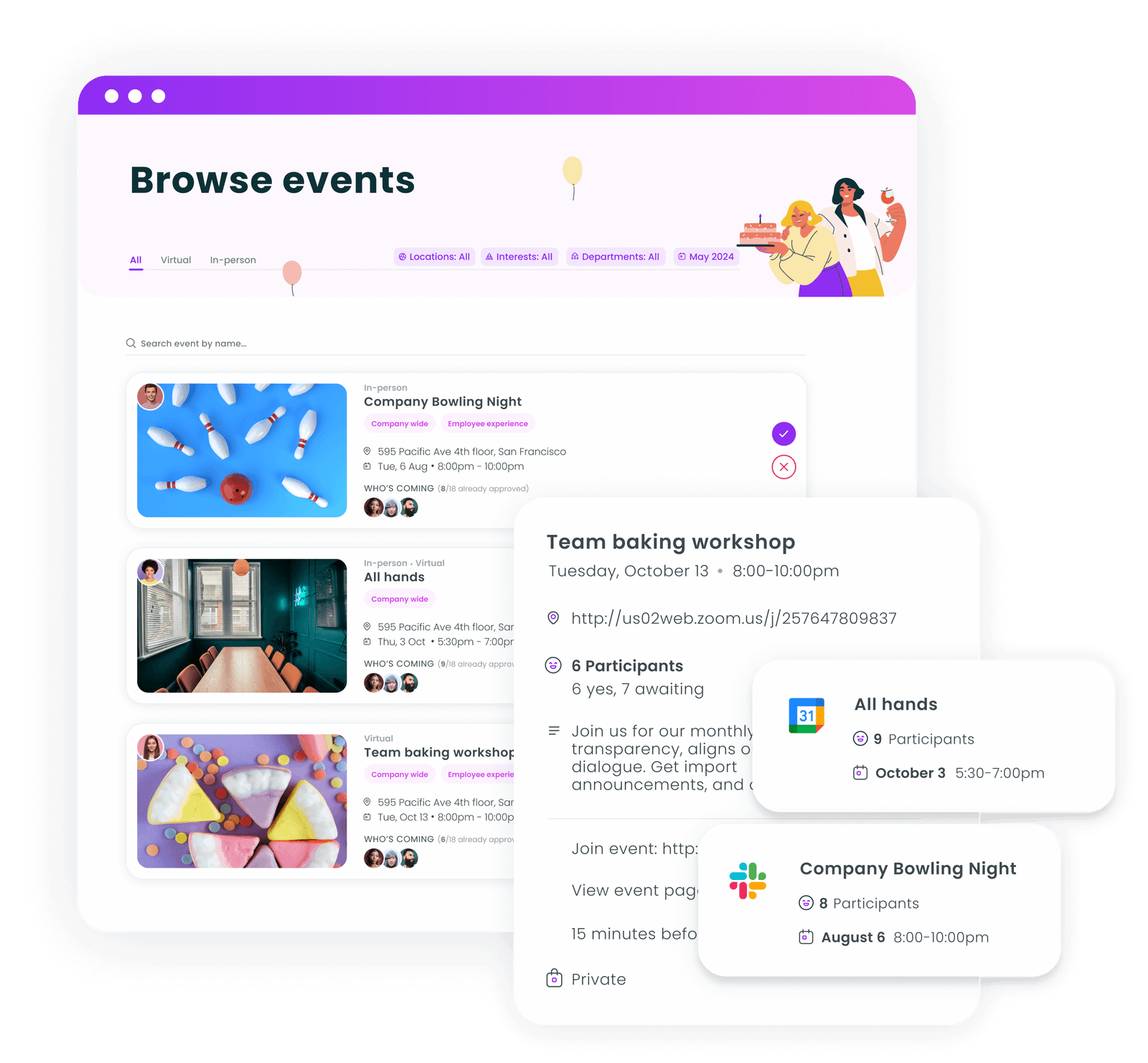
Step 6: Build your ROI report (for two different audiences)
Your CFO and your CMO care about different things. Build two versions of the same report.
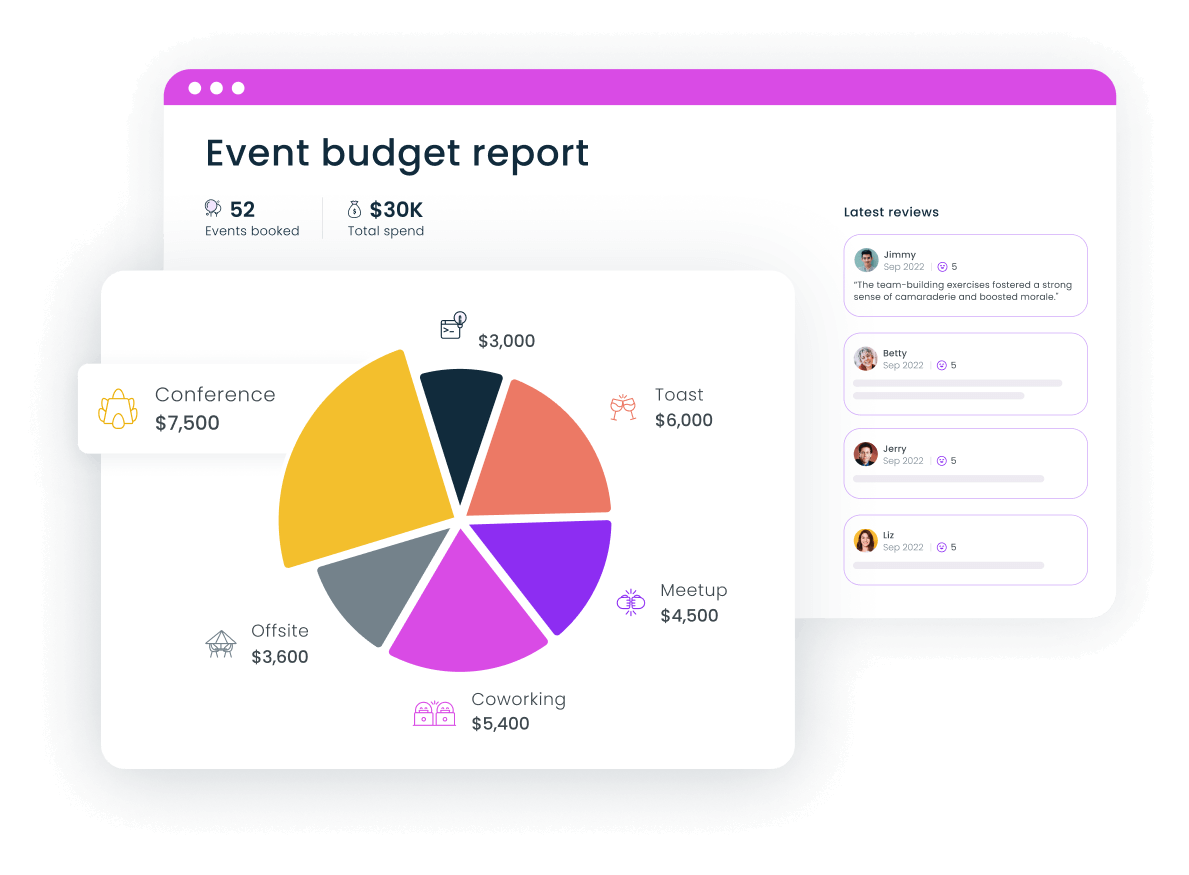
The CFO report should lead with:
- Total event cost (fully loaded, including staff time)
- Revenue generated (closed-won from event-sourced and event-influenced deals)
- ROI percentage
- Cost per opportunity and cost per lead vs. other channels
- Year-over-year trend (is event ROI improving?)
Keep it to one page. Use a table. No narrative fluff.
The CMO report should lead with:
- Pipeline created and influenced (total value and number of opportunities)
- Attendance and engagement metrics (registration conversion, session participation, NPS)
- Brand metrics (social reach, content engagement, media coverage)
- Qualitative highlights (key customer conversations, product feedback themes)
- Recommendations for the next event (what to repeat, what to change)
This can be two to three pages. Include visuals.
Both reports should include a "what we'd do differently" section. This is what separates measurement from optimization. If you're already tracking workplace transformation initiatives, you know that the value isn't just in the data; it's in the feedback loop.
Step 7: Avoid the most common measurement mistakes
Measuring too early. If you pull your ROI report two weeks after a B2B event, you'll see almost no revenue impact. Pipeline takes time. Set a 90-day check-in and a 180-day final report.
Confusing revenue with profit. Your ROI formula should use revenue (or gross margin, if you want to be precise), not bookings or contract value that hasn't been recognized yet. Be clear about which number you're using.
Ignoring qualitative value. Some events produce outcomes that don't fit neatly into a spreadsheet: a key customer relationship saved, a product insight that changes your roadmap, an executive connection that opens a new market. Note these in your report. They matter, even if they don't have a dollar sign.
Over-indexing on attendance. High attendance doesn't mean high ROI. A 50-person executive dinner that generates $2M in pipeline is worth more than a 5,000-person conference that generates $500K. Measure outcomes, not headcount.
Forgetting to benchmark. Your first event ROI report is a baseline, not a verdict. The real value comes from comparing events over time: which formats, audiences, and venues produce the best returns? This is where a data-driven approach to workplace experience pays off. You stop guessing and start optimizing.
Not accounting for Return on Objectives (ROO). Some events, particularly internal culture events, don't have a revenue goal. For these, measure Return on Objectives instead: did the event achieve its stated purpose? Did engagement scores improve? Did voluntary attrition decrease in the following quarter? ROO is just as rigorous as ROI when the objectives are clearly defined.
Making event ROI measurement a habit, not a project
The framework above works for a single event. But the real payoff comes when you apply it consistently across every gathering your company runs, from a 10-person team offsite to a 2,000-person user conference.
That requires three things. First, goal-setting becomes part of event planning, not an afterthought. Every event brief includes a goal, target metrics, and an attribution model. Second, tracking infrastructure is in place before the first invite goes out. You can't measure what you didn't capture. Third, reporting happens on a cadence, not just when someone asks.
78% of organizers say in-person events are their most impactful marketing channel. That's a strong conviction. Event ROI measurement is how you back it up with evidence, protect your budget, and make every next event better than the last.
From planning to post-event reporting, Gable gives workplace leaders the tools to prove event impact and optimize what comes next.
Get a demo