.svg)


.svg)
- Workplace transformation isn't one playbook; it's at least three distinct archetypes
- Dropbox's Virtual-First model made 90% of employees cite flexibility as a reason to stay
- DoorDash designed offices around "moments that matter," not mandatory attendance
- Government-scale consolidation proves change champions beat top-down mandates
- Gradual rollouts build momentum faster than big-bang launches
Every company going through a workplace transformation thinks they're unique. They're partly right. But after watching dozens of these play out since 2020, patterns emerge. The companies that succeed don't just redesign floor plans or update remote policies. They rethink the relationship between people, space, and work itself. These six workplace transformation examples show what that looks like in practice, across industries, scales, and strategies.
The 3 archetypes driving workplace transformation in 2026
Not every transformation looks the same, but most fall into one of three categories: flex-first (shrink the footprint, expand flexibility), consolidation (fewer locations, higher quality), or hub-and-spoke (distributed presence with intentional gathering points). Understanding which archetype fits your company is the first strategic decision.
The urgency is real. Office utilization hit 53% in 2026, up from 35% in 2023. That's progress, but it still means nearly half of office space sits empty on any given day. Companies are paying for space that doesn't earn its keep.
Meanwhile, average space per employee has dropped to 188 square feet, down from 203 in 2019. But here's the paradox: adjusted for hybrid attendance, the space available per person who actually shows up is higher than a decade ago. Companies aren't just shrinking. They're redistributing.
McKinsey's research on flexible work identifies 12 capabilities for hybrid success, including having a clear "North Star" vision for the workplace experience and building iterative testing into the strategy. The companies below didn't stumble into transformation. They designed it.
Before diving into the cases, it helps to understand the metrics that matter. The best transformations track utilization rates, employee engagement scores, retention impact, and cost per seat. If you're building a workplace strategy from scratch, those four numbers are your compass. And if you're trying to build the business case for analytics, these case studies give you the proof points your CFO wants to see.
Dropbox: From 3% remote to virtual-first leader
Before the pandemic, roughly 3% of Dropbox employees worked remotely. By 2021, the company had declared itself "Virtual-First," making remote work the default for all employees. It wasn't a reaction. It was a deliberate bet.
The strategy. Dropbox didn't just close offices. It reimagined what offices are for. Large headquarters were converted into smaller "Dropbox Studios," purpose-built for collaboration, not daily desk work. The company invested in on-demand flexible spaces so employees could access workspaces near home without committing to a permanent office footprint.
The results. 90% of Dropbox employees name Virtual-First as a top reason for staying at the company. That's not a satisfaction survey buried in an HR report; it's a retention lever. Flexibility became the single most cited factor in employee loyalty, with 93% pointing to it specifically.
The numbers go deeper. Dropbox logged over 7,000 employee visits to on-demand spaces in a single year. Its Offsite Planning Team cut planning time by 30% by standardizing how teams gather. And 71% of employees reported stronger team connections after intentional in-person gatherings, which challenges the assumption that remote work erodes relationships.
What makes this work. Dropbox didn't just remove the office requirement. It replaced it with something better: a system for intentional gathering. Studios for collaboration. On-demand spaces for focus work or local meetups. Structured offsites for team bonding. Every interaction has a purpose.
The lesson for other companies is that going remote-first doesn't mean going office-free. It means being deliberate about when and why people come together. If you're exploring a similar model, understanding how hybrid work actually functions at scale is essential context.
The archetype: Flex-first. Shrink the permanent footprint, expand access to flexible space, and design every in-person moment with intention.
DoorDash: Designing for curated moments that matter
DoorDash went fully remote in March 2020 like everyone else. But instead of rushing back to the old model, the company spent two years listening to employees before designing its flexible workplace strategy.
The strategy. DoorDash built a hub-and-spoke model with major offices in 10+ cities (each with 100+ employees) and remote-first policies for everyone else. The split landed at roughly 80% of employees working from an office several days per week, 15% fully remote, and 5% in-office daily. Nobody was forced into a bucket.
The key insight came from employee feedback: 75% of people said they came to the office for big meetings and social events, not for heads-down work. So DoorDash redesigned its spaces accordingly. Fewer dedicated desks. More café areas, event spaces, and team gathering zones. Offices in New York, DC, and San Francisco were reimagined around "moments that matter."
The results. DoorDash's approach validates what CBRE's 2026 data confirms: 68% of employees cite collaboration as the most important reason for coming to the office. When you design for that reality instead of fighting it, attendance becomes organic rather than mandated.
The company also avoided the backlash that plagued companies issuing rigid return-to-office mandates. By letting employee behavior shape the policy rather than the other way around, DoorDash maintained trust during a period when many companies were losing it.
What makes this work. DoorDash treated the office as a product, not a given. It gathered user research (employee surveys), iterated on the design, and measured outcomes. The hub-and-spoke model gave the company geographic reach without the cost of maintaining full-scale offices everywhere.
Managing this kind of distributed presence, with multiple offices, varying collaboration needs, and event coordination across cities, is exactly the operational challenge that Gable's platform was built to solve.
The archetype: Hub-and-spoke. Maintain presence in key markets, design spaces for collaboration, and let employee behavior guide policy.

Transformation only works when employees are on board. This step-by-step playbook covers the communication, phasing, and feedback loops that make change stick.
Read the guide
Stripe: Expansion as transformation
Not every workplace transformation involves downsizing. Stripe's story is the opposite: strategic expansion as a competitive weapon.
The strategy. In 2024, Stripe moved its New York operations from 199 Water Street to 28 Liberty Street in Lower Manhattan. Then it kept going. The company expanded from 146,000 square feet to 286,000 square feet across eight floors, nearly doubling its footprint in a single year.
This wasn't reckless growth. It was a deliberate flight to quality. Stripe invested in modern, flexible, Class A space designed to attract and retain talent in one of the most competitive hiring markets in the world. While other tech companies were shedding square footage, Stripe was betting that premium workspace is a recruiting advantage.
What makes this different. Stripe's transformation challenges the narrative that workplace transformation always means less space. For high-growth companies competing for top talent, the right space in the right location can be a differentiator. The transformation isn't about shrinking; it's about upgrading.
The company's approach reflects a broader trend in fintech and enterprise tech: consolidating into fewer, better locations rather than spreading thin across many mediocre ones. If you're managing a corporate real estate portfolio, Stripe's playbook is worth studying. Sometimes the right move is to invest more in fewer places.
The archetype: Consolidation into quality. Fewer locations, higher investment per location, space as a talent magnet.
GSA: Government-scale consolidation and change management
The General Services Administration's workplace transformation is one of the largest and most instructive examples of office consolidation in the public sector. It's also a masterclass in change management.
The strategy. The GSA consolidated 6,000 employees from four separate offices across the DC metro area into a single downtown location. This wasn't just a real estate play. It required fundamentally changing how government employees work: from fixed desks and assigned offices to hoteling, shared workspaces, and mobile work.
For a workforce accustomed to decades of "my desk, my office, my routine," this was seismic.
The change management approach. The GSA created a "Transformation Champions Network" of 100 employees who served as two-way communication channels between leadership and the broader workforce. These weren't cheerleaders. They were translators, helping leadership understand resistance and helping employees understand the rationale.
The agency also developed an employee readiness toolkit with modules on shared workspace etiquette, technology troubleshooting, and the practical logistics of working in a hoteling environment. They addressed resistance upfront rather than pretending it didn't exist.
Not everyone adapted smoothly. But the champions network created enough momentum to carry the transformation forward. The result: 6,000 employees successfully transitioned, with the consolidation delivering significant cost savings and reduced environmental impact.
What leaders can learn. Big transformations need three things: champions who bridge the gap between leadership and staff, transparent communication about what's changing and why, and phased adoption that gives people time to adjust. If you're planning something similar, the GSA's approach to getting employee buy-in is a blueprint worth following.
A professional services firm cut its footprint by 45% using a similar event-based office model. The pattern is consistent: consolidation works when it's paired with intentional design and genuine change management, not just a memo announcing the move.
The archetype: Large-scale consolidation. Fewer locations, shared space models, heavy investment in change management.
Gable gives you real-time visibility into utilization, attendance, and space performance across every location in your portfolio.
Learn more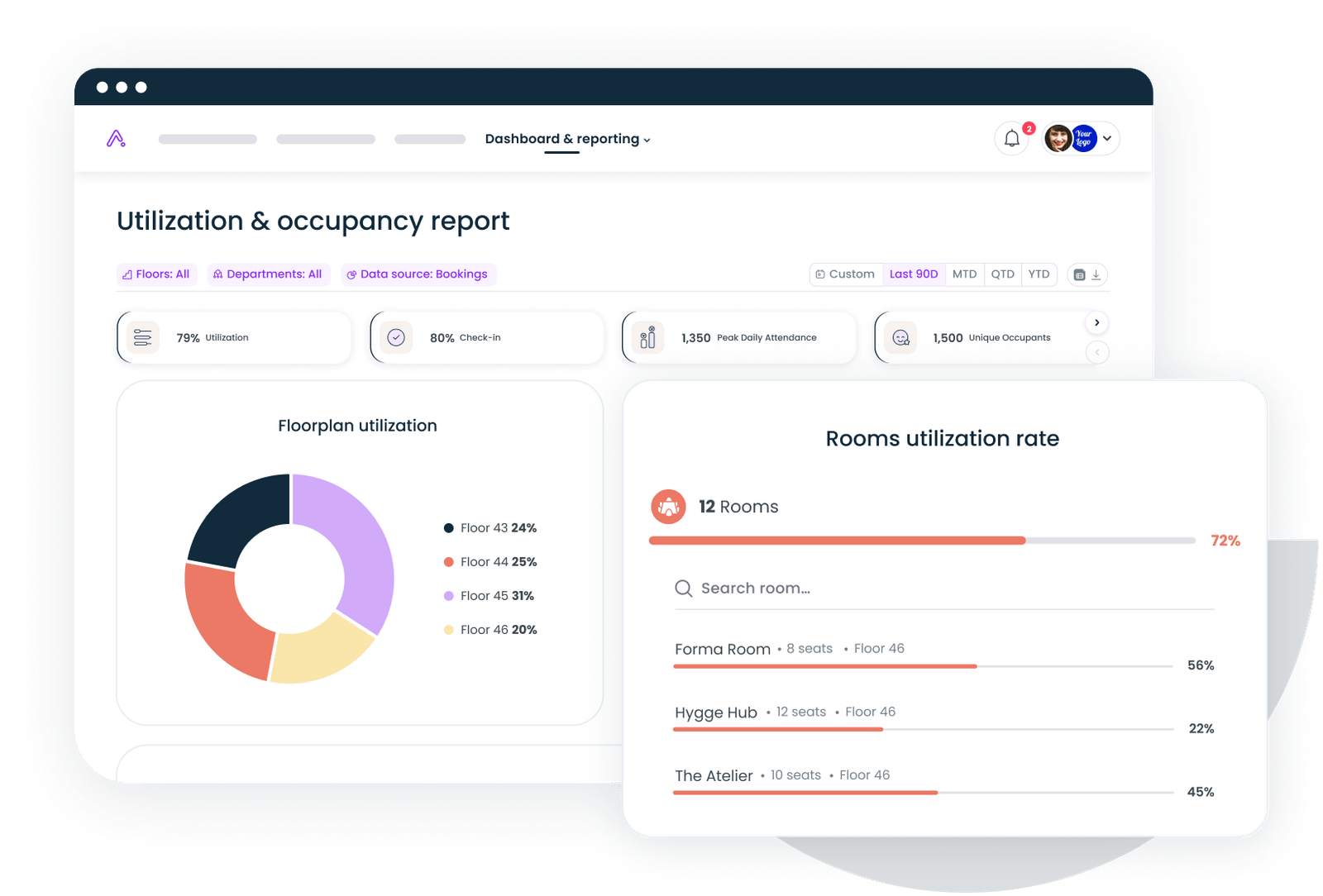
HUB International: Hybrid adoption through gradual rollout
HUB International is a massive insurance brokerage with over 600 offices and 16,000+ employees. It also acquires companies at a staggering pace, completing over 70 acquisitions in a single year. Transforming the workplace in that environment isn't just hard. It's a moving target.
The strategy. Instead of a top-down mandate, HUB started small. The company launched with 200 bookable seats in a single office, targeting what leadership called a "coalition of the willing," employees who were already enthusiastic about flexible seating. No one was forced to participate.
From that pilot, the program expanded to 61 offices and over 2,000 bookable seats. Real estate costs dropped roughly 20% while employee experience scores held steady or improved. Employees reported greater autonomy, and the gradual rollout built enthusiasm rather than resistance.
Why the gradual approach worked. HUB's acquisition-heavy model means new offices and new employees are constantly entering the system. A rigid, one-size-fits-all policy would have created chaos. Instead, the flexible seating program became something new acquisitions could opt into at their own pace.
This is the operational reality of managing multiple office locations: every site has its own culture, its own workflows, and its own level of readiness for change. Decentralized adoption, where local leaders decide when and how to participate, beats centralized mandates almost every time.
What leaders can learn. Pilot programs aren't just risk mitigation. They're momentum builders. When early adopters have a good experience, they become advocates. That organic enthusiasm is more powerful than any executive email.
The archetype: Gradual flex adoption. Start small, prove the model, expand organically, and let local leaders drive the pace.
Siemens: Digital transformation at global scale
Siemens offers a different lens on workplace transformation: one driven by technology rather than real estate.
The strategy. Siemens deployed a unified communication platform across 200,000 employees globally, replacing fragmented tools with a single system. The goal wasn't just efficiency. It was fundamentally changing how a 175-year-old industrial company collaborates.
The results. Within nine months, Siemens saw a 30% drop in email volume and a 15% increase in project delivery speed. Those aren't vanity metrics. Reduced email volume signals that people are collaborating in real time rather than lobbing messages back and forth. Faster project delivery means the new tools actually changed behavior, not just added another app to the dock.
What makes this relevant. Most workplace transformation conversations focus on physical space. Siemens reminds us that digital workplace transformation is equally important. The best physical space in the world doesn't help if teams can't coordinate across it. Technology and space strategy have to move together.
The archetype: Digital-first transformation. Change how people communicate and collaborate, then let the physical space follow.
Five principles that connect every transformation
These six companies span tech, insurance, government, fintech, and industrial manufacturing. Their strategies range from radical downsizing to aggressive expansion. But five principles show up in every successful case.
1. Listen first, mandate second. DoorDash surveyed employees for two years before designing its model. HUB started with volunteers. The GSA built a champions network. None of them led with a mandate.
2. Design for intention, not just efficiency. Cutting desk counts isn't a strategy. Dropbox's studios, DoorDash's "moments that matter" spaces, and Stripe's Class A investment all reflect a belief that space should earn its existence by enabling something specific.
3. Treat real estate as a strategic asset. Stripe expanded. Dropbox contracted. Both made the right call for their context. The common thread is that neither treated real estate as a fixed cost to be minimized. They treated it as a lever to be optimized.
4. Invest in change management. The GSA's champions network and HUB's coalition of the willing both prove the same point: transformation fails without people who bridge the gap between strategy and daily experience. If you're planning a major shift, communicating office policy changes well is half the battle.
5. Measure, iterate, repeat. Dropbox tracks retention against Virtual-First satisfaction. DoorDash measures why people come to the office. Siemens tracked email volume and delivery speed. None of these companies declared victory and moved on. They built feedback loops into the transformation itself.
What these workplace transformation examples mean for your strategy
The temptation after reading case studies is to copy the one that sounds most like your company. Resist that. Dropbox's Virtual-First model works because of Dropbox's culture, talent market, and product. Stripe's expansion works because of Stripe's growth trajectory and competitive landscape.
What you can borrow are the principles. Listen to your people. Design space with purpose. Treat change management as a first-class investment, not an afterthought. And measure everything, because intuition about how space gets used is almost always wrong.
The companies that get transformation right in 2026 won't be the ones with the most innovative floor plans or the most generous remote policies. They'll be the ones that treat the workplace as a system, where space, technology, policy, and culture all reinforce each other, and keep iterating until the system works.
From flexible space access to office analytics and event coordination, Gable gives workplace leaders the tools to design, measure, and optimize every part of the employee experience.
Get a demo