.svg)


.svg)
- Every office lease longer than 12 months now sits on your balance sheet
- Lease term, escalation clauses, and TI allowances all change the accounting math
- Operating vs. finance lease classification determines how expenses flow through your P&L
- Your CFO cares about lease liability because it affects debt covenants and ratios
- Aligning with Finance before signing prevents mid-year accounting surprises
Lease accounting changed fundamentally when ASC 842 and IFRS 16 took effect. Operating leases that used to live quietly in footnotes now show up as assets and liabilities on the balance sheet, which means every lease decision you make as a workplace leader has a direct, visible financial impact. If you're negotiating lease terms, evaluating renewals, or deciding between a long commitment and flexible space, you need to understand what Finance sees when they look at the same deal.
What changed with ASC 842 And IFRS 16, and why you should care
Before 2019, companies could sign a 10-year office lease and keep the obligation almost entirely off the balance sheet. The old standard, ASC 840, classified most real estate leases as "operating leases," which meant the payments showed up as rent expense on the income statement but the underlying obligation was buried in disclosure footnotes. Investors, lenders, and analysts knew the liabilities were there, but they weren't staring anyone in the face.
That changed when ASC 842 took effect for public companies in 2019 and private companies in 2022. The new standard requires all leases longer than 12 months to be recorded as right-of-use (ROU) assets and corresponding lease liabilities on the balance sheet. IFRS 16, the international equivalent, went even further by eliminating the operating lease classification for lessees entirely.
The practical impact for workplace leaders: your CFO now sees every lease commitment as a visible liability. A five-year office lease isn't just a monthly rent check anymore. It's a line item that affects debt-to-equity ratios, loan covenants, and how the company looks to investors. When Finance pushes back on a lease term or questions a renewal, this is usually why.
Pre-2019 vs. post-2019: How operating leases moved to the balance sheet
Under the old rules, a company could lease 50,000 square feet for $50 per square foot, pay $2.5 million annually, and the balance sheet barely noticed. The lease payments flowed through as operating expenses. The total future obligation might appear in a footnote, but it didn't inflate liabilities or reduce the company's apparent financial health.
Under ASC 842, that same lease creates two new balance sheet entries on day one:
Right-of-use (ROU) asset: This represents your right to use the office space for the lease term. Think of it as the accounting equivalent of saying "we control this space for five years, and that control has value."
Lease liability: This is the present value of all future lease payments. For a five-year lease at $2.5 million per year, discounted at your incremental borrowing rate, you're looking at roughly $10 to $11 million in new liability appearing on the balance sheet.
The shift was massive. Both ASC 842 and IFRS 16 require this on-balance-sheet recognition, which means companies worldwide suddenly had trillions of dollars in previously hidden obligations become visible. For workplace leaders, the takeaway is simple: the size and structure of your leases now directly affect how healthy the company looks on paper.
This is one reason many organizations are rethinking their CRE portfolio management strategies. When every lease shows up on the balance sheet, the portfolio isn't just an operational question; it's a financial one.
Operating vs. finance lease classification: The five tests under ASC 842
ASC 842 still distinguishes between operating leases and finance leases (IFRS 16 does not, which we'll cover in a moment). The classification matters because it changes how the expense hits your income statement.
A lease is classified as a finance lease if it meets any one of these five criteria:
- Ownership transfer. The lease transfers ownership of the asset to you by the end of the term.
- Purchase option. The lease includes a purchase option you're reasonably certain to exercise.
- Lease term. The lease term covers the major part of the asset's remaining economic life (generally interpreted as 75% or more).
- Present value. The present value of lease payments equals or exceeds substantially all of the asset's fair value (generally 90% or more).
- Specialized asset. The asset is so specialized that it has no alternative use to the landlord after the lease term.
For most office leases, none of these apply. You're not buying the building. You don't have a purchase option. A 5-year lease on a building with a 40-year useful life doesn't hit the 75% threshold. So most office leases end up classified as operating leases under ASC 842.
Why does classification matter? Operating leases recognize a single, straight-line lease expense each period. Finance leases split the expense into amortization of the ROU asset and interest on the lease liability, which front-loads the total expense (higher in early years, lower later). For your P&L, operating lease treatment is generally simpler and more predictable.
One important note: under IFRS 16, there's no operating lease category for lessees. Every lease gets treated similarly to a finance lease, with amortization and interest recognized separately. If your company reports under both US GAAP and IFRS (common for multinationals), the same lease can produce different expense patterns depending on which set of books you're looking at. This is worth understanding if you're managing office leases across regions.
Right-of-use assets and lease liabilities: What shows up and how it's measured
Let's make this concrete. Here's how a typical office lease translates to balance sheet entries under ASC 842.
Lease liability calculation:
Take all future lease payments over the lease term and discount them to present value using your company's incremental borrowing rate (the rate you'd pay to borrow a similar amount over a similar period). If the lease specifies a rate implicit in the lease and you can determine it, use that instead. Most office leases don't, so the incremental borrowing rate is what Finance will use.
Example: A 5-year lease at $200,000 per year, discounted at 5%, produces a lease liability of approximately $866,000 on day one.
ROU asset calculation:
Start with the lease liability, then adjust:
- Add any lease payments made before the start date
- Add initial direct costs (legal fees, broker commissions you paid)
- Subtract any lease incentives received (this is where tenant improvement allowances come in)
So if you received a $100,000 tenant improvement allowance, your ROU asset would be approximately $766,000 ($866,000 liability minus $100,000 TI allowance).
What this means for your company's financial ratios:
The lease liability increases total liabilities. The ROU asset increases total assets. But because the liability is often larger than the asset (especially after TI allowances reduce the ROU), the net effect typically worsens the debt-to-equity ratio. If your company has loan covenants tied to leverage ratios, a large new lease can push you closer to (or past) covenant thresholds.
This is the conversation your CFO is having with lenders that you might not be hearing. And it's why Finance sometimes seems unreasonably cautious about lease commitments.

Before you negotiate your next office lease, understand the fundamentals of lease structures, terms, and what to watch for.
Read the guide
How specific lease decisions hit your books
This is where lease accounting stops being abstract and starts affecting your day-to-day decisions. Every structural element of a lease changes the accounting math.
Lease term length
Longer leases mean larger liabilities. A 10-year lease at $200,000 per year creates roughly $1.5 million in lease liability (at a 5% discount rate), compared to $866,000 for a 5-year term. That's not just a bigger number; it's a bigger drag on financial ratios. This is why Finance often prefers shorter terms, even when the per-square-foot rate is higher. The total cost might be greater on a short lease, but the balance sheet impact is smaller at any given point.
Renewal options
Here's a trap that catches workplace teams off guard. If your lease includes a renewal option and you're "reasonably certain" to exercise it, ASC 842 requires you to include those renewal periods in the lease term for measurement purposes. A 5-year lease with a 5-year renewal that you're likely to exercise? That's a 10-year lease on the balance sheet.
"Reasonably certain" isn't a casual standard. It considers economic incentives, the cost of not renewing, leasehold improvements you've made, and the importance of the location to your operations. If you've built out a headquarters with $2 million in improvements, Finance (and your auditors) may argue you're reasonably certain to renew, even if you haven't decided yet.
Escalation clauses
Most office leases include annual rent escalations, typically 2% to 3% per year. Under ASC 842, fixed escalations are included in the lease liability measurement from day one. If your lease starts at $200,000 and escalates 3% annually, the liability calculation uses the full schedule of escalating payments, not just the starting rent.
Variable payments tied to an index (like CPI) are treated differently. Under ASC 842, you use the index rate at lease commencement and don't remeasure unless there's a lease modification. Under IFRS 16, you remeasure when the index resets. This difference can create meaningful gaps between US GAAP and IFRS balance sheets for the same lease.
Tenant improvement allowances
TI allowances are one of the most powerful tools for managing lease accounting impact, and they're often underappreciated by workplace teams. When a landlord provides a TI allowance, it reduces your ROU asset. A $500,000 TI allowance on a lease with an $4 million liability means your ROU asset starts at $3.5 million instead of $4 million.
This matters for asset-based ratios and for the amortization expense you'll recognize over the lease term. Negotiating a larger TI allowance doesn't just save you cash on buildout; it improves your accounting profile. Understanding how TI allowances work gives you leverage in conversations with both landlords and your CFO.
Lease modifications and early termination
If you decide to downsize, sublease, or terminate early, the accounting gets complicated fast. A lease modification triggers remeasurement of the liability and ROU asset. Early termination can result in a gain or loss depending on the remaining balances. If you abandon space entirely, you may need to test the ROU asset for impairment under ASC 360.
This is why right-sizing your office space before signing is so much easier than adjusting after the fact. Changes mid-lease create accounting events that Finance has to explain to auditors and, for public companies, to investors.
How to structure leases to minimize accounting surprises
You don't need to become an accountant. But you do need to understand which levers affect the numbers so you can structure deals that work for both operations and Finance.
Keep terms shorter when the balance sheet is tight. If your company is approaching covenant limits or preparing for a financing round, shorter lease terms reduce the liability. Yes, you'll likely pay more per square foot. But the balance sheet flexibility may be worth it. Some companies are shifting portions of their portfolio to flexible workspace arrangements specifically to manage this tradeoff.
Be deliberate about renewal options. If you want the option to renew without it inflating your lease liability, structure the renewal so it's genuinely optional, not economically compelled. Avoid making significant leasehold improvements that would make non-renewal economically irrational. Document your intent clearly. Your auditors will look at the substance, not just the contract language.
Negotiate TI allowances aggressively. Every dollar of TI allowance reduces your ROU asset. If you're choosing between a lower base rent and a higher TI allowance, the TI allowance may produce a better accounting outcome even if the total economic cost is similar. Bring Finance into this conversation early.
Understand the short-term lease exception. Leases of 12 months or less (with no purchase option) can be kept off the balance sheet entirely under ASC 842. You simply expense the payments as incurred. This is why some companies use short-term or month-to-month arrangements for satellite offices or temporary space needs. The operational flexibility and accounting simplicity can both be attractive.
Watch for embedded leases. Sometimes what looks like a service agreement is actually a lease under ASC 842. If a contract gives you the right to control the use of an identified asset for a period of time, it may contain a lease that needs to be recognized. Managed office agreements, dedicated coworking suites, and equipment contracts can all trigger this analysis.
Tracking actual space utilization is critical for making these decisions well. If you're evaluating whether to renew a lease or let it expire, you need to know how much of the space is actually being used. Gable's office management software gives workplace and finance teams shared visibility into occupancy patterns, desk utilization, and space demand, which is exactly the data you need to justify lease decisions to your CFO and auditors.
Real-time occupancy data and desk booking analytics help you make lease decisions backed by evidence, not estimates.
Learn more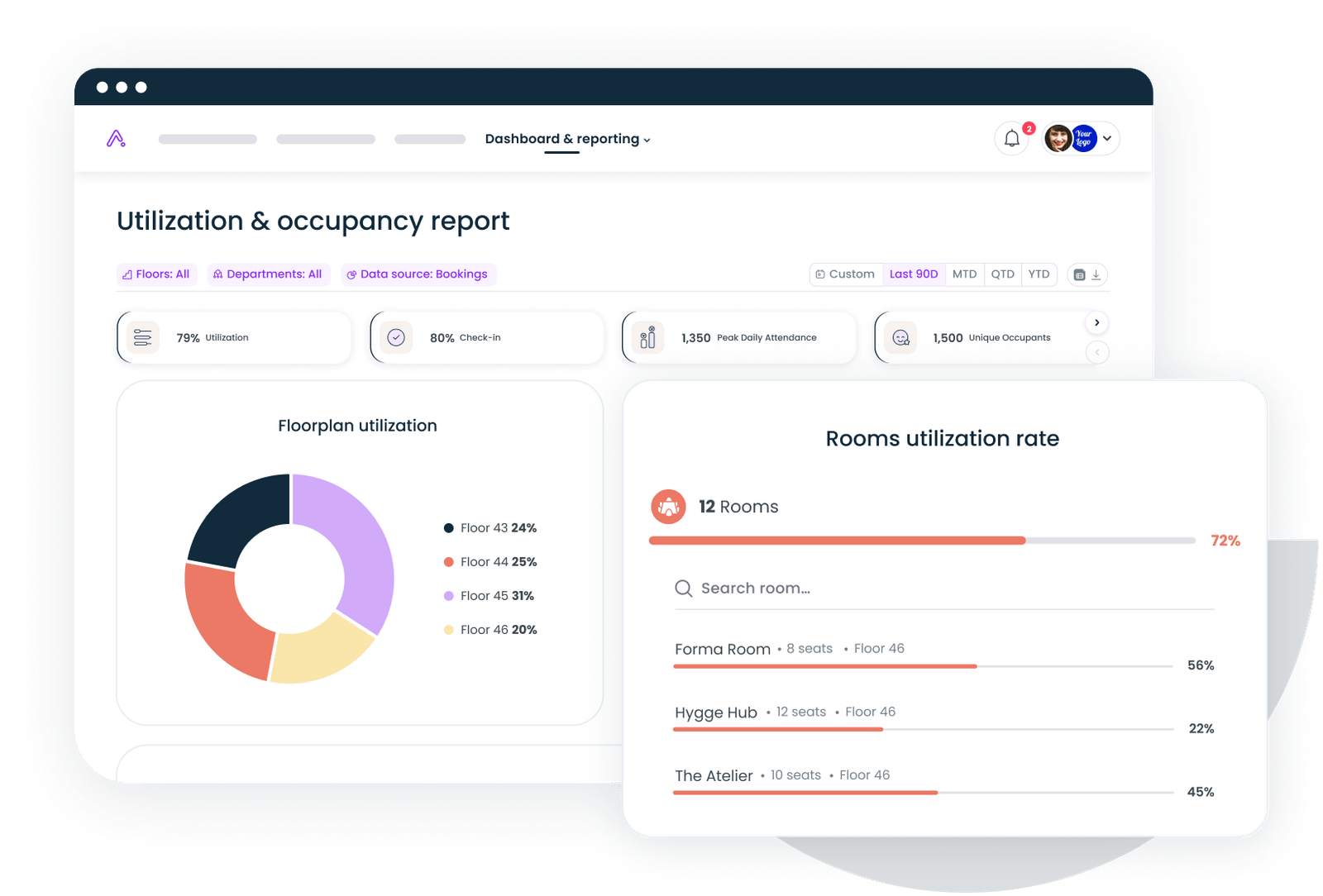
The workplace-CFO collaboration model: What to align on before signing
Most lease negotiations involve the workplace or real estate team driving the deal and Finance reviewing it late in the process. That's backwards under ASC 842. By the time Finance sees the term sheet, the accounting implications are already baked in.
Here's what to align on before you start negotiating:
Discount rate assumptions. Finance will use the incremental borrowing rate to calculate the lease liability. Ask what rate they're currently using. A higher rate produces a lower liability (because future payments are discounted more heavily), but you don't get to choose the rate; it's based on your company's actual borrowing conditions. Knowing the rate helps you model the balance sheet impact of different lease structures before you negotiate.
Acceptable liability ranges. Ask Finance directly: "What's the maximum new lease liability we can take on without triggering covenant issues or raising concerns with the board?" This gives you a concrete constraint to work within, not a vague sense that Finance wants "shorter leases."
Renewal likelihood. If you're negotiating a lease with renewal options, align with Finance on whether those renewals will be classified as "reasonably certain." This determination affects the liability from day one. If you and Finance disagree, the auditors will make the call, and you won't like being surprised.
TI allowance timing and treatment. Discuss whether TI allowances will be treated as lease incentives (reducing the ROU asset) or as reimbursements for lessee-owned improvements. The accounting treatment depends on who controls the improvements, and it can significantly change the balance sheet impact.
Modification and exit scenarios. Before signing, model what happens if you need to downsize in year three or sublease a floor. Finance can tell you the accounting consequences of each scenario, which helps you negotiate appropriate flexibility clauses. Our guide on reducing CRE costs covers several strategies for building this flexibility into your portfolio.
The best workplace-finance partnerships treat lease decisions as joint ventures. You bring the operational requirements, market knowledge, and space strategy. Finance brings the accounting constraints, ratio analysis, and covenant awareness. Neither perspective is complete without the other.
Lease accounting compliance is ongoing, not a one-time implementation exercise. Every lease modification, renewal decision, or space change triggers a reassessment. Building a regular cadence of workplace-finance check-ins (quarterly at minimum) keeps both teams aligned and prevents the kind of surprises that erode trust.
Common mistakes workplace leaders make with lease accounting
Ignoring the accounting impact until the deal is done. This is the most common and most expensive mistake. By the time you've negotiated terms and signed a letter of intent, Finance's ability to influence the accounting outcome is limited. Involve them at the term sheet stage, not the signature stage.
Assuming all leases are treated the same. A triple net lease and a gross lease with the same base rent can produce different accounting outcomes because of how variable payments (property taxes, insurance, maintenance) are treated. Variable payments based on usage or performance are generally excluded from the lease liability, while fixed payments are included.
Overlooking the "reasonably certain" standard for renewals. If you've told the landlord you plan to renew, made significant improvements to the space, or have no viable alternative location, your auditors may conclude you're reasonably certain to renew, even if you haven't formally exercised the option. This can add years to your lease term for accounting purposes.
Failing to track lease data systematically. ASC 842 requires detailed tracking of payment schedules, escalation terms, renewal options, TI allowances, and modification dates. If this data lives in scattered spreadsheets and filing cabinets, you're creating risk for Finance and audit. Centralized lease data, combined with workplace analytics on actual space usage, gives both teams a single source of truth.
Not modeling scenarios before committing. Before signing any lease with a term longer than three years, model at least three scenarios: full term with no changes, early termination at the midpoint, and renewal through the first option period. Understanding the accounting impact of each scenario helps you negotiate better terms and set realistic expectations with Finance.
Making lease accounting work for your workplace strategy
Lease accounting under ASC 842 and IFRS 16 isn't going away, and it isn't getting simpler. But it doesn't have to be an obstacle to good workplace decisions. The workplace leaders who navigate this well are the ones who understand enough about the accounting to have informed conversations with Finance, structure deals that work for both operations and the balance sheet, and bring data to the table instead of assumptions. The goal isn't to become your company's lease accountant. It's to stop being surprised by what Finance tells you after you've already committed to a space.
Get real-time occupancy and utilization data that helps workplace and finance teams align on space strategy.
Get a demo