


.svg)


.svg)
- Paper visitor logs cost more in admin hours than most teams realize
- AI cuts check-in time from five minutes to under thirty seconds
- Visitor data disconnected from occupancy data is a strategic dead end
- Unified workplace intelligence matters more than any single feature like facial recognition
- Point solutions for visitor management are already losing to integrated platforms
The visitor management system market hit roughly $1.9 billion in 2026, growing at a 13.5% compound annual growth rate toward a projected $6 billion by 2035. That's not a niche category anymore. AI visitor management has moved from a futuristic pitch deck slide to an operational requirement for workplace teams managing hybrid offices, fluctuating headcounts, and tightening real estate budgets. What changed isn't the technology alone; it's what workplace leaders now expect that technology to connect to.
The real cost of managing visitors without AI
A front desk coordinator at a 400-person company with three visitors per hour spends roughly 15 minutes per guest on manual data entry, host notification, badge creation, and NDA handling. That's 6 hours of a single person's day consumed by repetitive process. Multiply it across locations.
Roughly 60% of US businesses are still transitioning from paper logbooks to digital visitor management. The remaining share clings to clipboard sign-ins that produce zero usable data, create compliance gaps during audits, and make emergency evacuations a guessing game about who's in the building.
Legacy systems aren't slow in isolation. They're invisible to the rest of your workplace stack:
- A paper log can't tell your facilities team that visitor traffic on Floor 2 tripled last quarter.
- It can't reveal that 70% of external guests arrive between 10 AM and noon on Tuesdays.
- Without that signal, your space planning runs on gut feel instead of data.
The hybrid workplace made this worse. When employee attendance fluctuates between 30% and 80% depending on the day, visitor patterns become even harder to predict. Front desk teams staff for peaks they can't forecast, and empty reception areas on slow days become a line item nobody questions.
Five ways AI is reshaping visitor management right now
Real-time identity verification
Facial recognition and document scanning at check-in kiosks have compressed the average visitor arrival process from over five minutes to under thirty seconds. AI cross-references visitor data against internal records in real time, flagging mismatches before a badge prints. One pharmaceutical company reported eliminating 95% of manual data entry errors after deploying AI-powered identity verification at their three largest campuses.
Predictive visitor flow analytics
AI doesn't stop at recording who showed up. It forecasts who's coming. By analyzing historical patterns (conference schedules, recurring client visits, seasonal spikes), predictive models let facilities teams adjust staffing, parking allocation, and meeting room availability before the lobby gets crowded. When your system knows that the sales team's quarterly business reviews bring 40 external visitors every March, you stop scrambling.
Automated host workflows
Natural language processing now powers visitor invitations through Slack and Microsoft Teams. An employee types "invite Sarah Chen from Acme Corp for a meeting next Thursday at 2 PM," and the system handles pre-registration, sends the guest a QR code, reserves a meeting room, and notifies reception. No separate app. No form. No back-and-forth emails with the front desk.
Compliance and documentation intelligence
NDAs, safety waivers, export control acknowledgments: AI manages document routing based on visitor type, purpose of visit, and facility classification. A contractor visiting a data center gets a different sign-in flow than a candidate arriving for an interview. The system applies the right documents automatically, captures e-signatures, and stores everything in an audit-ready format.
Integration with occupancy and space data
This is the shift that matters most. AI visitor management systems now feed check-in data directly into workplace occupancy dashboards, treating visitor traffic as a signal alongside employee badge swipes and WiFi connections. That composite view is what turns visitor management from a security function into a planning tool.

Before selecting an AI-powered visitor system, you need a clear framework for comparing features, pricing, and integration depth across platforms.
Read the evaluation guide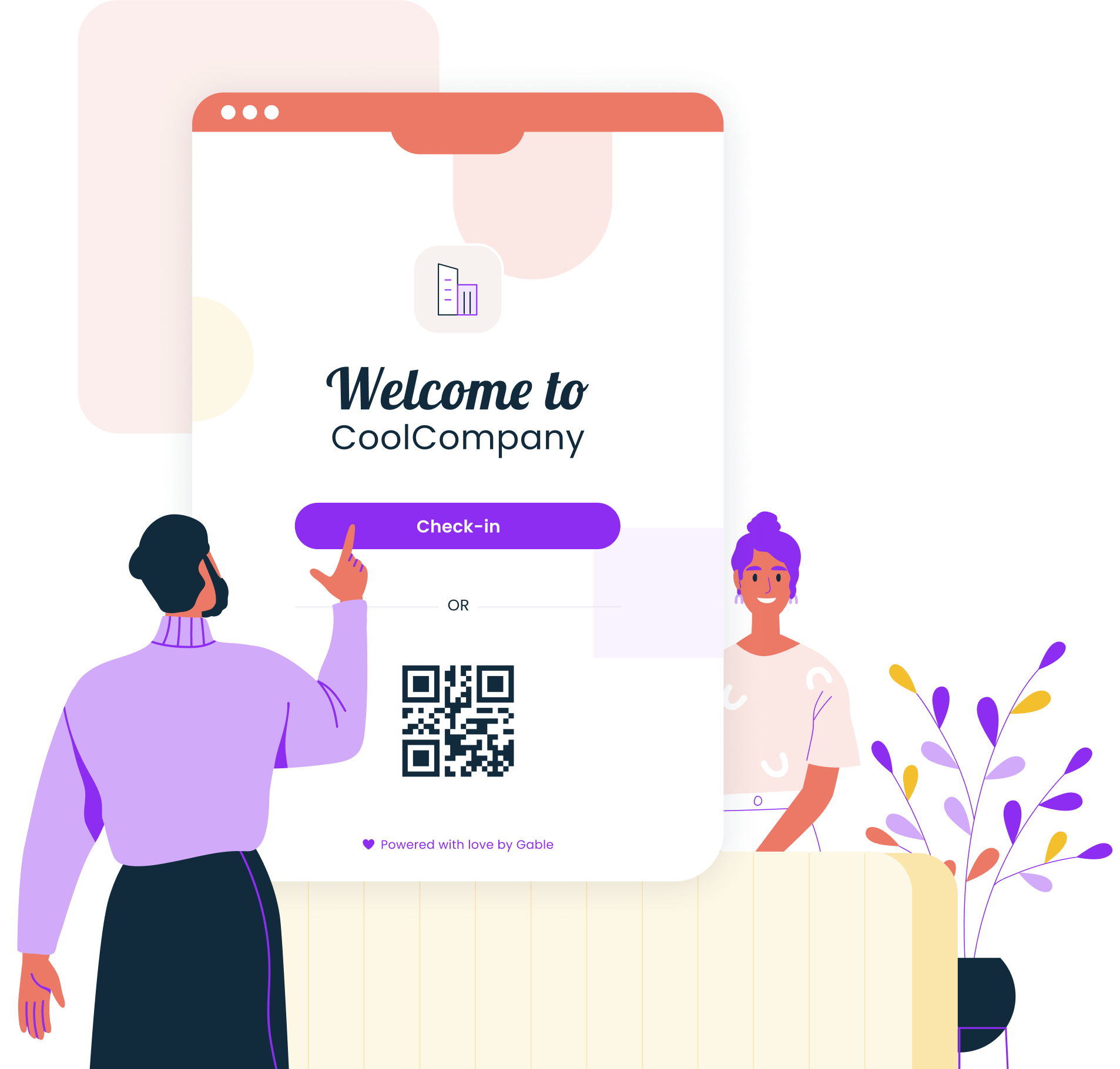
The business case workplace leaders care about
The vast majority of users report that visitor management software improves operational efficiency. That observation sounds impressive until you ask: efficiency at what? Signing people in faster is table stakes. The ROI that gets budget approval lives in three places.
Administrative time recovery
A workplace operations team managing 200 visitors per week across two offices typically dedicates 1.5 full-time equivalents to reception coordination. AI-powered pre-registration, touchless check-in, and automated host notifications can reduce that to 0.5 FTE. At a fully loaded cost of $65,000 per year per coordinator, that's $65,000 back in the budget. Not theoretical. Measurable in the first quarter.
Security risk reduction
Modern systems use AI to analyze visitor data in real time, cross-check it against background information, and flag potential risks based on patterns from previous visits. Watchlist screening happens at the kiosk, not after someone's already wandered past reception. Digital audit trails replace the liability of a missing sign-in sheet during an incident investigation.
Space planning intelligence
Here's where most standalone visitor management tools fall short. Visitor traffic data, when combined with employee attendance and space utilization metrics, reveals patterns that neither dataset shows alone. A law firm discovered that 60% of their conference room bookings on Wednesdays involved external clients, which meant their "collaboration day" policy was a client-facing day requiring different amenity planning.
What AI capabilities belong on your requirements list
Not every system calling itself "AI-powered" delivers the same depth. Here's what separates marketing language from operational value:
| Capability | Why it matters | What to test in a demo |
|---|---|---|
| Touchless check-in (QR, NFC, facial recognition) | Reduces lobby congestion and front desk dependency | Ask how the system handles a visitor whose QR code expired |
| Custom sign-in flows by visitor type | Ensures compliance without over-burdening low-risk guests | Create three different visitor types and compare their workflows |
| Real-time host notifications across Slack, Teams, email | Eliminates the "your guest is here" phone tag | Test notification latency; anything over 30 seconds is too slow |
| Badge printing with photo capture | Visible identification without manual assembly | Check if badges auto-expire and whether temporary access credentials sync |
| Bulk visitor invitations | Critical for events, all-hands, client days | Upload a CSV of 50 visitors and see what breaks |
| Analytics dashboards with trend data | Converts check-in logs into planning intelligence | Ask to see 90-day visitor trend reports by location, department, and time |
| Access control integration (Brivo, badge readers) | Temporary credentials without permanent badge provisioning | Verify that access auto-revokes at checkout |
| Multi-location governance | Consistent policies across offices with local flexibility | Configure different NDA requirements for two different sites |
The integration column matters more than most buyers realize. A visitor management system that can't talk to your access control, your office management platform, and your calendar tools creates another data silo. You already have enough of those.
How visitor management connects to your broader workplace strategy
Workplace teams operating at a high level in 2026 aren't thinking about visitor management as a standalone category. They're thinking about it as one data stream in a unified system that also captures desk bookings, room utilization, employee attendance patterns, and event participation.
Consider a 1,200-person company with offices in four cities. Their Tuesday visitor count in San Francisco averages 45 people. Their desk booking data shows 78% employee occupancy on the same day. Combined, that means the building is functionally at capacity, but the occupancy dashboard (if it only tracks employees) shows 22% availability. Without visitor data in the mix, that company might downsize their lease. Bad move.
This is why integration-first platforms are winning over point solutions. When visitor check-ins, desk reservations, meeting room bookings, and badge swipe data all live in one system, workplace leaders can answer questions that no single tool answers alone:
- How much space do we need?
- Which days require full front desk staffing?
- Should we convert Conference Room B into a focus area?
Visitor data also feeds employee experience decisions. If post-visit surveys reveal that guests consistently rate wayfinding as poor, that's a signal to invest in digital signage or interactive floor plans. If visitor no-show rates (compared to pre-registrations) run above 25%, your pre-registration workflow needs friction reduction.
Gable Offices combines visitor check-in, desk booking, room scheduling, and workplace analytics so your visitor data connects to your space strategy.
Learn more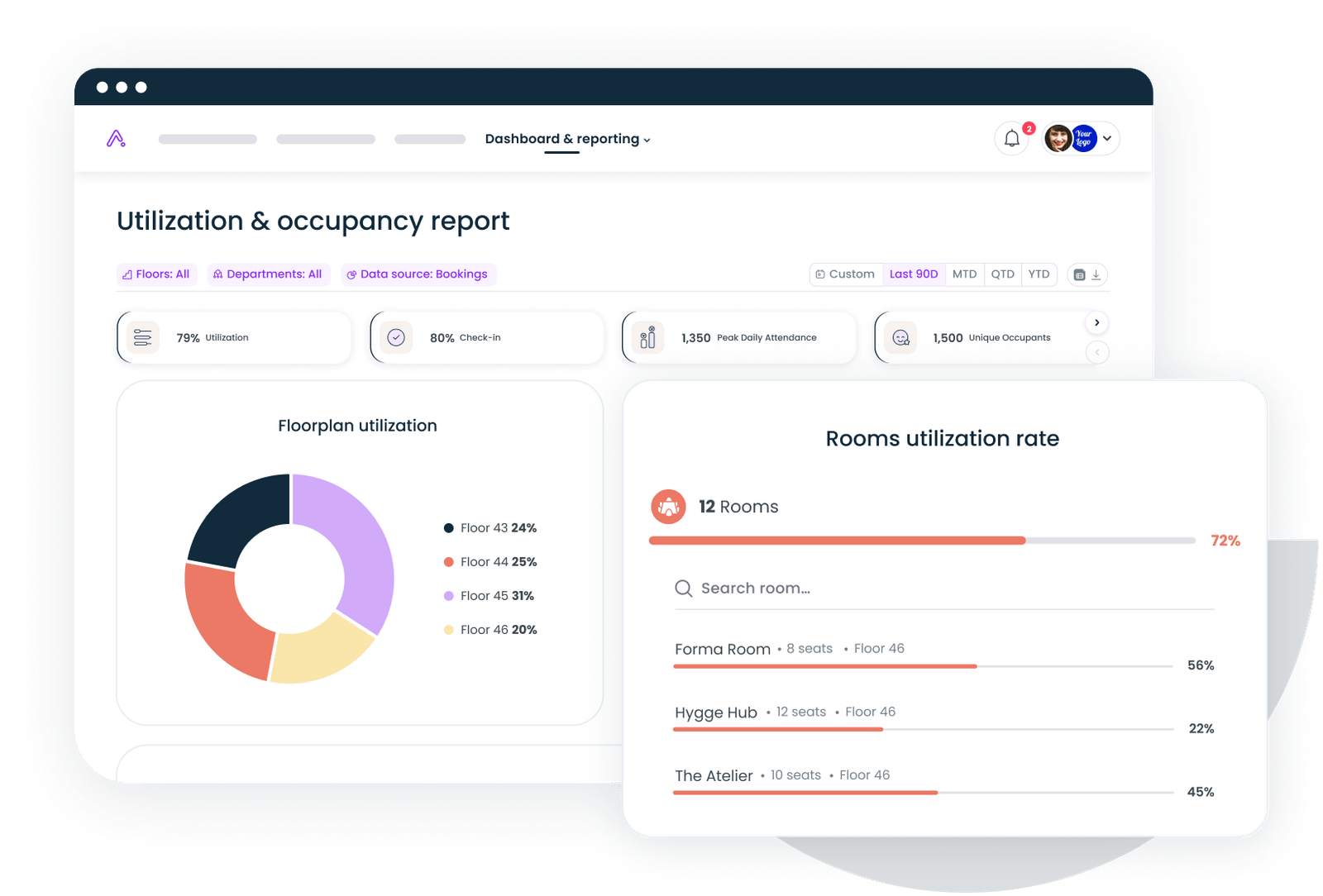
The implementation question: point solution or integrated platform?
Three years ago, most companies bought a visitor management system as a standalone product. It handled sign-ins well. It printed badges. It sent host notifications. Done.
That approach made sense when offices were full five days a week and "workplace strategy" meant choosing between open floor plans and cubicles. Hybrid changed the math. Now visitor management touches space planning, real estate optimization, employee scheduling, and event coordination. A tool that only manages the front desk can't participate in those conversations.
The migration path for most organizations looks like this:
- Phase 1: Replace paper logs with digital check-in (most companies completed this by 2024).
- Phase 2: Add AI-powered pre-registration, compliance automation, and host notifications.
- Phase 3: Integrate visitor data with desk booking, occupancy analytics, and access control for a unified view.
Companies stuck between Phase 1 and Phase 2 are paying for software that digitized their old process without improving it. The cost savings from AI don't materialize until visitor workflows connect to the systems employees and facilities teams use daily. Platforms like Gable that unify visitor check-in with desk booking and occupancy analytics close that gap by design, rather than through bolted-on integrations.
For multi-location organizations, centralized governance is non-negotiable. A visitor policy that works at your 50-person satellite office in Austin shouldn't require the same NDA workflow as your regulated R&D lab in Boston. AI handles this contextual routing automatically, applying location-specific rules without requiring a different admin configuration for each site.
What to ask vendors before you sign
Evaluation conversations for AI visitor management should go beyond feature checklists. Seven questions that separate serious platforms from dressed-up digital clipboards:
- Does the system handle walk-in visitors as smoothly as pre-registered ones, or does it break down without advance scheduling?
- How does visitor data flow into your workplace analytics dashboards? Is it a separate report or a unified view?
- Can employees invite visitors directly from Slack or Teams without opening a separate application?
- What happens to temporary access credentials when a visitor checks out early, stays late, or never shows up?
- How does the system handle a fire drill? Can you generate a real-time headcount of every person on site, employees and visitors combined, in under 60 seconds?
- What does the 90-day visitor trend report look like, and can you slice it by department, location, visitor type, and time of day?
- Is pricing per location, per visitor, or per employee, and what happens to your cost when visitor volume doubles during conference season?
That last question catches more teams off guard than any other. Per-visitor pricing sounds reasonable at 200 visitors a month. At 800 during your annual customer summit, the invoice looks noticeably different.
The trajectory is integration, not isolation
AI visitor management in 2026 is about whether your workplace data tells a complete story or a fragmented one. The organizations connecting every check-in, desk booking, room reservation, and badge swipe into a shared data layer are making sharper space decisions and recovering more administrative time than those treating visitor management as an isolated function.
The technology exists to answer the core question (are we using our space and our people's time well?) with precision. Industry data shows that AI-driven facility platforms that ingest occupancy and visitor signals can produce double-digit reductions in energy spend by adjusting HVAC and lighting against actual building load. That's the scale of impact available when visitor management feeds into workplace intelligence rather than sitting on its own.
The gap between where most organizations are and where they could be is an integration gap. Closing it starts with recognizing that the person signing in at your lobby kiosk generates data as valuable as the employee booking a desk on Floor 4.
Gable connects visitor check-in with desk booking, space analytics, and access control in one platform. See how it works for your offices.
Get a demo


