.svg)


.svg)
- Gable wins for hybrid teams needing visitor data connected to desk booking and analytics.
- Envoy Visitors leads G2 for five consecutive years (4.7/5).
- SwipedOn offers the best small-business value from $52.50/month per location.
- iLobby and Eptura Visitor are the strongest picks for regulated industries.
- This guide compares 7 platforms with pricing, features, and a selection framework.
Visitor management software has moved beyond digital sign-in sheets. For workplace, facilities, and real estate leaders at mid-sized companies, choosing the right platform in 2026 means evaluating security capabilities, integration depth, pricing models, and how visitor data connects to your broader workplace strategy.
The visitor management market reached $1.9 billion in 2026 and is projected to grow to $6 billion by 2035, driven by 13.5% compound annual growth.
The best visitor management software for 2026 at a glance
- Gable: best for hybrid teams needing unified workplace data. Visitor Management from $99/month per location.
- Envoy Visitors: best for high-traffic standalone lobbies. From $109/month per location.
- iLobby (FacilityOS): best for regulated industries and enterprise compliance. From $199/month per location.
- Eptura Visitor: best for enterprise watchlist screening. Custom pricing.
- SwipedOn: best low-cost standalone option. From $52.50/month per location.
- Robin: best if you already use Robin for desk and room booking. Custom pricing.
- Kadence: best if you already use Kadence for hybrid scheduling. Custom pricing.
Visitor management software comparison table
1. Gable: Best for hybrid teams who need unified workplace data
Gable is the only platform on this list that combines visitor management with desk booking, meeting room scheduling, parking, and workplace analytics in one product. Gable Visitor Management can be purchased standalone at $99 per location per month (priced competitively against Envoy at $109), or bundled into Gable's broader office management software at $2.50 per seat for teams that also want desk and room booking.
Visitor data flows into the same dashboard as desk and room bookings, so workplace leaders can see how visitor patterns correlate with overall occupancy and team gathering frequency. Customers using Gable have seen a 32% reduction in unused space by connecting visitor data with the rest of their workplace data.
Key features
- Guest check-in with host notifications via Slack, Microsoft Teams, or email
- Visitor data connected to space utilization analytics in a single dashboard
- Pre-registration, NDA collection, and badge printing
- Access control integrations for badge-based building entry
- Standalone Visitor Management or bundled with desk booking, meeting rooms, parking, and on-demand coworking
Pros
- Standalone Visitor Management at $99 per location undercuts Envoy by $10/month and beats iLobby by $100
- Bundled All-in-one option replaces two or three standalone tools (visitor, desks, rooms, analytics)
- Visitor data informs space planning instead of sitting in its own silo
Cons
- Less depth on enterprise-only features like deep watchlist screening or complex multi-tenant lobby configurations versus dedicated tools
Pricing: Visitor Management at $99 per location per month. Office Management (desk and room booking) at $2.50 per user per month. All-in-one bundle priced custom annually. G2 rating: 4.5/5 across 119 reviews.
2. Envoy Visitors: Best for high-traffic standalone lobbies
Envoy Visitors is the standalone market leader, holding the G2 Leader position with a 4.7/5 rating. Strengths are fast check-in flows, mailroom management, and the broadest third-party integration library in the category.
Key features
- iPad-based self check-in with host notifications
- Free Basic tier (100 entries/month, host notifications)
- Calendar and access control integrations
- Visitor photos, custom branding, SSO on Premium tier
- ID scanning, blocklist, advanced access control on Enterprise
Pros
- Most established VMS on the market with a five-year G2 Leader streak
- Free Basic tier removes the procurement hurdle for evaluation
- Broadest third-party integration library in the category
Cons
- iPad-only kiosks; no Android support
- Watchlist screening, advanced analytics, and SSO sit behind premium tiers
- $10/month per location more than Gable Visitor Management with no broader workplace data layer
Pricing: Free Basic tier (100 monthly entries). Standard and Premium at $109/month per location (billed annually). Enterprise custom. G2 rating: 4.7/5.
3. iLobby (FacilityOS): Best for regulated industries
iLobby earns a 4.7/5 on G2 across roughly 240 reviews. What sets iLobby apart is its modular architecture: you can add separate modules for emergency management, contractor compliance, logistics, and access control on top of the core VisitorOS product. This makes it the go-to choice for regulated industries like government, manufacturing, defense, and healthcare.
Key features
- VisitorOS with iPad hardware (MDM-enrolled) bundled into the subscription
- Touchless sign-in and pre-registration on Enhanced tier
- EmergencyOS module: SMS notifications, digital mustering, hazard alerts
- ContractorOS, LogisticsOS, and SecurityOS as separately priced modules
- Multi-tenant support on Enterprise
Pros
- Hardware (iPad, MDM-enrolled) included in the subscription
- Modular architecture lets enterprises add only the capabilities they need
- Strongest compliance and emergency-response capabilities in the category
Cons
- Priced and built for enterprise; overkill for a 200-person single-office company
- Fully loaded multi-module deployment adds up quickly
- Annual billing only; no monthly option
Pricing: VisitorOS Corporate from $199/month per location, Enhanced from $275/month, Enterprise custom. Modules: EmergencyOS from $249/month; ContractorOS $199 to $499/month; LogisticsOS from $369/month. G2 rating: 4.7/5.
4. Eptura Visitor: Best for enterprise watchlist screening
Eptura Visitor (formerly Proxyclick, acquired by Condeco in 2021, which later became Eptura, and rebranded as Eptura Visitor in 2025) holds a 4.6/5 on G2. Its strengths are enterprise-grade watchlist screening against global denied-party databases, deep access control integration, and compliance audit trails that satisfy financial services and government requirements.
Key features
- Watchlist screening against global denied-party databases
- Deep access control integration (Brivo, OpenPath, CCure, HID)
- Compliance audit trails for GDPR, HIPAA, SOX
- NDA collection and pre-arrival document workflows
- Multi-location enterprise deployment
Pros
- Strongest compliance and watchlist screening of the standalone tools
- Connects to the broader Eptura workplace platform for organizations already in that ecosystem
Cons
- Pricing no longer published publicly; quote-based only (was $100/month per location before the rebrand)
- Setup and integration can be complex, per G2 reviews
- Overkill if you don't need watchlist screening or audit-grade compliance
Pricing: Custom; contact sales. Industry intelligence suggests average annual contracts around $12,000, with enterprise deals reaching $35,000. G2 rating: 4.6/5.
5. SwipedOn: Best low-cost standalone option
SwipedOn leads on user satisfaction with a 4.8/5 G2 rating and the most accessible pricing in the standalone category. It's designed for offices that want a professional digital guest management experience without enterprise complexity. In 2025, SwipedOn merged with Sign In App to create a combined platform serving over 30,000 workplaces globally.
Key features
- Self check-in with host notifications
- Employee sign-in and basic desk booking
- Pre-visit registration and ID scanning on Enhanced tier
- Badge printing available on higher tiers
- Emergency evacuation mode
- SSO and SCIM on Pro tier
Pros
- Lowest-cost option that's still a serious standalone platform
- Highest G2 user-satisfaction score in the category (4.8/5)
- Free trial available; setup typically within a week
Cons
- No watchlist screening or deep access control integration
- No connection to broader workplace data (desks, rooms, analytics)
- Less suited for highly regulated environments
Pricing: Core $630/year per site (around $52.50/month). Enhanced $1,260/year (around $105/month, marked Popular). Pro $1,890/year (around $157.50/month). Resource Booking add-on at $3/month per resource. G2 rating: 4.8/5.
6. Robin: Best if you already use Robin
Robin (4.5/5 on G2, 210 reviews) started as room-booking software and added visitor management as a secondary feature. Strengths are desk and room booking, interactive floor plans, and AI-powered scheduling. VMS capabilities include branded invites, pre-arrival data collection, and NDA flows.
Key features
- Branded visitor invites with pre-arrival data collection
- NDA compliance flows
- Connects to Robin's desk and room booking workflows
Pros
- Logical add-on if Robin is already your desk and room booking platform
- Pre-arrival data collection reduces front-desk friction
Cons
- Missing some standalone VMS features like visitor Wi-Fi sharing and evacuation workflows
- VMS feels like a secondary feature versus Robin's room and desk booking core
Pricing: Custom; targets organizations with 500+ employees. Per-desk pricing estimated at $45 to $61 based on industry intelligence. G2 rating: 4.5/5.
7. Kadence: Best if you already use Kadence for hybrid scheduling
Kadence entered the VMS space in 2024 with an AI-driven visitor management module built on top of its hybrid scheduling platform. Worth watching if Kadence is already your team-coordination tool, but the VMS product is newer and less battle-tested than standalone alternatives.
Key features
- AI-driven visitor flow built into hybrid scheduling
- Connects to Kadence's team-coordination view
Pros
- Coherent stack if Kadence is already your team-coordination platform
Cons
- Newest VMS in this comparison; less battle-tested than alternatives
- Custom pricing trends expensive for smaller organizations
Pricing: Custom, based on organization size. G2 rating: 4.5/5.

Before you shortlist products, make sure you know which features actually matter for your organization. Our features breakdown walks through every capability and how to prioritize them.
Read the guide
Visitor management software pricing in 2026
Here's what the market looks like, broken down by product and tier.
Product-specific pricing
Gable sells Visitor Management standalone at $99/month per location, priced $10 below Envoy's standalone tier and $100 below iLobby. If you also want desk booking and meeting room scheduling, Gable Office Management is $2.50 per user per month. The All-in-one bundle (Visitor + Office + Events + On-Demand) is custom annual pricing.
Envoy offers a Free Basic tier (100 entries/month) plus paid tiers starting at $109/month per location, billed annually. Badge printing, analytics, and compliance features sit on Premium or Enterprise. G2 reviewers consistently note that essential features often sit behind upgrades.
iLobby (FacilityOS) starts at $199/month per location for VisitorOS Corporate, $275/month for Enhanced (the most popular tier), and custom pricing for Enterprise. Additional modules (EmergencyOS, ContractorOS, LogisticsOS, SecurityOS) cost $199 to $499/month each. All pricing is annual; no monthly billing option. This modular approach means you pay only for what you need, but a fully loaded enterprise deployment adds up quickly.
Eptura Visitor (formerly Proxyclick) no longer publishes pricing publicly; the product is sold via custom quotes after the rebrand. Industry data suggests average annual contracts around $12,000, with enterprise deals reaching $35,000.
SwipedOn offers transparent annual pricing: Core at $630 per site/year (around $52.50/month), Enhanced at $1,260/year (around $105/month, marked Popular), and Pro at $1,890/year (around $157.50/month). A free trial is available with no credit card required. Add-ons for Resource Booking ($3/month per resource) and delivery management are priced separately.
Robin and Kadence don't publish pricing publicly. Robin targets organizations with 500+ employees, and industry intelligence suggests per-desk pricing between $45 and $61, with discounts of 40 to 50% on larger contracts.
Hardware costs
Software pricing tells only part of the story. Most VMS deployments require front desk hardware:
- Tablets or kiosks: $200 to $900 per unit. iPads are the standard for most platforms (Envoy is iPad-only), though FacilityOS and SwipedOn support Android. Some vendors offer purpose-built kiosks with built-in cameras.
- Badge printers: $120 to $600 per unit. Higher-end models support photo badges with barcodes for access control integration.
- Mounting and accessories: $50 to $200 per station.
Total first-year cost estimates
Based on industry benchmarking data, here's what to budget:
- Small office (1 location, under 200 employees): $1,500 to $4,000 for the first year on a platform like Gable Visitor Management, SwipedOn Core, or Envoy Standard, plus one tablet and badge printer.
- Mid-sized organization (3 to 5 locations): $8,000 to $20,000 on a Professional-tier plan with hardware at each site.
- Enterprise (10+ locations): $20,000 to $60,000+ on an enterprise plan from iLobby, Eptura Visitor, or Envoy, with dedicated support, SSO, and multi-site management.
The ROI math works in your favor. Organizations that move from manual to digital visitor management typically see a 40 to 50% reduction in front-desk administrative workload. Companies using Gable's integrated approach have seen a 32% reduction in unused space by connecting visitor patterns to broader space utilization data, further offsetting the software investment.
How to evaluate visitor management tools for your organization
With hundreds of options on the market (Capterra tracks 494 products with nearly 1,000 reviews filed in the past year), narrowing the field requires a structured approach.
Build a weighted scorecard
Rather than comparing feature lists side by side, assign weights to the categories that matter most for your organization. A financial services firm will weight security and compliance far more heavily than a creative agency. Here's a starting framework:
- Security and compliance (30%): Watchlist screening, access control integration, audit logs, NDA collection, GDPR/HIPAA support. Eptura Visitor and iLobby are strongest here.
- Ease of use (25%): Self check-in experience, admin interface simplicity, mobile app quality, setup time. SwipedOn consistently scores highest on ease of implementation.
- Integrations (20%): Calendar systems, Slack/Teams notifications, access control hardware, HR platforms, workplace management software. Envoy has the broadest third-party integration library.
- Analytics and data (15%): Visit volume reporting, occupancy insights, peak time analysis, exportable data. Gable is strongest here because visitor data connects directly to space utilization analytics.
- Cost and support (10%): Pricing transparency, contract flexibility, onboarding quality, ongoing support responsiveness.
What buyers say on G2 and Capterra
Across thousands of verified reviews, three themes consistently rise to the top:
- Ease of setup matters more than feature count. Buyers want deployment in days, not months. SwipedOn and Envoy win here. iLobby and Eptura Visitor require longer implementation cycles, especially for regulated environments.
- Integration quality makes or breaks the experience. Calendar and access control integrations are the most-requested capabilities after basic check-in. 87% of buyers rank self check-in as their top priority, but integrations determine long-term satisfaction.
- Hidden costs from tiered feature lockout are the most common complaint. Buyers frequently report that a capability that looked included during the sales process turns out to require an upgrade. Ask vendors to demo every feature you need on the exact tier you plan to purchase.
Run real-world trials
Don't evaluate visitor management software in a vacuum. During your trial period, run these scenarios:
- The contractor who arrives without pre-registration. How smoothly does the ad-hoc check-in flow handle this?
- The VIP guest with specific access requirements. Can the system restrict floor access and notify multiple hosts simultaneously?
- The fire drill scenario. Can you pull a real-time list of every non-employee in the building within 30 seconds?
- The compliance audit. Export 90 days of visitor logs and check whether they include timestamps, host names, NDA acknowledgments, and photo IDs.
Standalone VMS vs. integrated platform: which do you need?
If your only goal is digitizing the front desk, a standalone tool like Gable Visitor Management ($99/mo per location), Envoy, or SwipedOn will do the job well. If you're also managing desk booking, meeting rooms, hybrid schedules, or on-demand coworking, an integrated platform like Gable's All-in-one bundle eliminates the data silo problem. Visitor data flows into the same dashboard as your other workplace data, so you're making space planning decisions with the full picture rather than stitching together insights from five different tools.
Gable Visitor Management connects guest check-in with desk booking, meeting rooms, and space utilization data in a single dashboard built for hybrid teams.
Learn more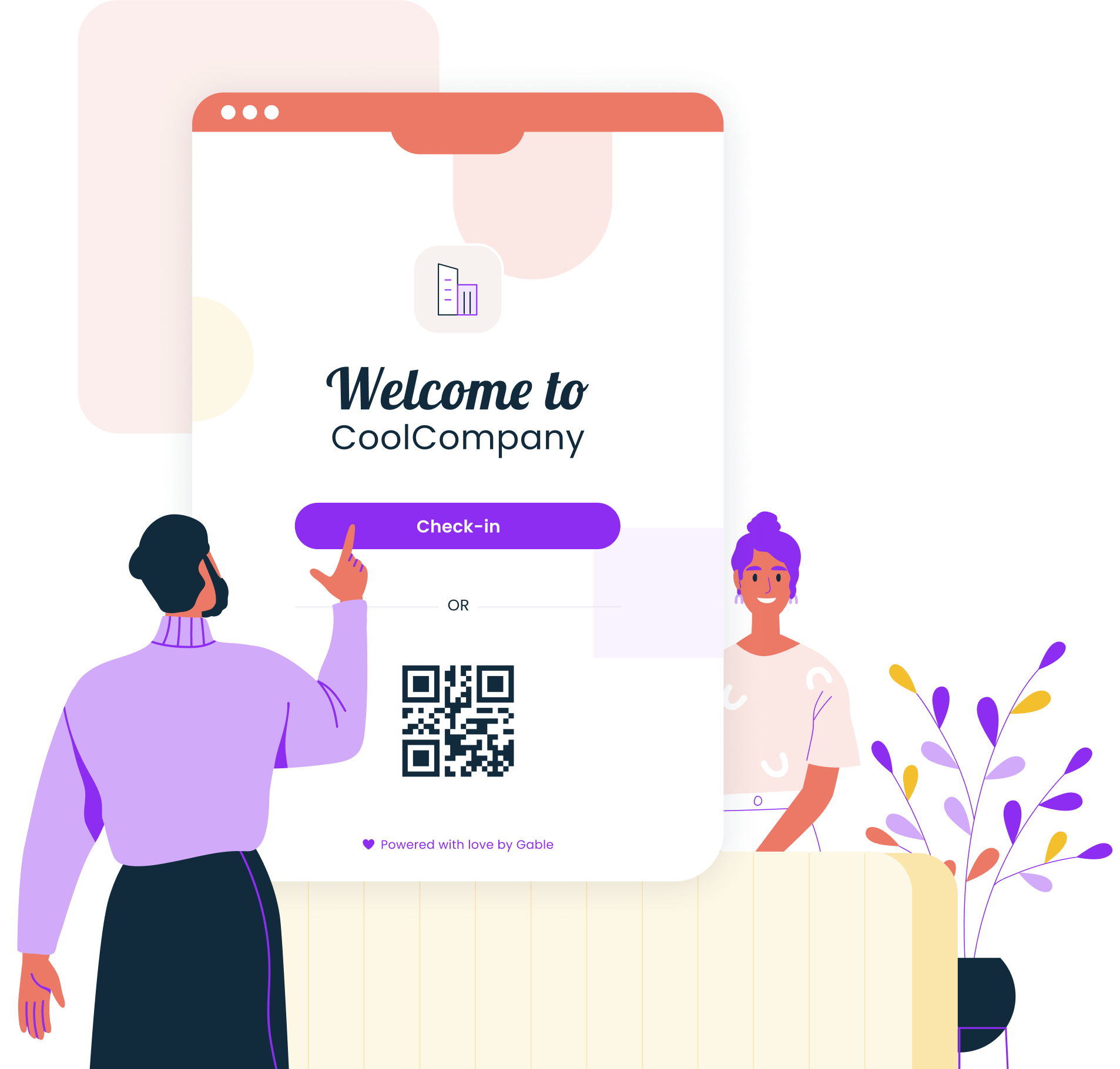
Implementing visitor management: best practices for a smooth rollout
Even the best software fails if the rollout is clunky. A phased approach consistently outperforms a big-bang launch, especially for multi-site organizations.
Phase 1: Pilot at one location (weeks 1 to 3)
Pick your highest-traffic office or the location with the most engaged facilities team. Install hardware, configure the software, and run the system alongside your existing process (paper logs, manual badges, or whatever you're replacing). This dual-run period surfaces edge cases without creating risk.
Key tasks: configure check-in flows for your most common visitor types (guests, contractors, delivery), set up host notifications, create your workplace visitor policy templates (NDAs, safety briefings, health screenings), and train reception staff.
Phase 2: Refine and document (weeks 3 to 4)
Collect feedback from front-desk staff, hosts, and visitors. Common adjustments include simplifying the check-in form (fewer fields means faster check-in), adding or removing notification channels, and tweaking badge designs. Document your configuration decisions so you can replicate them across sites.
This is also when you should configure your analytics dashboard. Set up the reports you'll actually review: weekly visit volume, peak check-in times, contractor vs. guest ratios, and no-show rates.
Phase 3: Multi-site expansion (weeks 5 to 8)
Roll out to remaining locations using the configuration playbook from Phase 2. Each site may need minor adjustments (different visitor types, different access zones, different compliance requirements), but the core setup should be replicable.
Phase 4: Optimize and integrate (ongoing)
Once the system is stable across all sites, focus on integrations. Connect your visitor management platform to your calendar system so pre-registration happens automatically when someone books a meeting with an external participant. Link it to your access control system so visitor badges grant the right level of building access without manual intervention. Connect it to your workplace analytics platform so visitor patterns become part of your overall occupancy data. Many teams also pair their visitor management system with the best guest WiFi software so guests get network access provisioned automatically at check-in.
The organizations that get the most value from visitor management software are the ones that treat it as an ongoing system, not a one-time deployment. Review your visitor data monthly, adjust policies quarterly, and use the insights to inform broader workplace strategy decisions.
How visitor management connects to workplace security and real estate strategy
Visitor management is often categorized as a facilities tool, but its strategic value extends into two areas that workplace leaders increasingly own: security posture and real estate optimization.
The security layer
The average data breach now costs $4.88 million globally and $9.36 million in the United States. While not every breach involves a physical visitor, unauthorized building access remains one of the most overlooked attack vectors. A proper visitor management system creates a documented chain of custody for every person who enters your space: who they are, why they're there, who they're meeting, what they signed, and when they left.
This is where enterprise-grade tools like iLobby and Eptura Visitor earn their premium pricing. Their watchlist screening and access control integrations ensure that a contractor badge only opens the doors it's supposed to, that expired visitor credentials are automatically deactivated, and that your security team has a real-time headcount during emergencies.
Compliance is the other side of this coin. GDPR enforcement generated over EUR 1.2 billion in fines in 2024 alone, and regulators increasingly scrutinize physical access records alongside digital ones. For organizations subject to HIPAA, SOX, or industry-specific regulations, the ability to produce auditable visitor logs on demand isn't optional. It's a requirement that manual processes can't meet at scale.
Building a comprehensive office security strategy means treating visitor management as a core component, not an afterthought.
The real estate optimization layer
When you know who's visiting, when, and where they're meeting, you can connect that data to broader space utilization patterns. 87% of organizations now operate with some form of hybrid program, which means visitor flow is increasingly unpredictable and harder to plan for without data.
Consider what happens when you combine visitor check-in data with desk and room booking analytics. You start to see that 72% of your visitor-related bookings are for team gatherings (a pattern Gable sees consistently across its customer base). You discover that Tuesday and Wednesday have 3x the visitor volume of Friday, which means your Friday lobby staffing can be reduced. You identify that your satellite office in Denver gets more contractor visits than guest visits, which changes how you configure that location's check-in flow.
Office utilization currently sits at 54% across the industry, up from 50% in 2024, and 73% of CRE leaders cite portfolio optimization as their primary goal. Visitor data is one of the inputs that makes that optimization possible, but only if it's connected to your other workplace data sources rather than isolated in a standalone system.
Bottom line: which visitor management software should you choose?
Choose Gable if you want visitor management connected to desk booking, room scheduling, parking, and analytics in one platform, eliminating the data silo problem at the front desk.
Choose Envoy Visitors if you want the most established standalone VMS with the broadest integration library and you're committed to iPad-based kiosks.
Choose iLobby (FacilityOS) if you're in a regulated industry (finance, government, healthcare, manufacturing) and need enterprise-grade compliance, emergency, and contractor modules.
Choose Eptura Visitor if you need enterprise watchlist screening and audit-grade compliance trails.
Choose SwipedOn if you have a small office, a single location, and want the lowest-cost option that's still a serious platform.
Choose Robin or Kadence if you already use them for room or desk booking, want a coherent stack, and don't need standalone VMS feature depth.
For most mid-market hybrid workplaces (200 to 1,000 employees, mixed compliance needs, visitor data as a real estate planning input), Gable is the strongest balance of features, integrations, and total cost. See the full benefits of a modern visitor management system for a deeper look at the ROI case.
See how Gable brings visitor management, desk booking, and space analytics into one platform built for hybrid teams.
Get a demo