.svg)


.svg)
- Core hours define when people overlap, not where they work
- A 4-hour daily window (like 10 AM-2 PM) is the most common pattern
- Distributed teams need regional overlap windows, not one global block
- Async norms outside core hours matter as much as the hours themselves
- Review your core hours quarterly; what works in Q1 rarely survives Q3
Most hybrid teams have figured out which days people come to the office. Fewer have nailed down when during those days everyone's actually available at the same time. That's what core hours solve: a defined overlap window where synchronous work happens, with flexible time on either side for deep focus, personal commitments, or async collaboration. Get core hours right and you reduce meeting chaos, protect focus time, and give people genuine flexibility. Get them wrong and you end up with a policy that looks good on paper but produces 7 AM calls for your West Coast team.
What core hours actually mean for hybrid work
Core hours are the daily window when every team member is expected to be reachable and available for synchronous work. Think of them as the "guaranteed overlap" in an otherwise flexible schedule. Outside that window, people manage their own time.
This is different from core days, which define when people show up to the office (Tuesday through Thursday, for example). Core hours operate on a separate axis. You can have both: core days that determine where you work, and core hours that determine when you're online. Many hybrid work schedule models combine the two, but they solve different problems.
The concept isn't new. Flex-time policies in the 1990s used a version of this. What's changed is scale. When half your team is remote on any given day and the other half is spread across three time zones, "just be available during business hours" doesn't mean anything. You need a specific, documented window.
Over 65% of workers prefer taking advantage of flexible options their companies offer. Core hours are the mechanism that makes flexibility structured enough to actually work. Without them, flexibility devolves into chaos: people schedule meetings whenever they want, nobody knows when anyone's available, and Slack messages pile up with no clear expectation of when they'll get a response.
Core hours for hybrid teams vs. distributed teams
These two models look similar on the surface but operate differently in practice. Confusing them is one of the most common mistakes I see.
Hybrid teams typically share a headquarters or regional office. Most people are within one or two time zones. The core hours window can be generous (four to six hours) because the time zone spread is narrow. The challenge isn't finding overlap; it's making sure remote days don't become meeting-free dead zones where nothing synchronous happens.
Distributed teams span multiple regions, sometimes 10+ time zones. The overlap window shrinks dramatically. For a team with members in San Francisco, London, and Singapore, the natural overlap is roughly zero. These teams need regional core hours (Americas overlap, EMEA overlap) or a rotating global sync window. The default mode is async, with core hours reserved for the small number of conversations that genuinely require real-time interaction.
Here's a practical comparison:
If you're managing a distributed workforce, your core hours strategy will look fundamentally different from a team that's mostly in New York with a few remote workers in Chicago. Don't copy a hybrid playbook for a distributed team, or vice versa.
The most common core hours patterns
Three patterns cover the vast majority of what's working in 2026. Most teams use one or a combination.
Pattern 1: The 4-hour overlap window
This is the workhorse. Set a daily block, typically 10 AM to 2 PM in the team's primary time zone, where everyone is online and available. Meetings, standups, collaborative work sessions, and real-time decisions happen here. Everything outside the window is flexible.
The 10-to-2 window is popular for a reason: it avoids early mornings and late afternoons, accommodates school drop-offs and pickups, and leaves enough room for deep work on either side. Teams with published availability norms had 40% fewer scheduling conflicts than teams relying on informal knowledge. A clear 4-hour block is the simplest version of that norm.
This pattern works best for single-region teams or teams within a 3-hour time zone spread.
Pattern 2: Asymmetric overlap with async bookends
For teams spanning 6+ time zones, a single overlap window forces someone into unreasonable hours. The fix: create two shorter overlap windows (90 minutes to 2 hours each) that cover different regional pairings, with async communication filling the gaps.
Example for a team across US Pacific, UK, and India:
- Window A (US + UK): 8:00-10:00 AM PT / 4:00-6:00 PM GMT
- Window B (UK + India): 8:00-10:00 AM GMT / 1:30-3:30 PM IST
The US and India teams rarely meet synchronously. Instead, they use recorded video updates, shared documents with comment threads, and a 48-hour async response norm. This is where having a clear global workplace policy becomes essential; you can't leave regional norms to chance.
Fairness matters here. If one group always gets the inconvenient time slot, resentment builds. Rotate the uncomfortable windows monthly or quarterly.
Pattern 3: No-meeting focus blocks
This isn't a replacement for core hours; it's a complement. Designate one or two days per week (Wednesday and Friday are common) where no internal meetings are scheduled during core hours. The overlap window still exists for urgent Slack messages or quick calls, but the calendar stays clear.
Atlassian's meeting-free experiments showed a 25% increase in focused work and a measurable drop in after-hours work. The logic is straightforward: if your 4-hour core window fills with back-to-back meetings five days a week, you've created a collaboration bottleneck, not a collaboration enabler. No-meeting blocks release the pressure valve.

Core hours are one piece of the puzzle. Our hybrid work schedule guide covers seven proven models and how to choose between them.
Read the guide
How to set core hours across time zones: A step-by-step framework
Setting core hours sounds simple until you try to do it for a team in four countries. Here's the process that works.
Step 1: Map your team's geography.
List every time zone where you have team members. Convert everything to UTC so you're working from a common reference point. A team that says "we're mostly US-based" often discovers they have people in Hawaii (UTC-10), Puerto Rico (UTC-4), and a contractor in Portugal (UTC+0). That's a 10-hour spread, not a 3-hour one.
Step 2: Find the natural overlap.
Plot each person's reasonable working hours (no earlier than 7 AM, no later than 8 PM local time) on a shared timeline. The intersection is your maximum possible core hours window. For some teams, it's four hours. For others, it's 45 minutes. Both are valid starting points.
Step 3: Determine how much overlap you actually need.
This depends on work type, not team size. Highly collaborative teams (product development, client services) need 3-4 hours of daily overlap. Independent contributors (engineering, writing, design) can function with 1-2 hours. Teams that adopted async communication saw a 32% reduction in meeting time, which means less overlap is needed when async norms are strong.
Don't default to "more is better." Every hour of core time is an hour someone can't use flexibly.
Step 4: Define async norms for everything outside the window.
Core hours only work if people trust that non-core time is genuinely flexible. That means explicit rules: response time expectations (e.g., 24 hours for non-urgent Slack messages), which tools to use for which communication types (Slack for quick questions, shared docs for decisions that need input from multiple time zones), and a clear escalation path for genuine emergencies.
Without async norms, core hours become a floor, not a ceiling. People still expect instant responses at 9 PM, and the policy loses credibility.
Step 5: Document, communicate, and model from the top.
Write it down. Put it in your hybrid work policy. Share it during onboarding. And critically, make sure leadership follows it. If the CEO schedules a 7 AM meeting "just this once," the policy is dead. Consistency from the top is the single biggest predictor of whether core hours stick.
Core hours policy templates you can adapt
Here are three templates covering the most common scenarios. Adapt the language to your company's tone, but keep the structural elements.
Template 1: Single-region hybrid team
> Core Hours Policy
All team members are expected to be available for synchronous communication between 10:00 AM and 2:00 PM ET, Monday through Friday. This applies whether you're working from the office or remotely.
During core hours, you should be reachable via Slack and available for scheduled meetings. Outside core hours, work your preferred schedule. Async communication norms apply: non-urgent messages should receive a response within 24 hours.
No-meeting days: Wednesdays are meeting-free. Core hours still apply for availability, but no internal meetings should be scheduled.
Exceptions: Recurring schedule conflicts (caregiving, medical, religious observance) should be documented with your manager. Approved exceptions are not penalized.
Template 2: Multi-region distributed team
> Regional Core Hours
- Americas: 10:00 AM - 12:00 PM ET
- EMEA: 10:00 AM - 12:00 PM GMT
- APAC: 10:00 AM - 12:00 PM SGT
Global sync window: One 60-minute all-hands slot per week, rotated monthly across regions so no group consistently bears the inconvenient time.
Default communication mode: Async-first. Decisions requiring input from multiple regions must be documented in writing with a 48-hour comment window before finalizing.
Escalation: For time-sensitive issues outside a region's core hours, use the #urgent Slack channel. Response expected within 2 hours during any region's core window.
Template 3: Exceptions and accommodations
> Core Hours Exception Process
We recognize that fixed windows don't work for everyone. If you have a recurring conflict with core hours (caregiving responsibilities, medical appointments, religious observance, or other personal commitments), submit a schedule accommodation request to your manager.
Approved accommodations may include: shifting to an alternate core hours window, substituting async participation for synchronous meetings, or recording video updates in lieu of live attendance.
All approved exceptions are documented in [your HR system] and reviewed quarterly. Exceptions are confidential and do not affect performance evaluations.
These templates work best when paired with a broader workplace experience strategy. Core hours are a scheduling mechanism, but the employee experience around them (how exceptions are handled, how leadership models the behavior, how feedback is collected) determines whether people actually follow them.
Common pitfalls and how to avoid them
Making core hours too long. If your "core hours" are 9 AM to 5 PM, you don't have core hours. You have a traditional schedule with extra steps. The whole point is constraint: a short, protected window for synchronous work, with genuine flexibility outside it. Cap core hours at four to six hours maximum. Anything longer defeats the purpose.
Centering everything on headquarters. This is the fastest way to alienate remote team members. If your core hours are 9 AM to 1 PM in San Francisco, your London team is working until 9 PM. That's not flexibility; it's a mandate disguised as one. Use regional windows or rotate the inconvenient slots.
Skipping async norms. Core hours without async norms create a two-tier system: people in the "right" time zone get real-time collaboration, everyone else gets leftovers. Define how decisions get made asynchronously, what response times look like outside core hours, and which tools to use for what. This is especially critical for hybrid teams where some people are in the office and others are remote on the same day.
Inconsistent enforcement. If managers ignore core hours for their own meetings but enforce them for everyone else, the policy collapses. Train managers explicitly. Make core hours part of your team agreements, not just an HR document. Review compliance quarterly.
Never revisiting the policy. Teams change. People move. New offices open. The core hours window you set in January may not work by July. Build in a quarterly review cadence, collect feedback through pulse surveys, and adjust. Rigidity is the enemy of a policy designed to enable flexibility.
Gable's workplace analytics platform helps you measure whether your scheduling policies are actually working, from meeting load to space utilization.
Learn more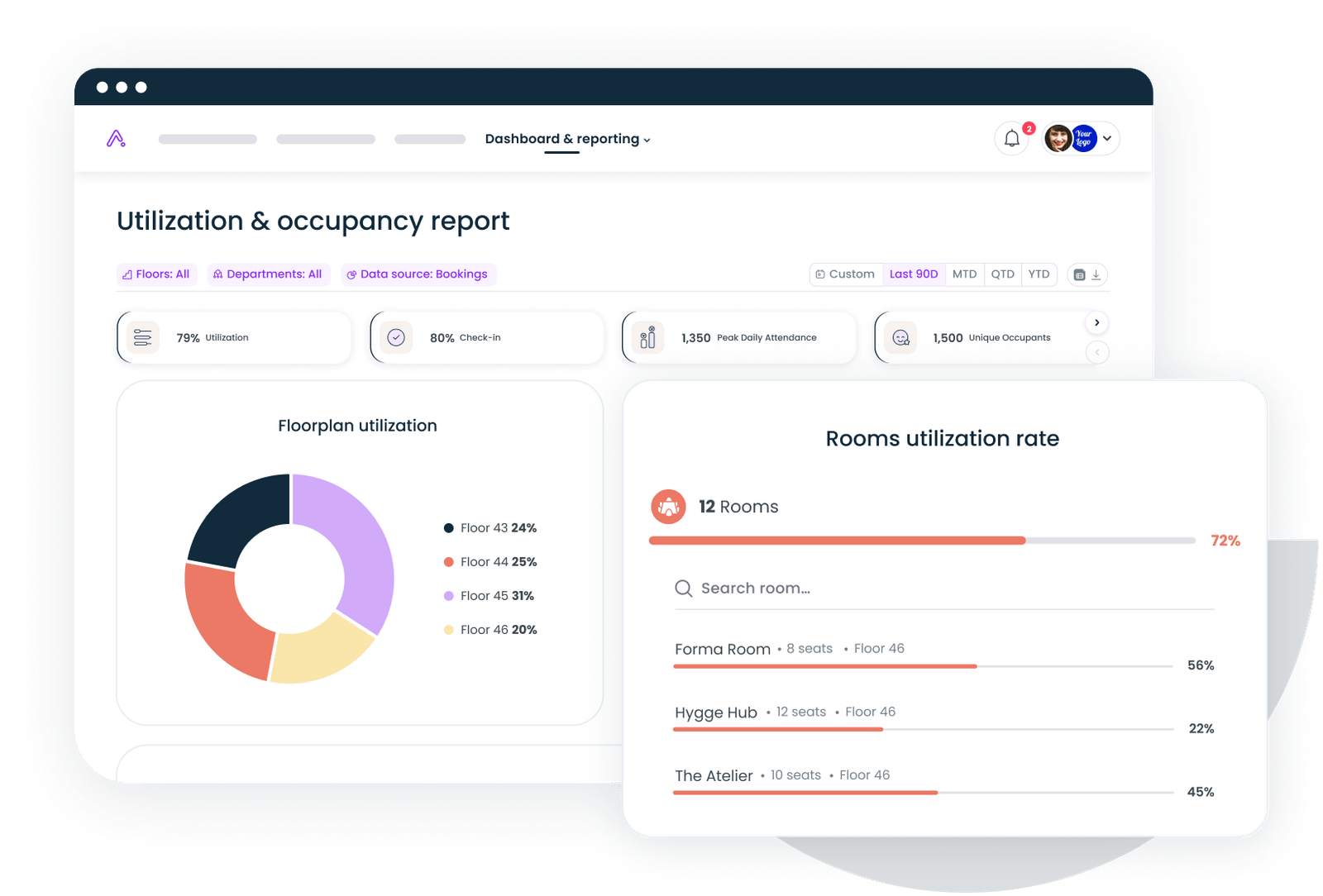
Measuring whether your core hours are working
You can't manage what you don't measure, and core hours are no exception. Here are the metrics that matter.
Meeting concentration. What percentage of meetings fall within core hours vs. outside them? If meetings are spilling beyond the window, your core hours aren't functioning as a boundary. Track this monthly using calendar analytics.
Focus time. How many uninterrupted hours do people have outside core hours? If the answer is "not many," meetings are colonizing the flexible time that core hours were supposed to protect. Workplace analytics tools can surface this data automatically by correlating calendar events with booking patterns.
Scheduling conflicts. Are people still struggling to find meeting times? If scheduling conflicts haven't decreased after implementing core hours, the window may be too narrow, or async norms aren't clear enough.
Employee sentiment. Run a quarterly pulse survey with three questions: Do you feel you have enough flexibility in your schedule? Are core hours working for your team? What would you change? Quantitative data tells you what's happening; sentiment data tells you why.
Participation equity. In meetings during core hours, are remote participants contributing equally to in-office participants? If remote voices are consistently quieter, the problem isn't the schedule; it's the meeting format. This connects to broader hybrid meeting practices that ensure everyone has equal airtime regardless of location.
Making core hours stick long-term
The hardest part of core hours isn't setting them. It's maintaining them six months later when the initial enthusiasm fades and old habits creep back.
Tie core hours to team agreements, not just company policy. A company-wide policy sets the framework, but individual teams should define their own version within it. An engineering team might use a 10-1 window with no-meeting Fridays. A sales team might need 9-2 to cover client calls. Let teams customize within guardrails.
Make the policy visible, not buried. Core hours should appear in calendar settings, Slack status defaults, and onboarding materials. If someone has to dig through a 40-page handbook to find the policy, it doesn't exist in practice. The best implementations I've seen auto-block focus time outside core hours in everyone's calendar on day one.
Collect feedback and actually act on it. The quarterly review isn't a checkbox exercise. If 60% of your team says the window is too early, move it. If distributed team members report feeling excluded from decisions made during a regional window, strengthen your async documentation practices. The communicating office policy changes playbook applies here: transparency about why you're adjusting builds more trust than the adjustment itself.
Expect iteration. Your first version of core hours won't be perfect. That's fine. The teams that succeed treat core hours as a living policy, not a permanent decree. Revisit quarterly, adjust based on data and feedback, and communicate changes clearly.
The bottom line on core hours in 2026
Core hours solve a specific problem: how to give people genuine schedule flexibility without losing the synchronous collaboration that makes teams effective. They're not a silver bullet, and they don't replace the harder work of building async communication habits, training managers, and designing meetings that respect everyone's time.
But they are the foundation. Without a defined overlap window, hybrid and distributed teams default to one of two failure modes: either everyone's in meetings all day because there's no shared understanding of when to collaborate, or nobody can find anyone because "flexible" became "unpredictable." Core hours sit in the middle, providing just enough structure to make flexibility sustainable.
From desk booking to team coordination to workplace analytics, Gable gives you the tools to make flexible work policies operational.
Get a demo