.svg)


.svg)
- Office design in 2026 is driven by how space performs, not just how it looks. Activity-based zoning, acoustic design, and real-time utilization data are the defining shifts.
- Employees in workplaces with biophilic elements report 15% higher well-being and are 6% more productive, according to a study of 7,600 workers across 16 countries (Human Spaces/Interface).
- 63% of employees feel more productive in the office, but 72% face moderate to very high stress at work. Design that addresses both is the competitive edge.
- Global office utilization reached 53% in 2026, up from 38% in 2024 (CBRE). Closing that gap requires smarter design and smarter management tools.
- The most effective office design trends in 2026 don't work in isolation. They reinforce each other as part of a coherent workplace strategy.
The biggest office design trends of 2026 share a common thread: the office has to earn its place in employees' weeks. As hybrid work data confirms, most knowledge workers now have real choice about where they work. That changes what office design has to do. It's not enough for a space to be functional. It has to be worth the commute. This list covers the six trends that are reshaping physical workplaces right now, and why each one matters to workplace leaders making real investment decisions.
The trends below are ordered from foundational to aspirational: structural choices that affect everything else first, followed by technology and strategy, then the experiential layer that turns a functional office into a place people actually want to be.
1. Activity-based zoning replaces the one-size-fits-all open plan
The era of rows of identical desks is over. What's replacing it isn't just "open space with some couches." It's a deliberate mix of environments designed around what people actually do when they come to the office.
Activity-based working (ABW) divides the office into zones calibrated for specific work modes: focus areas for heads-down individual work, collaboration zones for team problem-solving, informal social spaces for casual connection, and quiet rooms for calls and video meetings. Each zone is designed with its purpose in mind, with acoustics, furniture, lighting, and density all following from function rather than aesthetics.
The data behind this shift is clear. Return-to-office research consistently shows that employees come to the office primarily for connection and collaboration, not for tasks they could do just as well at home. A Steelcase Global Report confirmed that employees are most motivated to commute for people, not amenities. If the entire office is a sea of assigned desks, it's optimized for a type of work most people don't come in to do.
Hot desking and flexible seating arrangements are integral to this model. Organizations that track desk usage find most assigned desks sit empty 40-60% of the time. Activity-based zoning lets you right-size each type of space based on how it's actually used, rather than how leadership assumes it's used.
Implementing ABW well requires two things most organizations skip: a real understanding of how different teams work before the redesign, and a booking and wayfinding system that helps employees navigate the new environment without friction. Without the second piece, flexible space becomes chaotic. Employees default to the same spots every day, collaboration zones stay empty, and the whole model breaks down. Getting the zoning right is step one. Making it operationally coherent is what determines whether it sticks.
The shift also intersects with the broader return-to-office calculus. When employees can find a quiet room when they need focus, a collaborative table when they need to think out loud, and a comfortable lounge when they want to decompose after a meeting, the office starts to feel like it was designed for them. That's a very different experience from being assigned a desk and expected to be productive regardless of what the day requires.
2. Biophilic design moves from nice-to-have to performance lever
Biophilic design (the practice of incorporating natural elements into built environments) has been a fixture of office design trend lists for years. What's different in 2026 is that the business case is finally strong enough to move it from the "if budget allows" column into standard design practice.
A study of 7,600 office workers across 16 countries, led by organizational psychologist Professor Sir Cary Cooper and commissioned by Interface, found that employees in environments with natural elements report 15% higher well-being, are 6% more productive, and score 15% higher on creativity measures. A 6% productivity gain applied across a 200-person office has real financial weight.
Biophilic design goes further than adding a few potted plants. At its most effective, it integrates natural light (the single most-requested workplace element in most employee surveys), natural materials like wood and stone, views of the outdoors, and organic forms that echo natural environments. Even modest interventions (natural light optimization, plant integration in collaboration zones, materials that feel warm rather than clinical) produce measurable effects on how people feel in a space.
Nearly 3 in 4 U.S. employees (72%) face moderate to very high stress at work, according to Aflac's 2025 WorkForces Report. For workplace leaders being asked to improve wellbeing scores alongside space efficiency metrics, sensory-conscious design is one of the few environmental levers that moves both needles. The 2026 shift is embedding biophilic principles at the concept phase rather than applying them as a finish: orienting floor plans for natural light, specifying warm materials, and designing adjacencies that give employees visual access to greenery even from heads-down work areas.

Great office design starts with great space planning. See how to build a plan that actually reflects how your team works.
Read the guide
3. Acoustic-first design becomes non-negotiable
Poor sound management ranks as the top workplace complaint in most employee surveys, and hybrid work has made it harder, not easier, to solve. Open-plan offices were never designed for a world where half the people in them are on video calls at any given moment. Sound bleeds between zones, focus workers get disrupted by collaboration conversations, and the informal noise of a busy office becomes an attention-destroying intrusion for anyone trying to concentrate.
85% of employees say access to quiet zones significantly improves their productivity, according to the International Workplace Group. The design response has multiple layers: acoustic panels and ceiling systems (felt baffles, timber grids, suspended elements) absorb and diffuse sound without creating visual separation. Phone booths and office pods provide instant private space for calls without the cost or permanence of new construction. Research cited by CBRE found that pods instead of built meeting rooms could save U.S. companies approximately $30 billion by 2030.
Micro-zoning addresses the problem at the layout level. Rather than treating the entire office as one acoustic environment, organizations are deliberately separating noisy collaborative areas from quiet focus zones, with transitional spaces in between. Video call quality depends on room acoustics too: if a meeting room produces echo or bleed from adjacent spaces, the remote participants bear the cost. Designing rooms with camera placement, microphone pickup patterns, and soundproofing in mind is now a functional requirement.
Neurodivergent employees (an estimated 15-20% of the workforce) often have different sensory thresholds than neurotypical colleagues. An office that provides genuine acoustic variety (not just "quiet rooms available upon request" but a real gradient from social to semi-private to fully enclosed) serves the full range of the workforce without requiring anyone to opt out of the main space.
4. Smart technology and data-driven space decisions
One of the most significant office design trends of 2026 isn't visible. It's the data layer underneath the physical space.
Occupancy sensors, badge integrations, desk booking systems, and meeting room analytics now generate detailed pictures of how space actually gets used, not how it was designed to be used, and not how leadership assumes it's used. Organizations consistently find that some zones run at 80%+ capacity while others barely break 20%, and that peak occupancy windows are far narrower than expected. Office occupancy rate analysis gives workplace leaders the evidence to right-size floor plans and make the case for redesign. Global office utilization reached 53% in 2026, up from 38% in 2024 (CBRE), which still means nearly half of available space sits empty on any given day.
Desk booking software connects the physical and the digital. When employees book desks or rooms in advance, the system captures demand patterns: which zones are oversubscribed, which types of spaces generate high rebooking rates, and where the gaps are. That data becomes the input for the next design iteration.
This is where Gable Offices fits directly into the design conversation. Gable gives workplace teams interactive floor plans, real-time desk and room booking, and utilization analytics that surface actual occupancy patterns rather than estimates. When 72% of bookings at Gable customers are for team gatherings, that's a clear, actionable signal: the office is primarily used for collaboration, not individual work. Organizations using Gable have cut unused desk space by 32%, not by removing desks arbitrarily, but by understanding demand well enough to make confident changes.
92% of corporations globally see workforce productivity as a key business objective over the next three years, according to JLL Global Design Perspectives 2026. The organizations closing that gap are treating space data as a design input, not an afterthought.
From interactive floor plans to real-time utilization data, Gable Offices gives you the tools to design and manage spaces that work for your team.
Learn more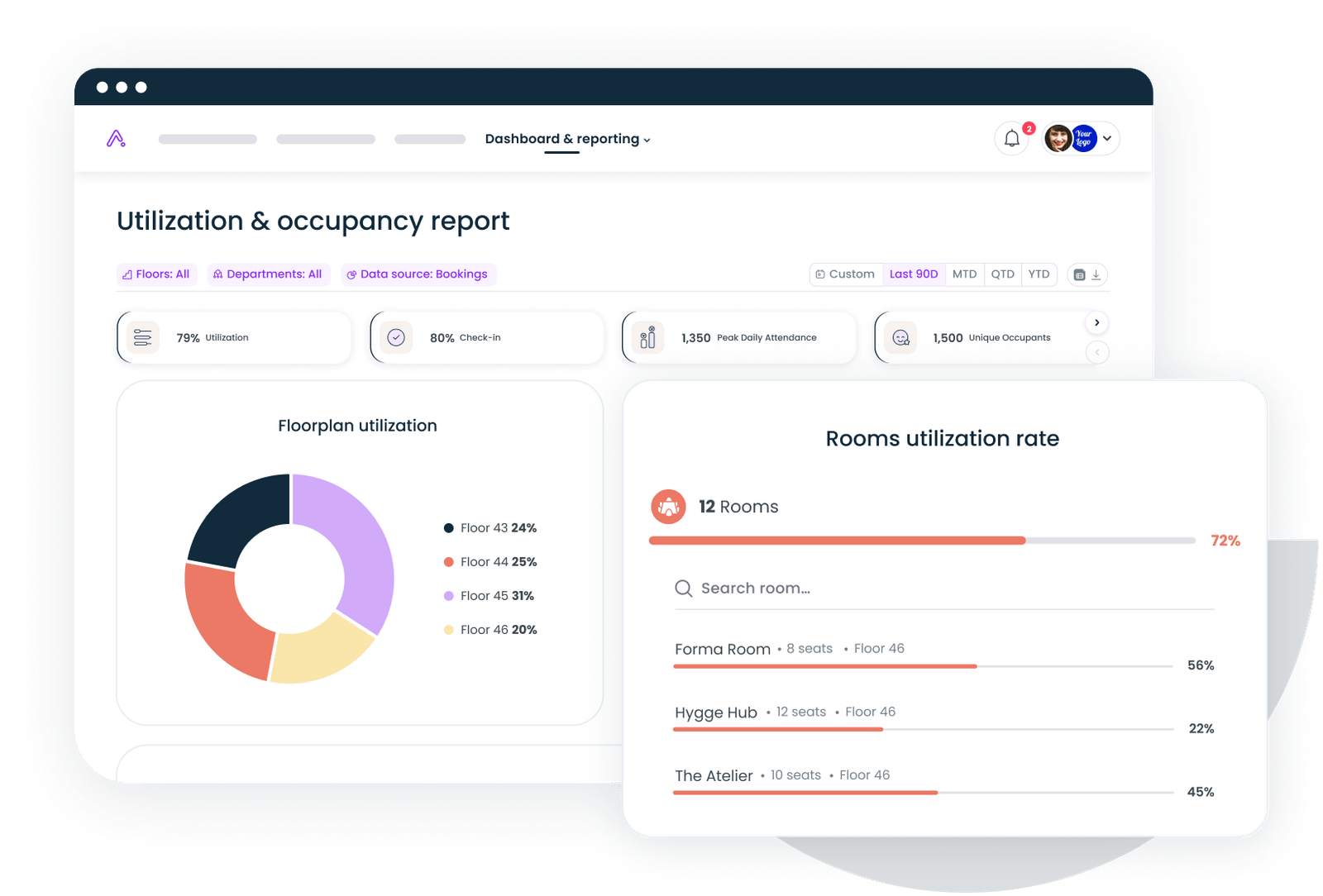
5. Sustainability shifts from trend to operational requirement
Sustainability was a design differentiator five years ago. In 2026, it's a procurement requirement. Institutional investors scrutinize the ESG credentials of the properties their portfolio companies occupy. Enterprise procurement teams include environmental performance in vendor evaluations. Employees, especially younger workers, factor it into whether a workplace reflects values they want to align with professionally.
Corporate real estate portfolio management teams are responding on two fronts: making existing spaces greener, and using utilization data to reduce the footprint they actually need. Sustainable offices in 2026 prioritize energy-efficient lighting (LED plus daylight-responsive controls), HVAC sized for actual occupancy rather than theoretical maximums, low-embodied-carbon materials, and modular furniture that can be reconfigured rather than discarded when layouts change. Traditional fitouts generate significant waste when partitions come down and custom furniture is removed. Modular systems avoid that cycle entirely.
Buildings pursuing LEED or WELL Building Standard certification have a structured framework for these decisions, and both certifications are now common specifications in office RFPs, particularly for companies with 500+ employees.
There's a direct cost link too. Reducing real estate costs and reducing environmental footprint point in the same direction: right-sized space, efficient systems, and less waste. An office that's too large for its actual usage isn't just expensive; it's generating emissions for empty space. Utilization data is what makes right-sizing defensible internally, and right-sizing is one of the highest-impact sustainability interventions available to most organizations.
6. Wellness and hospitality-inspired design attract and retain talent
The central question for office design in 2026: why would someone choose to be in your office when they have the option of working from home? The answer can't be "because you're required to." It has to be because the office offers something their home setup genuinely doesn't.
That's the philosophy behind "workspitality," a portmanteau of workplace and hospitality that describes offices designed with the warmth and intentionality of high-end hospitality spaces rather than the functionality-first logic of traditional corporate interiors. Cafe zones, lounge seating, soft lighting in informal areas, and cafe-style pantries replace cafeteria food service and break rooms. The goal is a space employees want to spend time in, not one they tolerate until they can leave.
Ergonomics is part of the calculus. Adjustable-height desks, well-calibrated monitors, and the option to work at different postures throughout the day aren't perks in 2026; they're expectations. Employees who work from well-equipped home setups have calibrated what physical comfort looks like. An office that falls short sends a clear message about how much the organization values the people in it.
Sensory design extends this further: natural light access, thermal comfort, clean air quality, and noise control all affect how people feel physically while they work. For neurodivergent employees (an estimated 15-20% of the workforce), these aren't preferences; they're functional requirements. Quiet rooms, adjustable lighting, lower visual complexity, and clear wayfinding make the office more accessible to people with different cognitive profiles, and create environments most people find more comfortable regardless. Organizations that design for the full range of the workforce don't sacrifice anything; they build offices that work better for everyone.
Conclusion: design and data have to work together
The six trends above point in a consistent direction. Office design in 2026 is about intentionality: every zone, material, acoustic decision, and technology integration should connect back to a specific outcome for the people using the space.
The organizations getting this right aren't the ones with the biggest budgets. They're the ones with the clearest understanding of how their employees actually use their offices. Activity-based zoning built on assumptions about how teams work doesn't deliver. Acoustic design that addresses the wrong problem doesn't solve it. Sustainable investments made without utilization data don't right-size anything.
Gable Offices connects the design layer to the data layer. Interactive floor plans give employees and facilities teams a shared view of available space. Desk and room booking captures real demand patterns. Utilization analytics surface the gaps between how space was designed and how it's actually used. That data drives better design decisions, and better design decisions drive outcomes that matter: higher space efficiency, lower real estate costs, better employee experience, and an office that earns its place in people's weeks.
The office isn't dead. But the office that doesn't justify itself with data and experience? That one is.
See how Gable helps workplace teams manage space, track utilization, and give employees a better in-office experience.
Get a demo