.svg)


.svg)
- Buildings produce nearly 40% of global CO2; your office is a climate lever
- Green offices boost cognitive function by 26% and cut sick days by 30%
- Hybrid work and desk booking are sustainability strategies, not just admin tools
- Retrofits beat new builds for reducing embodied carbon
- You don't need LEED Platinum to start; low-cost wins compound fast
Sustainable office design is the intersection of real estate strategy, employee health, regulatory compliance, and operational cost reduction. If your company has ESG commitments, a hybrid workforce, or a CFO who asks hard questions about square footage, this guide covers the decisions that actually move the needle.
What sustainable office design means in 2026
The definition has expanded. Five years ago, "sustainable office" mostly meant energy-efficient lighting and maybe a green roof. Now it encompasses materials sourcing, indoor air quality, water systems, waste streams, occupant well-being, and how flexibly the space adapts over its lifetime.
The urgency is real. Buildings consume nearly 40% of global energy and produce roughly a third of greenhouse gas emissions worldwide. That makes every office lease, renovation, and fit-out a climate decision, whether you frame it that way or not.
Regulatory pressure is accelerating. The EU's enabling Consumers Directive hit its 2026 deadline, tightening rules on greenwashing claims. In the US, SEC climate disclosure requirements are reshaping how public companies report on their real estate footprint. If your workplace team isn't coordinating with legal and finance on ESG reporting requirements, you're already behind the conversation.
Sustainable design also isn't a one-time project. It's an operating philosophy. You audit, you design, you measure, you iterate. The companies doing this well treat their office the same way product teams treat software: ship, learn, improve.
The business case for green offices
Let's start with money, because that's what gets budget approved.
Energy and water efficiency measures typically deliver 3 to 7 year payback periods, then keep saving for the life of the building. The upfront premium for sustainable design runs 2 to 7 percent above conventional construction. That's real, but it's a one-time cost against decades of lower operating expenses.
The talent argument is just as strong. 34% of office workers consider sustainability more important than an annual bonus, and 90% believe a sustainable workplace positively impacts their well-being. If you're spending money on talent attraction strategies, your physical space is either reinforcing or undermining that investment.
Then there's the health data. Green-certified buildings show a 26% increase in cognitive function among occupants and a 30% reduction in sick days, according to research from the Harvard T.H. Chan School of Public Health. That's not a soft benefit. It's measurable productivity.
And the real estate market has noticed. Over 80% of corporate tenants now actively seek green building certifications when selecting office locations. If you own or lease space without sustainability credentials, you're limiting your future options.
The business case isn't "sustainability is nice." It's: lower operating costs, healthier employees, stronger recruiting, better lease terms, and regulatory compliance. That's a CFO-friendly argument.
Eight core design principles that actually matter
Sustainable office design breaks down into eight interconnected areas. None of them work in isolation, and you don't need to tackle all eight at once. But understanding the full picture helps you prioritize.
1. Energy efficiency
This is the highest-impact category for most offices. LED lighting with smart controls, high-efficiency HVAC systems, and occupancy-based climate management can cut energy consumption by 30 to 50 percent compared to conventional systems. Smart thermostats alone reduce energy use by up to 10 percent.
The key insight: energy efficiency isn't just about equipment. It's about matching energy use to actual occupancy. If your office runs full HVAC on a Friday when 40% of desks are empty, you're cooling air for nobody. This is where space utilization data becomes a sustainability tool, not just a facilities metric.
2. Sustainable materials
Specify materials with low embodied carbon: recycled steel, FSC-certified wood, bamboo, cork, recycled textiles. Choose low-VOC paints and adhesives. Look for Cradle to Cradle or Environmental Product Declaration certifications on furnishings.
The circular economy angle matters here too. Furniture take-back programs, modular systems that can be reconfigured rather than replaced, and upcycled materials all reduce waste while extending the useful life of what you buy.
3. Natural light and biophilic design
Maximize daylight penetration through floor plan layout, glass partitions, and light shelves. Add plants, natural materials, and views of nature where possible. Biophilic design isn't decorative; it's linked to reduced stress, improved focus, and lower absenteeism.
When you're planning collaborative office layouts, position high-traffic collaboration zones near windows. Reserve interior zones for focus rooms and phone booths that benefit from acoustic isolation more than natural light.
4. Indoor air quality
This one got a lot more attention post-pandemic, and rightly so. Specify MERV-13 or higher filtration, ensure adequate ventilation rates (ASHRAE 62.1 as a minimum), and monitor CO2 levels in real time. Low-VOC materials and finishes reduce off-gassing. Air quality sensors give you data to act on, not just a vague sense that "the air feels stuffy."
5. Water conservation
Low-flow fixtures, sensor-activated faucets, and efficient cooling tower management are table stakes. Rainwater harvesting and greywater recycling systems make sense for larger facilities. Even simple changes like eliminating bottled water in favor of filtered tap reduce both waste and cost.
6. Waste reduction
Paper accounts for roughly 70% of total office waste. Going digital-first is the single biggest waste reduction move most offices can make. Beyond that: comprehensive recycling and composting programs, elimination of single-use plastics, and procurement policies that favor minimal packaging.
If your office hasn't gone paperless yet, that's probably your fastest sustainability win.
7. Flexibility and longevity
This is the principle most sustainability guides underplay. A space that can adapt to changing needs lasts longer and wastes less. Modular furniture, demountable partitions, raised access floors, and flexible infrastructure all extend building lifespan and reduce the embodied carbon of future renovations.
Flexibility also means right-sizing. If your hybrid team only needs 60% of desks on peak days, designing for that reality (rather than for 100% occupancy that never happens) reduces your footprint from day one.
8. Occupant well-being
Ergonomic furniture, thermal comfort controls, acoustic management, and access to wellness spaces all fall under this umbrella. The WELL Building Standard codifies many of these elements. Healthy employees are productive employees, and wellness-focused design reinforces the sustainability message in a way people can feel every day.

Hybrid models don't just save on real estate. They fundamentally change the carbon math of your office portfolio.
Read the guide
How to audit and plan your sustainable office transformation
You don't need to gut your office to make it sustainable. In fact, retrofitting is usually the better environmental choice. Demolishing a functional space and building new generates enormous embodied carbon. A refurbishment-first approach keeps existing materials in use and focuses investment where it creates the most impact.
Start with a current-state assessment
Walk your space with fresh eyes. Document energy systems, lighting types, HVAC age and efficiency, water fixtures, waste streams, materials condition, and indoor air quality. Pull utility bills for the past 12 months. If you have occupancy data, overlay it against energy consumption to find the gaps between usage and cost.
Align your stakeholders
Sustainable office design touches facilities, HR, finance, legal, and executive leadership. Each group cares about different outcomes. Facilities cares about operational efficiency. HR cares about employee experience and recruiting. Finance cares about cost reduction and asset value. Legal cares about regulatory compliance.
Build your business case with all four lenses. A project that saves energy, improves air quality, supports ESG reporting, and helps attract talent is much easier to fund than one that's "just" green.
Set measurable goals
"Be more sustainable" isn't a goal. "Reduce energy consumption per square foot by 25% within 18 months" is. "Achieve WELL certification for our headquarters by Q4 2027" is. Tie each goal to a metric you can track, a timeline, and a responsible owner.
Phase your implementation
Don't try to do everything at once. A phased approach lets you capture quick wins (LED retrofits, smart thermostats, waste programs) while planning longer-lead projects (HVAC upgrades, renewable energy, major material replacements). Quick wins build momentum and generate savings you can reinvest in bigger projects.
Sustainable materials: What to specify and why
Material choices have two carbon dimensions: embodied carbon (the emissions from manufacturing, transporting, and installing the material) and operational carbon (the energy the material helps save or waste over its lifetime). Both matter.
High-impact material swaps
Flooring: Carpet tiles with recycled content and take-back programs (like Interface's ReEntry program) beat conventional broadloom. Cork and bamboo are renewable alternatives for hard flooring. Polished concrete, if your slab allows it, eliminates the need for a finish material entirely.
Furniture: Look for manufacturers with circular economy programs. Modular systems that can be reconfigured, reupholstered, or returned beat fixed furniture that goes to landfill when your layout changes. Specify recycled aluminum frames, FSC-certified wood, and recycled textile upholstery.
Partitions: Demountable wall systems can be relocated and reconfigured without demolition waste. They cost more upfront but pay back quickly if your space needs change every few years, which in a hybrid environment, they will.
Finishes: Low-VOC and zero-VOC paints, adhesives, and sealants protect indoor air quality and reduce chemical off-gassing. They're now price-competitive with conventional products, so there's no real trade-off.
The cost premium reality
Sustainable materials typically cost 5 to 15 percent more than conventional alternatives. But lifecycle cost analysis usually favors them. Durable materials need less frequent replacement. Modular systems avoid demolition costs. And healthier materials reduce the hidden costs of poor air quality: sick days, reduced cognitive performance, and employee complaints.
Energy systems, HVAC, and renewables
Energy is where most offices spend the most and waste the most. It's also where the ROI on sustainability investment is clearest.
Lighting
LED retrofits are the lowest-hanging fruit in any office. They use 75% less energy than fluorescent tubes and last five times longer. Add occupancy sensors and daylight harvesting controls, and you're looking at 50 to 70 percent lighting energy reduction.
HVAC
Heating, ventilation, and air conditioning typically account for 40 to 60 percent of an office building's energy consumption. High-efficiency systems, variable refrigerant flow (VRF) technology, heat recovery ventilation, and smart controls that respond to occupancy and weather data can cut that significantly.
The hybrid work connection is direct: if your building runs full HVAC regardless of how many people are actually in the office, you're wasting energy proportional to your empty desks. Zone-based controls that respond to real-time occupancy data solve this.
Renewable energy
On-site solar is increasingly viable for offices with suitable roof space. Where on-site generation isn't practical, renewable energy procurement (power purchase agreements or green tariffs) lets you decarbonize your electricity supply without capital investment.
Smart building controls
Building management systems (BMS) that integrate lighting, HVAC, access control, and occupancy data create a feedback loop. The system learns patterns, adjusts automatically, and flags anomalies. This is where the operational savings compound over time.
Integrating sustainability with hybrid work
Here's the angle most sustainability guides miss entirely: hybrid work is itself a sustainability strategy.
When your team works in the office three days a week instead of five, you've reduced commuting emissions by 40%. When you right-size your space based on actual peak occupancy rather than headcount, you've eliminated the energy, water, and materials cost of space nobody uses. When you implement activity-based working with shared desks, you need fewer desks, less furniture, and less square footage.
But flexibility without visibility creates waste of a different kind. If people show up unpredictably, you can't optimize HVAC zones, you can't consolidate floors on low-occupancy days, and you can't make informed decisions about how much space you actually need.
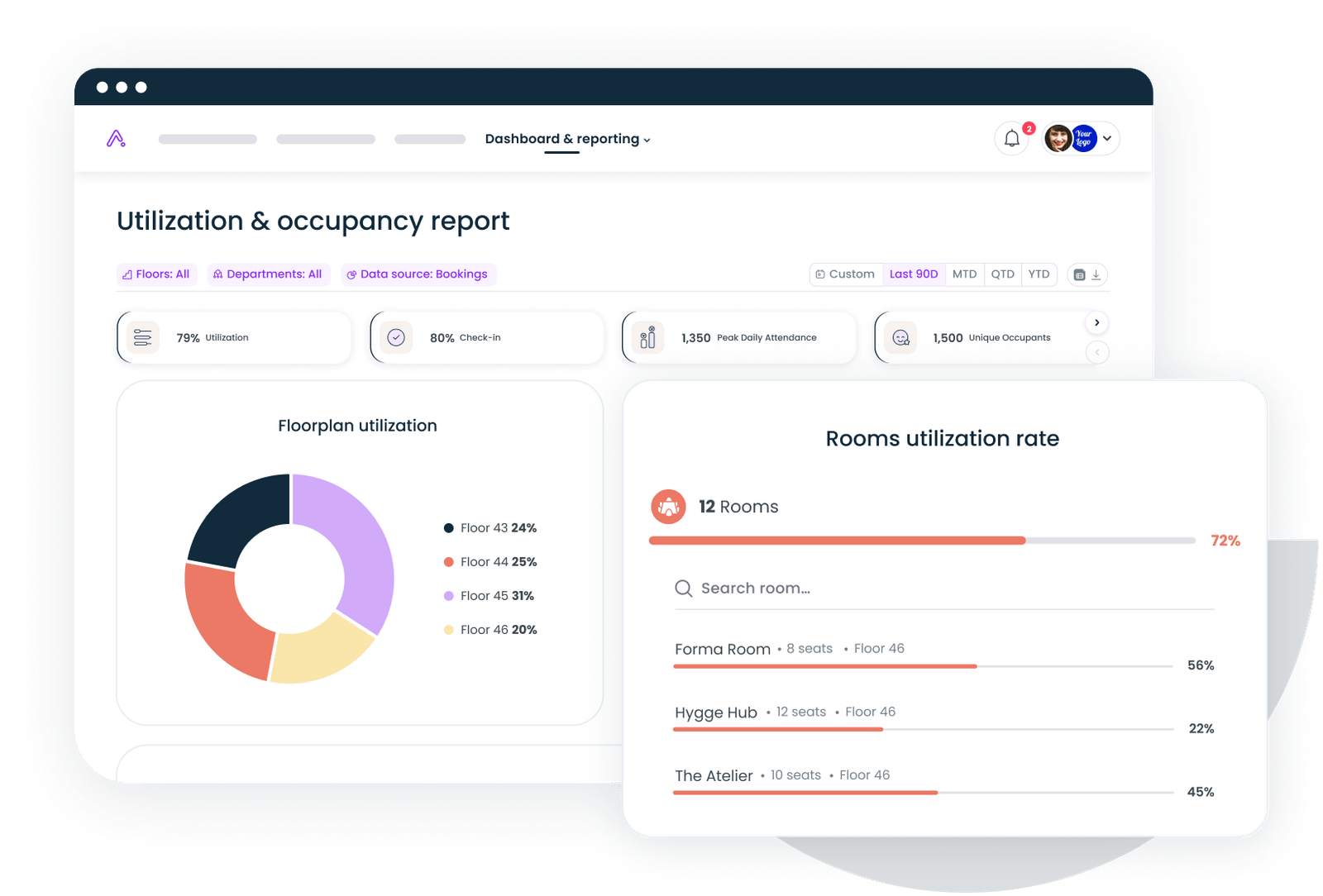
This is where desk booking and space management systems become sustainability infrastructure. When employees book desks in advance, you get demand signals. You know Tuesday will be 80% occupied and Friday will be 35%. You can adjust building systems accordingly. You can consolidate teams onto fewer floors on quiet days. You can make data-backed decisions about whether to renew that lease on the third floor.
Gable Offices handles desk and meeting room booking, visitor management, and utilization analytics in one platform, giving workplace teams the occupancy data they need to align space decisions with both employee experience and sustainability goals.
The math is straightforward. If your office space planning is based on headcount rather than actual usage, you're overbuilding. Overbuilding means more materials, more energy, more water, and more cost. Data-driven space management is sustainability management.
Desk booking, room reservations, visitor management, and utilization analytics in one platform. Built for hybrid teams that need real data, not guesswork.
Learn more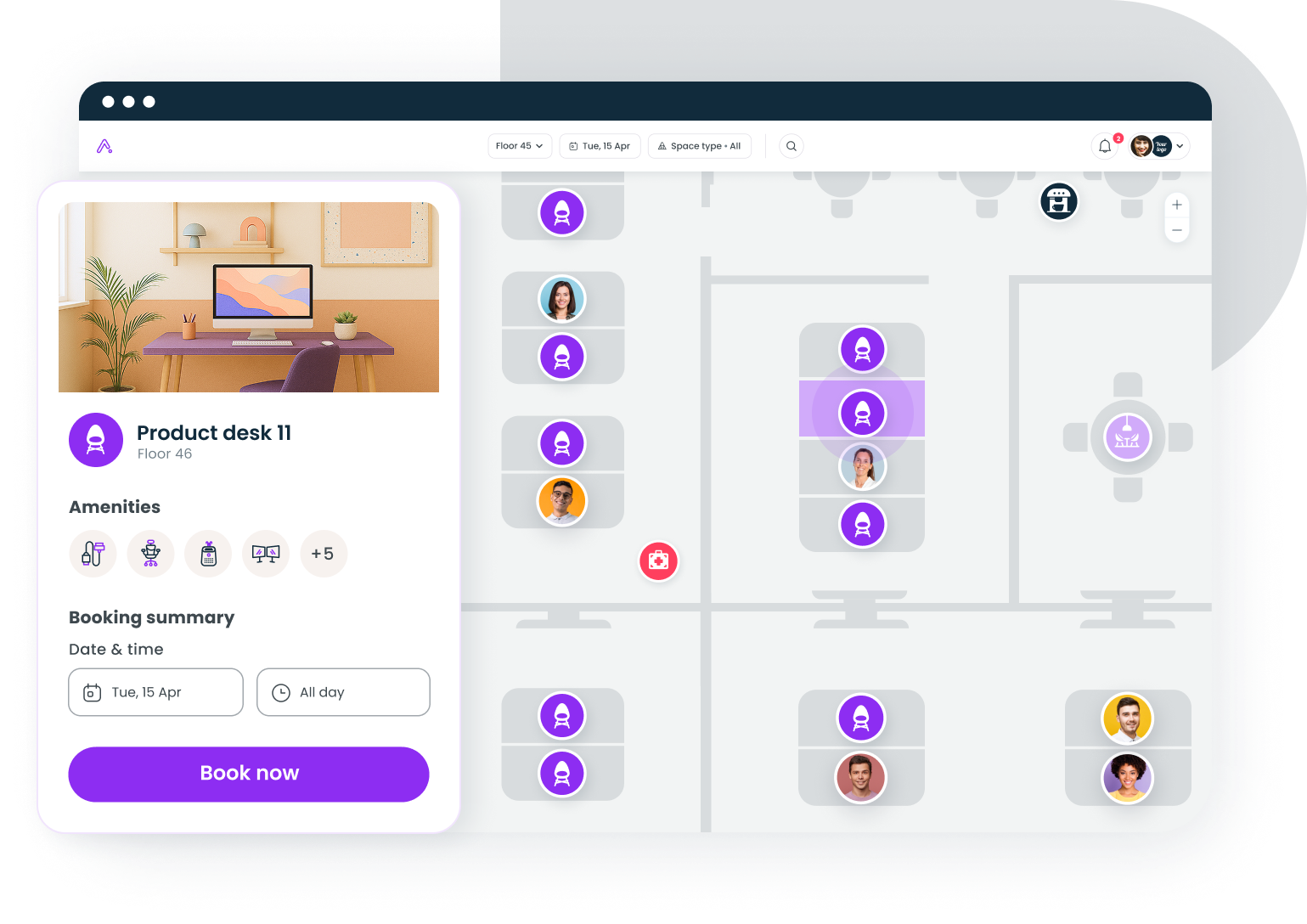
Green building certifications: Choosing the right one
Certifications serve two purposes: they provide a structured framework for sustainable design decisions, and they give you third-party validation for ESG reporting, investor communications, and talent marketing. But they're not all the same, and you don't necessarily need the most expensive one.
LEED (leadership in energy and environmental design)
The most recognized certification globally, especially in North America. Covers energy, water, materials, indoor environment, and innovation. Four levels: Certified, Silver, Gold, Platinum. LEED-certified buildings can reduce operational costs by up to 19% and command higher property values. The certification process is rigorous and can take 12 to 18 months.
BREEAM (building research establishment environmental assessment method)
The dominant standard in Europe and the UK. Similar scope to LEED but with different weighting and regional adaptations. If your offices are primarily in Europe, BREEAM may be more relevant to your tenants, investors, and regulators.
WELL Building standard
Focuses specifically on occupant health and well-being rather than environmental performance. Covers air, water, nourishment, light, movement, thermal comfort, sound, materials, mind, community, and innovation. WELL complements LEED or BREEAM rather than replacing them. If your sustainability strategy emphasizes employee health, WELL is the certification that validates it.
EDGE (excellence in design for greater efficiencies)
Developed by IFC (World Bank Group), EDGE is designed to be faster and more affordable than LEED or BREEAM. It focuses on three areas: energy, water, and embodied energy in materials. Good for organizations that want certification without the full complexity and cost of LEED. Particularly popular in emerging markets.
Which one should you choose?
It depends on your geography, your priorities, and your budget. US-based offices with investor-facing ESG requirements typically go LEED. European offices lean BREEAM. Companies prioritizing employee health add WELL. Budget-conscious organizations start with EDGE. Many companies pursue multiple certifications for different properties in their portfolio.
Measuring and reporting on sustainable office performance
You can't improve what you don't measure. And with ESG reporting requirements tightening, "we think our office is pretty green" doesn't cut it anymore.
Key metrics to track
Energy use intensity (EUI): Energy consumption per square foot per year. This is your primary efficiency metric. Track it monthly, benchmark against industry averages, and set reduction targets.
Carbon emissions: Scope 1 (direct, like on-site gas), Scope 2 (indirect, like purchased electricity), and increasingly Scope 3 (commuting, supply chain). Your office contributes to all three.
Water use intensity: Gallons per square foot per year. Benchmark and reduce.
Waste diversion rate: Percentage of waste diverted from landfill through recycling, composting, and reuse. Target 80% or higher.
Occupancy rate vs. capacity: The gap between how much space you have and how much you use. This is the metric that connects sustainability to real estate cost. If you're tracking workplace analytics, occupancy data should be feeding directly into your sustainability reporting.
Indoor air quality: CO2 levels, particulate matter, VOC concentrations, temperature, and humidity. Continuous monitoring, not annual spot checks.
Building a reporting cadence
Monthly operational reviews should cover energy, water, and waste. Quarterly reports should add occupancy trends and cost analysis. Annual sustainability reports should synthesize everything for ESG disclosure, investor communications, and employee engagement.
The companies doing this well aren't treating sustainability reporting as a compliance exercise. They're using it as a management tool, the same way they use financial reporting to make better decisions.
Overcoming barriers: Cost, resistance, and phased wins
Let's be honest about the obstacles. Sustainable office design costs more upfront. Not everyone in your organization will prioritize it. And the payback timeline, while favorable, isn't instant.
The cost objection
The 2 to 7 percent premium is real, but it's misleading in isolation. Frame it against total cost of ownership over a 10-year lease. Energy savings, water savings, reduced maintenance, lower absenteeism, and stronger talent retention all compound. Most sustainable office investments break even within 3 to 7 years and generate net savings for the remaining lease term.
If budget is genuinely tight, start with no-cost and low-cost measures. Optimize HVAC schedules based on occupancy data. Switch to LED bulbs as existing ones burn out. Implement a recycling program. Go paperless. These moves cost almost nothing and create immediate savings you can reinvest.
The resistance objection
Some stakeholders will see sustainability as a distraction from "real" business priorities. Counter this with data, not ideology. Show the cost savings. Show the talent data. Show the regulatory trajectory. Frame sustainability as risk management and operational efficiency, because that's what it is.
Getting employee buy-in for office changes matters too. Involve people in the process. Let teams choose their sustainable materials. Celebrate milestones. Make the data visible. When people can see the building's energy dashboard in the lobby, sustainability stops being abstract.
The "perfect is the enemy of good" trap
You don't need to achieve LEED Platinum on day one. You don't need to replace every system simultaneously. A phased approach that captures quick wins, builds organizational capability, and reinvests savings into bigger projects will get you further than an ambitious plan that stalls because it's too expensive or too complex.
Start where the impact is highest and the cost is lowest. Build from there.
The sustainable office is the well-managed office
Sustainable office design in 2026 isn't a separate initiative from workplace strategy. It's the same initiative. Right-sizing your space, optimizing energy use, choosing durable materials, tracking occupancy, and designing for flexibility: these are things good workplace teams do anyway. Sustainability just gives you a framework for doing them more intentionally and measuring the results.
The companies that treat sustainability as a bolt-on will always struggle with it. The companies that treat it as how they operate will find it gets easier and cheaper over time. The data supports it. The regulations require it. The employees expect it. And the math works.
From desk booking to occupancy analytics, Gable gives you the visibility to right-size your office and reduce waste.
Get a demo