.svg)


.svg)
- The largest global trial found reduced burnout and improved health across six countries
- 92% of companies that tried a 4-day workweek kept it
- Compressed hours (4×10) don't work; true hour reduction does
- Knowledge work benefits most, but creative scheduling extends it further
- A 90-day pilot with clear metrics beats an indefinite "let's see how it goes"
The 4 day workweek has gone from a fringe idea to a tested workplace model with multi-year, multi-country data behind it. 92% of participating companies kept the policy after their trials ended, citing lower stress, reduced sick leave, and stable or higher revenues. If you're a workplace leader still treating this as a thought experiment, you're behind the curve. The question has shifted from "does it work?" to "how do we implement it without breaking things?"
The evidence in favor of 4-day workweeks
The research base is no longer thin. Iceland ran the earliest large-scale trials from 2015 to 2019, putting 2,500 public sector employees on 35-36 hour weeks with no pay cut. Productivity stayed the same or improved. Worker wellbeing improved dramatically across stress, burnout, health, and work-life balance measures. By 2026, roughly 86% of Iceland's workforce has access to shorter hours or is actively working them.
The UK followed with its own trial: 61 companies, six months, and results that made the business case hard to ignore. Revenue stayed broadly consistent (up 1.4% on average) while staff turnover dropped 57%. Burnout fell by 71%. When the trial ended, 92% of companies chose to continue.
Then came the study that changed the conversation's rigor. Published in Nature Human Behaviour in 2025, it tracked 2,896 employees across 141 companies in six countries over six months. It's the largest randomized controlled trial of a shorter workweek ever conducted. The findings: reduced burnout, increased job satisfaction, improved mental and physical health. This wasn't a self-selected group of startups. It was a proper experiment.
And the management side? 93% of US managers now say they support a four-day workweek for their team, with 64% expecting their company to transition within five years. The skepticism hasn't disappeared, but it's moved from "this is crazy" to "how would we actually do this?"
Which company sizes and industries benefit
Not every company can flip a switch. That's the honest answer, and pretending otherwise undermines the case for the companies where it genuinely works.
Knowledge work is the sweet spot. Tech, finance, marketing, consulting, professional services: these are roles where output isn't measured by hours on a clock. Companies like Buffer, Duolingo, and Wonderlic have run successful implementations. The pattern is consistent: work that can be redesigned, roles with fewer handoff dependencies, and cultures that already lean toward workplace flexibility.
Mid-market companies (200-2,000 employees) seem to have the easiest time. They're large enough to have real operational complexity but small enough to move without eighteen months of committee approvals. No Fortune 500 company has gone company-wide yet, though several have piloted within departments.
The harder cases are real. Healthcare, manufacturing, retail, and customer-facing operations have structural constraints that a standard Monday-through-Thursday model doesn't solve. But "harder" doesn't mean "impossible." Rotating teams, staggered schedules, and shift-based models can extend the benefit. The key is that someone needs to think through the scheduling logistics carefully, not just announce a policy. If you're managing multiple office locations, the complexity multiplies.
The 100-80-100 principle and why compression fails
There are two fundamentally different things people mean when they say "4-day workweek," and conflating them is the fastest way to kill a pilot.
The first is the 100-80-100 model: 100% pay, 80% of typical hours, 100% output. Employees work 32 hours across four days. This is what the research supports. It's what drove the burnout reductions, the retention gains, the satisfaction scores.
The second is the 4×10 model: 40 hours compressed into four days. Same workload, same hours, just crammed into fewer days. This is what most skeptics picture, and they're right to be skeptical. Ten-hour days create fatigue. Stress doesn't drop. The wellbeing gains that make the 4-day week compelling largely evaporate.
The distinction matters because the mechanism isn't "Fridays off." It's "less time working, same results." That only happens when you redesign how work gets done. Fewer meetings. More asynchronous communication. Clearer decision rights. If you skip the redesign, you're just compressing misery into fewer days.
This is why companies that succeed at the 4-day week almost always report that the process of preparing for it, auditing workflows, cutting low-value meetings, clarifying priorities, made them better organizations regardless of the schedule change. The workplace efficiency gains are a feature, not a side effect.

Thinking about testing a 4-day workweek? Start with a structured pilot framework that gives you real data before you commit.
Read the guide
Your 90-day pilot framework
Talking about a 4-day workweek is easy. Running a pilot that produces actionable data is harder. Here's a framework based on what's worked across the global trials.
Phase 1: Discovery and alignment (weeks 1-2)
Start by defining what success looks like before you change anything. Survey your team on readiness, concerns, and expectations. Pick your metrics: revenue stability, retention rate, sick days, burnout scores (use a validated scale like the Maslach Burnout Inventory), engagement, and customer satisfaction.
Choose a pilot group. One department or function, ideally knowledge work. Don't try to pilot across the whole company simultaneously; the complexity will overwhelm the learning. Model the scenarios: What does client coverage look like? Do you need staggered days off? What's the cost if it doesn't work?
Phase 2: Work redesign (weeks 3-6)
This is where most pilots succeed or fail, and it happens before the schedule changes. Conduct a workflow audit. Where are the low-value meetings? Which decisions require live synchronous discussion, and which can move to async? Where are the bottlenecks?
Establish new norms: meetings capped at 30 minutes with required agendas, one meeting-free day per week, clear async communication channels. This is also where workplace analytics become critical. You need baseline data on how time is currently spent: meeting hours per week, space utilization patterns, collaboration frequency. Without a baseline, you can't measure change.
Brief all stakeholders. Clients, partners, and internal teams that aren't in the pilot need to understand what's happening and why. Surprises breed resentment.
Phase 3: Trial execution (weeks 7-12)
Run the reduced schedule. Weekly pulse surveys keep you close to the data without being intrusive: three to five questions on energy, workload, and blockers. Monitor your business metrics in real time. If ticket velocity drops or client satisfaction scores dip, you want to catch it in week 8, not week 12.
Hold bi-weekly syncs with a small pilot task force to surface problems early. Watch for overtime creep; if people are quietly working on their day off, the pilot isn't working, it's just hiding the same hours in different places.
Phase 4: Analysis and decision (week 13+)
Compare baseline data to trial data. Segment by role and demographic to spot inequities; if the benefit accrues only to senior staff while junior employees absorb extra workload, that's a problem. Run an NPS-style question: "How willing would you be to return to a five-day week?" The answer tells you more than any productivity metric.
Then make a decision. Continue, refine, or sunset. All three are legitimate outcomes. The point of a pilot is learning, not proving a predetermined conclusion. For guidance on communicating policy changes after the decision, the framing matters as much as the outcome.
Critical success factors and common failure points
The global trials reveal a clear pattern in what separates successful implementations from abandoned ones.
Leadership participation is non-negotiable. If executives exempt themselves from the reduced schedule, the message is clear: this isn't real. Every successful trial in the UK and Nature studies had visible leadership buy-in, meaning leaders actually took the day off.
Work redesign beats hour cutting. Companies that simply announced "Fridays off" without changing how work happens saw productivity dip and stress rise. The ones that audited meetings, clarified async norms, and enabled faster decision-making saw gains. This is fundamentally a workplace change management challenge, not a scheduling one.
Measurement discipline separates pilots from experiments. Track data rigorously. Don't rely on anecdotes or vibes. The companies that continued their 4-day weeks post-trial were overwhelmingly the ones that had hard numbers to show leadership.
Larger hour reductions outperform smaller ones. This is counterintuitive, but the burnout reduction is dose-dependent. Cutting eight or more hours per week produces meaningfully better wellbeing outcomes than cutting four. Half-measures produce half-results.
The failure points are equally predictable: compression without redesign, unclear success metrics, too many departments piloting simultaneously, and ignoring the operational constraints of shift-based or client-facing roles. If you wouldn't run a product launch this loosely, don't run a workweek pilot this way either.
How to measure success: The metrics that matter
The wrong metric can kill a good pilot. Individual productivity measures (lines of code, emails sent, calls made) are counterproductive. They incentivize busywork and miss the point entirely.
Business metrics: Revenue stability or growth, customer satisfaction scores, project completion rates, deal cycle length. These tell you whether the business is healthy.
People metrics: Retention rate, sick days, burnout scores on a validated scale, job satisfaction. These tell you whether the humans are healthy. Track employee engagement through structured surveys, not hallway conversations.
Operational metrics: Meeting hours per week, async communication adoption rate, decision lag time, space utilization. These tell you whether the work redesign is sticking.
Equity lens: Are the benefits distributed equally across roles, levels, and demographics? If parents benefit but childless employees absorb extra coverage, or if senior staff take Fridays off while junior staff can't, the policy has a fairness problem that will erode trust.
Gable's cross-product platform, spanning office management software, on-demand workspaces, and workplace intelligence, gives pilot teams a single place to track occupancy patterns, collaboration frequency, and space utilization before, during, and after a trial, replacing the spreadsheet chaos that derails most measurement efforts.
Track occupancy, collaboration patterns, and space utilization across your entire portfolio in real time.
Learn more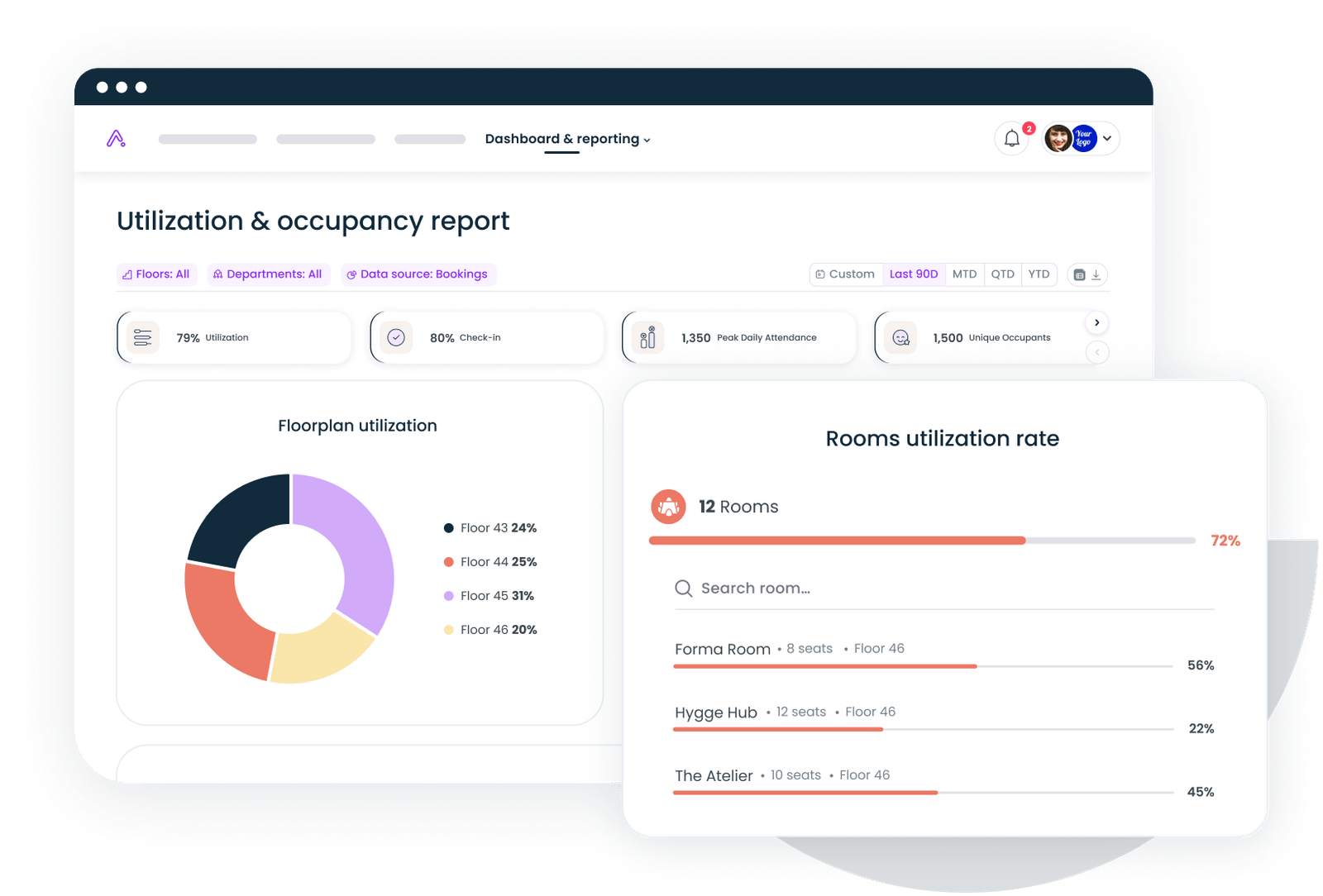
AI And the 4-day workweek window
Here's the argument that's gaining traction in 2026: AI productivity gains create a natural opening for shorter workweeks.
OECD research shows productivity increases of 5% to 25% in customer support, software development, and consulting from AI integration. That's real time being recaptured. The question is where it goes.
Option one: companies pocket the gains and expect more output per person. Option two: companies redistribute some of those gains back to workers in the form of time. The 4-day workweek is option two, formalized.
This framing matters for talent strategy. Companies that invest in workplace AI adoption and pair it with a shorter workweek are making a compelling offer: we'll give you better tools and more time. That's a differentiated employer brand in a market where most companies are just asking people to do more with the same tools.
The window may not stay open forever. As AI capabilities expand, the pressure to convert productivity gains into more output (rather than more time) will intensify. Leaders who pilot now, while the narrative still favors worker benefit, have a stronger case than those who wait.
The counterargument, and why it's partly right
I'd be dishonest if I didn't acknowledge the legitimate concerns. Not every role can be redesigned for 32 hours. Client-facing businesses with global time zones face real coverage challenges. Some industries have regulatory or safety requirements that make reduced hours genuinely complicated.
And there's a subtler risk: the 4-day week can become a perk that masks deeper organizational dysfunction. If your meetings are pointless and your decision-making is slow, cutting a day doesn't fix the root cause. It just gives people one fewer day to suffer through it.
The strongest implementations treat the 4-day week as a forcing function for better work design, not as a benefit layered on top of broken processes. If you're not willing to do the hard work of redesigning how your organization operates, a schedule change won't save you.
Where the idea goes from here
The 4-day workweek in 2026 sits at an inflection point. The evidence is strong enough that dismissing it outright is intellectually lazy. But the implementation challenges are real enough that treating it as a simple policy change is naive.
The companies getting this right share three traits: they run structured pilots with clear metrics, they redesign work before changing schedules, and they're honest about where it works and where it doesn't. The ones getting it wrong either announce it without preparation or reject it without engaging with the data.
If you're considering a pilot, start with the 90-day framework. Pick one team. Define your metrics. Do the work redesign. Measure rigorously. Then decide based on evidence, not ideology. That's how workplace strategy should work, regardless of how many days are in your week.
See how workplace leaders use Gable to track occupancy, collaboration, and engagement across every stage of a workplace pilot.
Get a demo