.svg)


.svg)
- Global office utilization hit 54% in 2025, but targets sit at 79%, creating a 25-point gap that the right software can close.
- The best platforms now combine desk booking, meeting room scheduling, visitor management, and AI-powered analytics in a single system.
- Resource-based pricing (per desk or room) is replacing per-user models, making costs more predictable for larger organizations.
- No-show prevention features like auto-release, check-in requirements, and zone capacity caps are now table stakes.
- Choosing a unified platform over disconnected point solutions saves admin time and produces better data for real estate decisions.
Office management software has shifted from a nice-to-have booking tool to a core piece of workplace infrastructure. With global office utilization reaching 54% in 2025 (up from 49% the year before) and target utilization climbing to 79%, workplace leaders face a persistent gap between how much space they're paying for and how much is being used. That gap costs real money. According to OfficeSpace Software, underutilized space costs $1.3 trillion annually in the U.S. alone when you factor in asset downtime and lost productivity.
The challenge isn't getting people back to the office. It's making the office worth coming back to, while keeping costs under control and making sense of fluctuating attendance patterns. Many workplace teams still juggle desk bookings, meeting room scheduling, and visitor management across disconnected tools that don't share data.
This guide covers the best office management software for 2026, including essential features, 10 platform comparisons, pricing models, and a framework for choosing the right solution. Whether you're managing a single headquarters or a multi-location portfolio, you'll find actionable guidance for unifying people, space, and data.
What is office management software?
Office management software automates and centralizes how organizations manage their physical workspaces. At its core, it handles desk booking, room scheduling, and visitor management through a single platform that connects people, spaces, and usage data in real time.
Modern systems go well beyond reservation calendars. They provide utilization analytics, integrate with communication tools like Slack and Microsoft Teams, support AI-powered forecasting, and produce the data workplace leaders need for space planning and real estate decisions.
Why it matters
The resource booking software market is projected to grow from $2.81 billion in 2025 to $4.88 billion by 2029, at a 14.8% CAGR. That growth reflects a fundamental shift: organizations are moving from "best-of-breed desk booking" to full workplace operations platforms that handle everything from space reservations to portfolio analytics.
Three forces are driving this adoption:
Hybrid has stabilized, but the gap persists
Hybrid workers now spend roughly 2.3 days per week in the office. Meanwhile, 44% of global real estate leaders now mandate five days a week, up from 34% two years ago. Average attendance still hovers around three days. That gap between policy and reality represents wasted real estate costs and missed collaboration opportunities.
Cost pressure is intensifying
Office vacancy rates are expected to peak at 19%, and many organizations are paying for space that sits empty two or three days a week. Without utilization data, it's impossible to know which spaces to keep, which to consolidate, and which to replace with flexible alternatives.
Employee expectations have shifted
85% of employees report higher satisfaction in hybrid models. But satisfaction depends on the experience: being able to find a desk near teammates, book the right-sized meeting room, and know who else will be in the office on a given day. Without software supporting those interactions, the office becomes a source of friction rather than connection.

Scaling your office operations doesn't have to mean scaling your headaches. Learn how growing companies build workplace systems that hold up.
Read the guide
Essential features to look for
Real-time desk and room booking
The foundation of any office management system is space reservations, but booking alone isn't enough in 2026. You need intelligence layered on top. Look for platforms that offer:
- Interactive floor plans showing real-time availability
- Mobile booking via app, Slack, or Teams
- Check-in requirements that auto-release no-shows
- Team-based booking with visibility into who else will be on-site
- QR or NFC tap-to-book at physical desks
Modern office space is designed for collaboration, not rows of assigned desks. Your software should accommodate this through neighborhood-based seating, team coordination features, and flexible capacity management across different space types.
Meeting room scheduling and optimization
Meeting rooms deserve equal attention to desk booking. Organizations that adopt dedicated booking systems see significant improvements in meeting room utilization, reducing ghost bookings and reclaiming hours of wasted room time per week. Yet many companies still rely on calendar-only reservations that produce ghost bookings and room hoarding.
Effective meeting room management includes:
- A rules engine with access controls, booking quotas, advance booking windows, and approval workflows
- Utilization analytics showing occupancy by room, floor, and time of day
- Auto-release for rooms that aren't checked into within a set window
- Hybrid meeting support, matching room size to actual in-person attendee counts
- Integration with conference room technology for display panels and kiosk check-in
The data from room booking is especially valuable for space planning decisions. If your boardroom runs at 85% capacity on Tuesdays but 15% on Fridays, that's actionable intelligence for scheduling, space allocation, and even lease negotiations.
Integrations with existing tools
Hybrid teams need cohesive workflows without constant app-switching. The most effective platforms connect directly with tools your team already uses:
- Slack and Microsoft Teams for in-app booking, approval workflows, and notifications
- Google Calendar and Outlook for automatic calendar sync and auto-release triggers
- SSO providers (Okta, Azure AD) for security and frictionless adoption
- HRIS systems (Workday, Rippling) for automated user management and department-level reporting
- Access control and WiFi for occupancy data that goes beyond booking records
With 320 million monthly active users, integration with collaboration tools isn't optional. It's a prerequisite for adoption.
Data-driven insights and AI
The most valuable feature of modern office management tools is the insight they produce. Too many return-to-office decisions have been made on intuition rather than data.
Look for platforms that provide:
- Real-time utilization dashboards showing booked vs. actually used space
- Peak-time analysis by zone, floor, and day of week
- No-show trend tracking and cost-per-occupied-seat calculations
- Department-specific insights into different teams' office preferences
- AI-powered forecasting for demand planning
AI is becoming a meaningful differentiator in this category. Some platforms now offer purpose-built workplace AI models trained on occupancy behavior, rather than generic large language models. These can forecast space demand, flag maintenance needs, and help employees find the right room or colleague through conversational interfaces. For a deeper look at what's real vs. hype, see our guide on workplace AI adoption.
No-show prevention and demand management
Ghost bookings, where someone reserves a desk or room but never shows up, are one of the biggest drains on office utilization. Modern platforms address this with:
- Auto-release: If an employee doesn't check in within a set window (typically 10-15 minutes), the booking is canceled and the space becomes available
- Team neighborhoods: Assigning zones to departments so teams sit together, reducing random bookings across the floor
- Zone capacity caps: Limiting how many people can book into a specific area on a given day
- Booking time limits: Preventing employees from reserving space more than a set number of days in advance
These features turn booking data into accurate occupancy data, which is what you need for real estate decisions.
Scalable policies and customization
Every organization's hybrid model is different. 64% of companies use hybrid, but implementation varies dramatically based on culture, industry, and business goals.
Your office management software should let you:
- Customize booking rules by seniority, department, or project
- Support a mix of assigned and flexible desks
- Set priority access for specific teams during peak days
- Automate recurring bookings for regular team meetings
- Adjust policies by location for global organizations
The ROI of office management software
The business case for office management software goes beyond convenience. Here's how the numbers typically break down:
Space cost reduction
Organizations that use data-driven space management typically reduce underused office space by 20-40% while maintaining employee satisfaction. With average cost per desk ranging from $8,000 to $15,000 annually in major metros, even a 20% reduction in a 500-desk office translates to $800,000 or more in annual savings.
Administrative time savings
Manual booking management, spreadsheet-based space tracking, and ad hoc visitor coordination consume significant admin hours. Automated systems typically save 10+ hours per admin per month by eliminating manual processes.
Collaboration and productivity gains
When employees can see who's in the office, book desks near their teammates, and find the right-sized room for their meeting, collaboration improves. Organizations using unified workplace platforms report 30%+ increases in team collaboration, which directly affects productivity metrics.
Payback timeline
Most organizations see payback within 6-12 months, primarily through space optimization and reduced administrative overhead. The key is having accurate utilization data, which requires a platform that combines booking records with check-in data, badge swipes, or WiFi connections.
Gable Offices combines desk booking, room scheduling, visitor management, and real-time analytics in one platform built for hybrid teams.
Learn more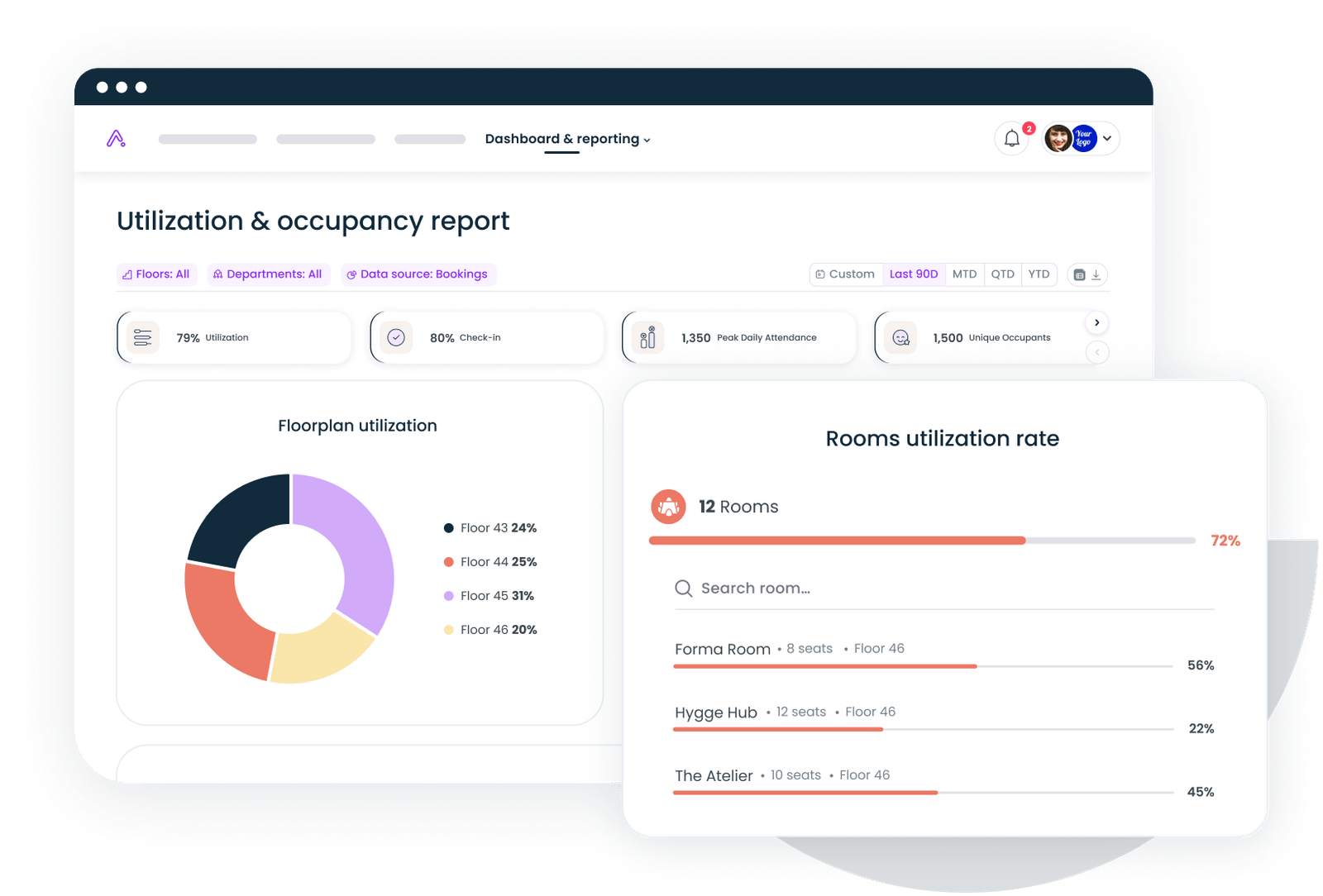
Top 10 Office management software platforms for 2026
Gable Offices
Best for: Organizations seeking unified office and on-demand workspace management
Gable Offices stands out by combining traditional office space management with access to 20,000+ flexible workspaces globally. Employees can manage desk and room reservations in leased offices and coworking spaces through a single platform, with AI-powered analytics across the entire portfolio.
Key features:
- Desk booking, room scheduling, visitor management, and event coordination in one platform
- Interactive floor plans with QR/NFC desk booking
- AI copilot for instant workplace insights via chat
- Native integrations with Microsoft Teams, Google Workspace, Slack, and HRIS systems
- Coordinate in-office days with colleague visibility
Pricing: Starts at $3 per seat per month, billed annually. Transparent pricing with no hidden add-ons.
Best for: Companies with distributed teams, those expanding into new markets, or organizations wanting to reduce fixed real estate commitments while maintaining workspace flexibility.
OfficeSpace Software
Best for: Large organizations requiring detailed space planning and move management
OfficeSpace Software offers a comprehensive suite with a strong focus on space planning, facility management, and AI-powered workplace operations. Their recent positioning as an "AI operating system for the built world" reflects significant investment in automation.
Key features:
- Advanced space planning with CAD integration
- AI agents for forecasting, maintenance, and employee guidance
- Move management capabilities for office relocations
- Detailed reporting and analytics
Limitations: Complex interface that may require extensive training. Higher implementation costs for full deployment. Pricing complexity due to multiple modules.
Pricing: Enterprise pricing typically starts around $6-12 per user per month, billed annually.
Robin
Best for: Mid-size companies prioritizing employee experience and team coordination
Robin emphasizes user experience through intuitive booking interfaces and team coordination features. It's a solid choice for organizations where employee adoption is the primary concern.
Key features:
- User-friendly mobile app with simple booking flows
- Team coordination showing colleague schedules and locations
- Quick implementation with minimal IT requirements
- Office analytics dashboard
Limitations: Limited analytics compared to enterprise platforms. Fewer integration options. Basic visitor management. Scalability constraints for larger multi-location organizations.
Pricing: Starts around $3-8 per user per month, depending on features.
Envoy
Best for: Organizations prioritizing security and comprehensive visitor management
Envoy built its reputation on visitor management and has expanded into desk booking and room scheduling. It's strongest for organizations where security, compliance, and front desk operations are top priorities.
Key features:
- Advanced visitor management with pre-registration and security screening
- Compliance features for regulated industries
- Professional front desk solutions with check-in kiosks
- Integration with security and access control systems
Limitations: Higher cost for comprehensive feature sets. Less focus on space optimization and utilization analytics. Can be overkill for organizations with simple visitor needs.
Pricing: Starts around $5-12 per user per month, with additional costs for visitor management modules.
Skedda
Best for: Small to mid-size organizations wanting straightforward space booking
Skedda offers a clean, focused approach to space booking with strong self-service configuration. It's popular with organizations that want to get up and running quickly without heavy IT involvement.
Key features:
- Intuitive booking interface with interactive floor plans
- Self-service setup and configuration
- Rules-based booking policies
- Calendar integrations
Limitations: Limited enterprise features. Basic analytics compared to full workplace platforms. Fewer integrations with HRIS and access control systems.
Pricing: Free tier available for small spaces; paid plans start around $2-5 per resource per month.
Kadence
Best for: Hybrid-first organizations focused on team coordination
Kadence positions itself as a hybrid work platform with strong emphasis on helping teams coordinate their in-office days. It's designed specifically for the hybrid use case rather than traditional office management.
Key features:
- Hybrid scheduling with team coordination
- Neighborhood-based seating
- Analytics focused on hybrid work patterns
- Slack and Teams integration
Limitations: Narrower feature set than full workplace platforms. Limited visitor management. Less suited for organizations with complex space planning needs.
Pricing: Starts around $4-6 per user per month.
Deskbird
Best for: European organizations with hybrid teams
deskbird is a European-headquartered platform with strong GDPR compliance and a focus on hybrid work coordination. It's particularly popular with organizations that need data privacy compliance built into their workspace tools.
Key features:
- Desk and room booking with interactive floor plans
- Hybrid work scheduling
- Strong privacy and GDPR compliance
- Analytics dashboard
Limitations: Smaller global workspace network. Less mature enterprise features. Limited visitor management capabilities.
Pricing: Starts around $2-4 per user per month.
Condeco
Best for: Large enterprises with complex meeting room booking requirements
Condeco provides comprehensive meeting room booking and space management with strong enterprise features and global deployment capabilities. It's been in the market longer than most competitors.
Key features:
- Enterprise scalability for large multi-location deployments
- Advanced booking features including catering and equipment management
- Strong reporting for facility managers
- Global 24/7 support
Limitations: Complex interface requiring extensive user training. Higher cost structure. Implementation complexity often requiring dedicated project management.
Pricing: Enterprise pricing starts at $8-15 per user per month, billed annually.
Archie
Best for: Coworking operators and organizations managing flexible space
Archie focuses on the intersection of coworking management and office booking. It's a strong fit for organizations that operate their own flexible spaces or manage a mix of traditional and coworking environments.
Key features:
- Coworking and office management in one platform
- Member management and billing
- Room and desk booking
- Community features
Limitations: Less suited for traditional enterprise office management. Limited AI and advanced analytics. Smaller integration ecosystem.
Pricing: Starts around $5-10 per location per month, with resource-based pricing tiers.
Tactic
Best for: Mid-size companies wanting a balance of simplicity and analytics
Tactic offers a focused approach to hybrid office management with an emphasis on making data accessible to workplace leaders without requiring a dedicated analytics team.
Key features:
- Desk and room booking with floor plans
- Hybrid scheduling and team coordination
- Utilization analytics and reporting
- Slack and Teams integration
Limitations: Smaller market presence. Fewer enterprise-grade features. Limited visitor management.
Pricing: Starts around $3-5 per user per month.
Platform comparison matrix
| Feature | Gable | OfficeSpace | Robin | Envoy | Skedda | Kadence | deskbird | Condeco | Archie | Tactic |
|---|---|---|---|---|---|---|---|---|---|---|
| Desk booking | ✓ | ✓ | ✓ | ✓ | ✓ | ✓ | ✓ | ✓ | ✓ | ✓ |
| Room scheduling | ✓ | ✓ | ✓ | ✓ | ✓ | ✓ | ✓ | ✓ | ✓ | ✓ |
| Visitor management | ✓ | ✓ | Basic | ✓ | ✗ | ✗ | ✗ | ✓ | ✗ | ✗ |
| AI/automation | ✓ | ✓ | ✗ | ✗ | ✗ | ✗ | ✗ | ✗ | ✗ | ✗ |
| No-show auto-release | ✓ | ✓ | ✓ | ✓ | ✓ | ✓ | ✓ | ✓ | ✗ | ✓ |
| Interactive floor plans | ✓ | ✓ | ✓ | ✓ | ✓ | ✓ | ✓ | ✓ | ✗ | ✓ |
| On-demand workspaces | ✓ | ✗ | ✗ | ✗ | ✗ | ✗ | ✗ | ✗ | ✓ | ✗ |
| HRIS integration | ✓ | ✓ | ✗ | ✓ | ✗ | ✓ | ✓ | ✓ | ✗ | ✗ |
| Access control integration | ✓ | ✓ | ✓ | ✓ | ✗ | ✗ | ✗ | ✓ | ✗ | ✗ |
| Pricing model | Per user | Per user | Per user | Per user | Per resource | Per user | Per user | Per user | Per location | Per user |
| Starting price | $3/mo | $6/mo | $3/mo | $5/mo | $2/mo | $4/mo | $2/mo | $8/mo | $5/mo | $3/mo |
How to choose the right platform
Selecting the best office management software depends on your organization's specific needs, size, and hybrid strategy. Here's a framework for making the decision:
Match the platform to your primary challenge
- Unified hybrid management (office + flex space): Gable Offices provides the broadest coverage, combining internal office management with access to on-demand workspaces globally.
- Enterprise space planning and moves: OfficeSpace delivers deep CAD integration and move management for large facility teams.
- Employee experience and adoption: Robin's intuitive interface makes it the easiest for employees to pick up without training.
- Security and visitor compliance: Envoy's visitor management is the most mature in the category.
- Budget-conscious small teams: Skedda and deskbird offer the lowest entry points with solid core features.
Evaluate total cost of ownership
Don't compare subscription prices alone. Factor in:
- Implementation and configuration costs
- Training time for admins and end users
- Integration complexity with your existing tech stack
- Ongoing support and maintenance
- The cost of data silos if you choose disconnected point solutions
Resource-based pricing (per desk or room) is becoming more common and can be more economical for organizations with large headcounts but limited physical space. Per-user pricing works better when most employees need booking access.
Plan for growth
Choose platforms that can adapt as your hybrid strategy evolves. Solutions that support multiple workspace types, from owned offices to coworking to event spaces, offer greater long-term flexibility than office-only systems.
Implementation playbook
Successful deployment requires thoughtful change management, not just technical setup. Here's a condensed roadmap:
Weeks 1-2: Discovery and planning
Interview stakeholders across facilities, HR, IT, and end-user departments. Document current booking processes, pain points, and success metrics. Map existing workflows, including manual reservation systems, meeting room conflicts, and visitor procedures.
Weeks 3-4: Configuration and pilot
Configure floor plans, booking rules, and user permissions. Test integration points with calendar systems and HRIS. Select a pilot group that includes representative users from different departments. Document feedback mechanisms before broader rollout.
Weeks 5-6: Training and rollout
Develop role-specific training: basic booking for employees, advanced analytics for facilities managers. Champion programs work well, with early adopters providing peer support during transition. Focus communication on benefits (time savings, fewer booking conflicts) rather than feature lists.
Weeks 7+: Optimization
Monitor adoption metrics including booking rates, check-in compliance, and support ticket volume. Quarterly reviews should assess space allocation effectiveness, booking policy adjustments, and feature adoption. For a deeper implementation framework, see our guide on workplace change management.
The right choice for your team
The best office management software in 2026 does more than manage reservations. It connects your people, spaces, and data so you can make informed decisions about real estate, collaboration, and employee experience.
The 25-point gap between current utilization (54%) and target utilization (79%) represents both a cost problem and an opportunity. Organizations that close even half that gap through better space management can redirect significant budget toward initiatives that matter, whether that's better collaboration spaces, expanded flexible workspace access, or improved workplace amenities.
Start by identifying your primary challenge (cost optimization, employee experience, or hybrid coordination), then match it to the platform that addresses it most directly. Prioritize solutions that deploy quickly (under 4 weeks), integrate with your existing tools, and produce the utilization data you need for strategic decisions.
Whether you're managing one office or twenty, Gable brings desk booking, room scheduling, visitor management, and analytics into a single platform. Talk to our team to see it in action.
Get a demo