.svg)


.svg)
- Most workplace teams track assets informally until a move or audit forces the issue
- Four asset categories matter: FF&E, AV/IT equipment, access devices, and sensors
- Spreadsheets work until you hit three locations or 500 assets, then they break
- Lifecycle tracking (procure through decommission) prevents ghost assets on your books
- Integrating asset data with your HRIS and FM tools eliminates the manual reconciliation that nobody has time for
Workplace asset management is the practice of tracking every physical item your company owns or leases across its offices: furniture, AV equipment, IT hardware, badges, keys, and sensors. It matters because most organizations don't know what they have, where it is, or what it's costing them. Asset inventories are off by 20-40% at many organizations, largely because buildings change faster than anyone updates the spreadsheet. If you're running one office, that's annoying. If you're running five, it's expensive.
What counts as a workplace asset
Before you can track anything, you need to agree on what "asset" means in your context. The word gets used loosely. IT teams think it means laptops. Finance thinks it means anything on the depreciation schedule. Facilities thinks it means the standing desks that keep disappearing from the third floor.
Here's a practical taxonomy that covers what workplace and facilities teams actually need to manage:
FF&E (furniture, fixtures, and equipment). Desks, chairs, monitor arms, whiteboards, phone booths, kitchen appliances, lounge furniture. This is usually the largest category by item count and the one most likely to go untracked. If you're budgeting for a fit-out, your office capex planning should feed directly into your asset register.
AV and IT equipment. Conference room displays, cameras, speakers, projectors, wireless presentation systems, network switches, access points. These items have shorter useful lives, higher per-unit costs, and more complex maintenance needs than furniture. They also tend to be the first things that "walk away" during office moves.
Access control devices. Badge readers, key fobs, physical keys, smart locks. These sit at the intersection of security and facilities. When someone leaves the company and their badge isn't deactivated, you have a security gap. When a badge reader fails and nobody notices for a week, you have a visitor management problem. Tracking these as assets, not just security infrastructure, closes that gap.
Sensors and IoT devices. Occupancy sensors, environmental monitors (temperature, humidity, CO2), desk presence sensors, people counters. The smart office sensor market has exploded, and many workplace teams have deployed hundreds of devices without a clear inventory of what's where. Sensors need firmware updates, battery replacements, and eventual decommissioning. They're assets.
Leased vs. owned. This distinction matters more than most teams realize. Leased furniture (common with companies like CORT or Fernish) has return obligations. Leased AV equipment may have maintenance contracts bundled in. Your asset register needs a field that distinguishes ownership status, because the lifecycle workflows are different. You can't donate or dispose of something you don't own.
Why most teams don't formalize asset tracking until it's too late
Let's be honest about how this usually works. Someone orders 40 desks for a new floor. They arrive, they get assembled, and the purchase order lives in someone's email. Maybe the facilities coordinator adds them to a spreadsheet. Maybe not.
This works fine when you have one office and a stable headcount. It stops working the moment any of these things happen:
You relocate. Moving offices means physically inventorying everything, deciding what to bring, what to sell, what to donate, and what to trash. If you don't have a current asset register, you're starting from scratch under time pressure. Teams that track assets proactively complete relocations faster because they're not spending the first two weeks of a move project just figuring out what they have. Your office relocation checklist should include an asset reconciliation step well before moving day.
You get audited. Finance needs to reconcile the fixed asset register with what's physically in the building. If your facilities records don't match the books, you've got ghost assets (items on the depreciation schedule that no longer exist) or unrecorded assets (items in the building that aren't on the books). Both create problems.
You scale to multiple locations. Three offices means three sets of furniture, three AV setups, three badge systems. Without centralized tracking, you'll buy duplicates, lose track of transfers, and have no visibility into total cost of ownership across your portfolio.
How to choose between spreadsheets, IWMS, and dedicated asset management software
The tooling question comes up early, and the answer depends on your scale and complexity.
Spreadsheets. Perfectly fine for a single office with fewer than 500 tracked assets. Use a shared Google Sheet or Excel file with standardized columns: asset ID, category, subcategory, location (building/floor/zone), condition, acquisition date, cost, depreciation method, assigned user, and notes. The problem isn't the format; it's the discipline. Spreadsheets don't enforce data entry, don't send maintenance reminders, and don't survive personnel changes well. The person who built the spreadsheet leaves, and the next person starts a new one.
IWMS platforms. If you're already evaluating IWMS solutions, most include an asset management module. These are powerful but heavy. They're designed for organizations managing millions of square feet with dedicated FM teams. If you're a 500-person company with three offices, an IWMS is probably overkill for asset tracking alone. But if you're already using one for space planning and maintenance, adding asset tracking to the same platform makes sense.
CAFM software. A lighter alternative to IWMS, CAFM tools often include asset registers, maintenance scheduling, and basic reporting. They're a good middle ground for organizations that have outgrown spreadsheets but don't need enterprise-scale IWMS.
Dedicated asset management software. Tools like Asset Panda, Sortly, or UpKeep focus specifically on asset tracking with features like barcode/QR scanning, mobile apps for field audits, and automated depreciation calculations. These work well when your primary need is inventory accuracy and lifecycle tracking, not integrated space management.
Workplace management platforms with asset visibility. If your organization uses Gable's office management software for desk and meeting room booking, you already have a foundation for understanding what's deployed where. Interactive floor plans and integration with access control data mean your space inventory and occupancy data stay synchronized, which eliminates the manual reconciliation step that plagues multi-location teams.
The decision matrix is straightforward. One office, under 500 assets: spreadsheet. Multiple offices or over 500 assets but no dedicated FM team: CAFM or dedicated asset tool. Enterprise scale with a facilities department: IWMS. Already using a workplace management platform: extend it before adding another point solution.

Not sure whether your organization needs a full IWMS or a lighter CAFM tool? This comparison breaks down the differences by use case, team size, and budget.
Read the guide
Five stages of the asset lifecycle
Every workplace asset follows the same arc: procure, deploy, maintain, audit, decommission. The organizations that manage assets well have documented workflows for each stage. The ones that don't are the ones discovering 40 missing monitors during an annual count.
Procure
Procurement is where asset data should originate, not after delivery. When a purchase order is approved, the asset register gets a new entry with the PO number, vendor, cost, expected delivery date, and warranty terms. If you're using a tenant improvement allowance to fund FF&E purchases, tracking which assets were TIA-funded matters for lease accounting.
Tag assets before they hit the floor. QR codes are cheap (a few cents per label) and scannable with any smartphone. Barcode labels work too, but QR codes can encode more data and link directly to the asset's record in your tracking system.
Deploy
Deployment means assigning the asset to a location and, optionally, a person. A desk goes to Building A, Floor 3, Zone East, Position 12. A laptop goes to a specific employee. A conference room camera goes to Room 4B.
This is where floor plans matter. If your asset register says "Building A" but doesn't specify the floor or zone, you'll spend 20 minutes walking around looking for it during the next audit.
Maintain
Maintenance tracking is the stage most workplace teams skip entirely for non-IT assets. Nobody schedules preventive maintenance for office chairs. But AV equipment, HVAC components, sensors, and even high-end ergonomic furniture have maintenance intervals that affect their useful life.
At minimum, track: last service date, next service date, service provider, and cost. Unplanned downtime costs roughly $25,000 per hour on average for equipment failures. That stat comes from manufacturing contexts, but the principle applies: reactive maintenance is always more expensive than preventive maintenance, even for a conference room AV system that goes down before a board meeting.
Audit
Physical audits verify that what's in your register matches what's in the building. Best practice is quarterly rotating audits by zone rather than a single annual full-inventory count. Rotating audits spread the workload, catch discrepancies faster, and don't require shutting down operations for a day.
During an audit, verify: presence (is the asset physically here?), condition (does it work? is it damaged?), location accuracy (is it where the register says it is?), and assignment accuracy (is the right person or room associated with it?).
Decommission
Decommission covers everything from surplus furniture donation to e-waste recycling to secure data destruction on IT equipment. Every decommissioned asset needs a disposition record: date, method (sold, donated, recycled, scrapped), proceeds if any, and authorization.
This stage has compliance implications. E-waste regulations vary by jurisdiction. Data-bearing devices need certified destruction. And if you're tracking assets for compliance management purposes, your disposition records are part of the audit trail.
Integrating asset data with FM software, HRIS, and procurement systems
Asset data that lives in isolation loses value fast. The real power comes from connecting it to the systems that drive employee lifecycle events, space changes, and purchasing decisions.
HRIS integration. When a new employee joins, they need a badge, a desk assignment, and equipment. When they transfer offices, their assets should transfer with them in the register. When they leave, their badge gets deactivated and their equipment gets retrieved. If your HRIS and asset register aren't connected, these handoffs happen manually, which means they happen inconsistently.
FM and space management integration. Your floor plans should reflect what's physically deployed in each zone. If you remove 20 desks from a floor to create a collaboration area, your asset register and your space plan both need to update. Otherwise, you'll have phantom desks in your space utilization calculations.
Procurement system integration. When a purchase order is approved, the asset register should auto-populate with the relevant fields. When a warranty claim is filed, the asset record should link to the vendor and PO. This eliminates the "who bought this and when?" question that comes up every time something breaks.
Access control integration. Badge readers generate data about who's entering which spaces. That data, combined with your asset register, tells you whether the AV equipment in a conference room that nobody badges into is worth maintaining. It also flags security gaps: if a badge reader is offline and not in your asset register as a tracked device, nobody's monitoring its status.
The ISO 55000 framework emphasizes aligning asset management objectives with organizational objectives and using integrated systems to continually improve performance. That sounds abstract, but the practical translation is simple: your asset data should flow between systems, not sit in a standalone spreadsheet that someone updates quarterly.
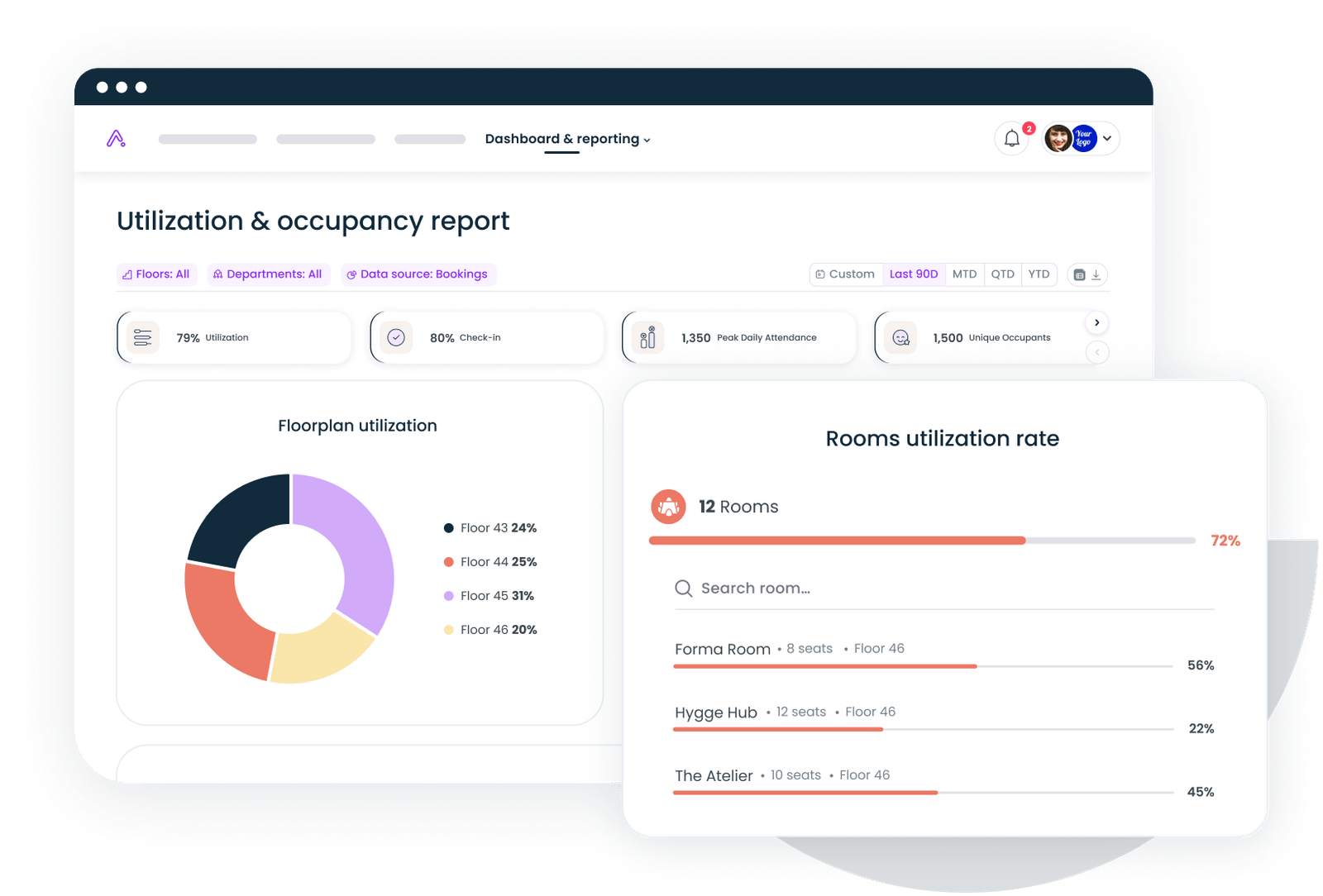
Gable Offices connects desk booking, room scheduling, and access control data in one platform, giving you a real-time view of what's deployed and how it's being used.
Learn more
Conducting audits and managing depreciation
Asset audits serve two masters: facilities (is the stuff where we think it is?) and finance (does our depreciation schedule reflect reality?). Most organizations treat these as separate exercises, which means facilities counts chairs while finance counts dollars, and nobody reconciles the two until year-end.
The facilities audit
A facilities audit answers four questions for every asset: Is it here? Does it work? Is it where the register says? Is it assigned correctly?
The most common finding isn't theft. It's drift. Departments swap monitors. Someone moves a whiteboard to a different floor. A contractor relocates desks during a renovation and nobody updates the system. Over six months, these small changes compound into a register that's 20-40% inaccurate.
To reduce drift, make updates easy. QR codes on assets that link to a mobile-friendly update form. A simple "I moved this" button. The harder you make it to report a change, the less likely anyone will bother.
The finance view
Finance tracks assets for depreciation, tax reporting, and insurance purposes. They care about acquisition cost, useful life, depreciation method (straight-line vs. declining balance), salvage value, and disposal date.
The gap between facilities and finance usually shows up as ghost assets: items that have been disposed of, lost, or broken but are still on the depreciation schedule. Ghost assets inflate your asset base, which can affect insurance premiums, property tax assessments, and financial ratios.
Bridging this gap requires a shared asset ID that both systems reference. When facilities decommissions an asset, finance should be notified automatically (or at least through a monthly reconciliation report) so the depreciation schedule gets updated.
Depreciation basics for workplace teams
Most office furniture depreciates over 7 years (IRS guidelines for office furniture and fixtures). IT equipment typically depreciates over 5 years. Leasehold improvements follow the lease term or the improvement's useful life, whichever is shorter.
If you're managing office expense tracking alongside asset management, your depreciation data feeds directly into your operating cost calculations. A desk that's fully depreciated but still functional has zero book value but real operational value. Knowing the difference helps you make smarter replacement decisions.
Managing assets across multiple office locations
Multi-site asset management is where spreadsheets go to die. The complexity isn't just volume; it's the coordination required when assets move between locations.
Centralized vs. distributed registers
Some organizations let each site maintain its own asset register. This works until someone at HQ needs a consolidated view for insurance, budgeting, or audit purposes. Then you're merging five spreadsheets with different column structures, different naming conventions, and different update frequencies.
A centralized register with location-level views is almost always better. One system of record, one data model, one set of naming conventions. Site managers can filter to their location. Leadership can see the portfolio view. If you're managing multiple office locations, your asset register should mirror your organizational structure.
Transfer workflows
When assets move between offices, you need a chain-of-custody process. It doesn't have to be elaborate, but it does need to exist.
A basic transfer workflow: the sending site scans the asset out (updating status to "in transit" and recording the destination). The receiving site scans it in (updating location and confirming condition). If the asset arrives damaged, the receiving site flags it. If it doesn't arrive at all, the discrepancy is caught within days, not months.
Without this workflow, furniture loss during moves is almost guaranteed. Most of it isn't theft; it's undocumented moves where departments swap items, contractors relocate desks, and nobody updates the register.
Relocation planning
Office relocations are the ultimate stress test for your asset management process. You need to know exactly what you have, decide what's coming to the new space, arrange disposition for everything else, and verify that what arrives matches what was shipped.
Start the asset reconciliation at least 90 days before the move. Walk every floor. Scan every tagged asset. Update conditions. Flag anything that should be disposed of rather than moved (it's cheaper to buy new than to ship old furniture that's past its useful life in many cases).
Building your asset register: Template and structure
You don't need expensive software to start. You need a consistent data model. Here are the fields every workplace asset register should include:
Core fields:
- Asset ID (unique identifier, alphanumeric, never reused)
- Category (FF&E, AV/IT, Access Control, Sensor/IoT, Other)
- Subcategory (desk, chair, monitor, badge reader, etc.)
- Description (make/model/color/size)
- Serial number (if applicable)
- Location: building, floor, zone, position
- Status (active, in storage, in transit, decommissioned)
Ownership and cost fields:
- Ownership type (owned, leased, rented)
- Vendor/supplier
- PO number
- Acquisition date
- Acquisition cost
- Warranty expiration
- Lease end date (if leased)
Lifecycle fields:
- Condition (new, good, fair, poor, non-functional)
- Last audit date
- Last maintenance date
- Next maintenance date
- Depreciation method
- Accumulated depreciation
- Net book value
Disposition fields:
- Decommission date
- Disposition method (sold, donated, recycled, scrapped)
- Disposition proceeds
- Authorized by
Start with the core and ownership fields. Add lifecycle and disposition fields as your process matures. The worst asset register is the one nobody uses because it's too complex to maintain.
The operational case for getting this right
Workplace asset management isn't glamorous work. Nobody gets promoted for maintaining an accurate furniture inventory. But the costs of getting it wrong are real and recurring.
You overspend on replacements because you don't know what you already have in storage. You pay insurance premiums on ghost assets that were scrapped two years ago. You fail audits because your books don't match your buildings. You waste days during relocations because nobody documented what's on the fourth floor.
The organizations that do this well treat asset management as a continuous process, not a project. They tag assets at procurement. They update locations when things move. They audit quarterly. They reconcile with finance annually. And they use systems that talk to each other so the data stays current without heroic manual effort.
It's not exciting. But it's the kind of operational discipline that separates workplace teams that are always reacting from ones that actually have time to think strategically.
Gable brings desk booking, room scheduling, and utilization data into one platform, so you always know what's deployed, where, and whether it's being used.
Get a demo