



.svg)


.svg)
- A workplace audit reviews operational performance, not just safety compliance
- Audit five dimensions: cost, space, experience, operations, and vendors
- Run a full audit annually with quarterly pulse checks on high-risk areas
- Use 25+ specific checkpoints with measurable thresholds to score each dimension
- Turn findings into a prioritized 90-day action plan with assigned owners
A workplace audit is a structured review of how well your workplace function is performing across cost, space utilization, employee experience, operations, and vendor management. It's not a safety inspection. It's not a lease audit. It's the operational equivalent of a financial audit, applied to the physical workplace. If you haven't run one recently, you're making decisions about your second or third largest line item based on gut feel.
What a workplace audit is
Most people hear "audit" and think compliance. OSHA walkthroughs. Fire extinguisher checks. That's a safety audit, and it matters, but it's a different exercise entirely. A lease audit is also different; that's about verifying what your landlord charges you against what your lease says.
A workplace audit, as we're using the term here, is an operational review of the workplace function as a whole. IFMA defines a facilities audit as a systematic process of inspecting and reporting on all services and assets within a facility. We're taking that concept and expanding it beyond physical assets to include employee experience, vendor performance, and cost efficiency.
Think of it this way: a safety audit asks "Is this building safe?" A workplace audit asks "Is this workplace working?"
The distinction matters because the people who should lead each audit are different, the cadence is different, and the outputs are different. A safety audit produces a compliance report. A workplace audit produces a strategic action plan.
What's in scope: The five dimensions
A useful workplace audit covers five interconnected dimensions. Skip one and you'll get a partial picture that leads to partial decisions.
1. Cost. What you're spending per occupied desk, how vendor invoices compare to contracted rates, and where costs are escalating without explanation. This is the dimension your CFO cares about most. Understanding your cost per desk is the foundation.
2. Space. How your space is actually being used versus how it's allocated. Utilization rates, peak day patterns, floor-by-floor comparisons. This is where the gap between what you're paying for and what you're using becomes visible.
3. Experience. What employees think about the workplace. Not just satisfaction surveys, but attendance patterns, feedback themes, and whether people are choosing to come in or being forced to. Your workplace NPS score is one input here, but not the only one.
4. Operations. How well the workplace runs day to day. Maintenance response times, ticket resolution rates, SLA adherence, incident frequency. This is the dimension that's easiest to measure and hardest to improve.
5. Vendors. Whether your service providers are delivering what they promised. Contract compliance, performance against SLAs, insurance and COI status, cost variance from original bids.
These five dimensions aren't siloed. A vendor underperforming on cleaning SLAs (dimension 5) shows up as employee complaints about office cleanliness (dimension 3), which drives down attendance (dimension 2), which makes your cost per occupied desk spike (dimension 1). The audit framework helps you trace those connections.
The 5-dimension audit framework: What to measure
Let's get specific about what to measure in each dimension. For each one, I'll cover the core metrics, the benchmarks you should compare against, and the data sources you'll need.
Cost
The goal here isn't just to know what you're spending. It's to know what you're spending relative to what you're getting.
Core metrics:
- Cost per occupied desk (not cost per desk; the "occupied" part matters)
- Total occupancy cost as a percentage of revenue
- Vendor spend variance (actual vs. contracted)
- Year-over-year cost escalation by category (janitorial, security, maintenance, supplies)
- Unplanned spend as a percentage of total facilities budget
Benchmarks: Your workplace spend benchmarks will vary by market and industry, but the key is tracking trends over time. A 15% year-over-year increase in janitorial costs with no change in scope deserves investigation.
What to watch for: Costs that creep up without a corresponding change in service level or headcount. Vendor invoices that consistently exceed estimates. Emergency maintenance spend that suggests deferred preventive maintenance.
Space
Space is where most workplace audits start, because the gap between allocation and utilization is usually the most dramatic finding.
Core metrics:
- Average daily utilization rate (desks, meeting rooms, collaboration areas)
- Peak day vs. low day utilization spread
- Meeting room no-show rate
- Desk-to-employee ratio vs. actual attendance
- Square footage per employee (allocated vs. needed)
Benchmarks: Meeting room no-shows average around 40%, which means nearly half of booked meeting space sits physically empty. If your numbers are in that range, you've got a booking behavior problem, not a space shortage problem. Understanding your office occupancy rate is the starting point for this dimension.
What to watch for: Floors or zones that consistently run below 30% utilization. Meeting rooms booked for two people that seat twelve. Days of the week where the office is essentially empty but fully staffed with reception, security, and HVAC.
Experience
This is the dimension most workplace teams either skip or reduce to a single annual survey. Both approaches miss the point.
Core metrics:
- Employee Net Promoter Score (eNPS) for the workplace specifically
- Attendance adherence (do people come in on the days they're expected?)
- Qualitative feedback themes (from surveys, Slack channels, help desk tickets)
- Amenity usage rates (cafeteria, gym, quiet rooms, collaboration spaces)
- Commute burden (average commute time, transportation subsidy usage)
Benchmarks: A good eNPS score is above 30; scores over 50 indicate exceptional satisfaction. But the number alone isn't enough. You need to understand what's driving it. A score of 40 with complaints about noise is a different problem than a score of 40 with complaints about commute time.
What to watch for: Declining attendance on non-mandatory days. Feedback themes that repeat quarter over quarter without resolution. Amenities that cost money but nobody uses. Running a workplace satisfaction survey at least quarterly gives you the trend data you need.
Operations
Operations is the engine room. When it works, nobody notices. When it doesn't, everyone notices.
Core metrics:
- Average response time for maintenance requests
- First-time fix rate
- Ticket volume trends (increasing volume may signal aging infrastructure)
- Planned vs. reactive maintenance ratio
- SLA adherence across all service categories
- Incident frequency and severity
Benchmarks: Industry benchmarks for first-time fix rate sit between 85% and 92%. Below 85% means your vendors are making repeat visits for the same issues, which costs you money and frustrates employees. Track this monthly, not annually.
What to watch for: Rising ticket volumes without a corresponding increase in headcount or space. Reactive maintenance outpacing planned maintenance (a sign of deferred investment). SLA breaches that go unclaimed as credits.
Vendors
Vendor management is the dimension most workplace teams handle informally. Contracts get signed, invoices get paid, and nobody checks whether the work matches the agreement until something goes wrong.
Core metrics:
- SLA compliance rate per vendor
- Cost variance (invoiced vs. contracted)
- Response time adherence
- Certificate of Insurance (COI) status and expiration tracking
- Contract renewal dates and auto-renewal clauses
- Vendor satisfaction score (your team's rating of the vendor)
Benchmarks: Vendor performance gaps cost facility owners $8,000 to $22,000 per vendor annually in undocumented rework, unclaimed SLA credits, and compliance penalties. Multiply that by your vendor count and the audit pays for itself.
What to watch for: Vendors with expired COIs (this is a liability issue, not just an administrative one). Auto-renewal clauses that lock you in without a performance review. Invoices that consistently exceed contracted rates by small amounts that individually seem trivial but add up.

If you're auditing workplace performance, you need a clear framework for measuring return on investment across all five dimensions.
Read the guide
25+ audit checkpoints: Your complete checklist
Here's the part you can print out and bring to your next team meeting. Each checkpoint is a specific question with a measurable answer. Score each one as green (on track), yellow (needs attention), or red (requires immediate action).
Cost checkpoints
- What is your cost per occupied desk this quarter vs. last quarter?
- What percentage of your facilities budget went to unplanned spend?
- Are vendor invoices within 5% of contracted rates?
- Which cost categories increased more than 10% year over year?
- Are you claiming all SLA credits you're entitled to?
- What's your total occupancy cost as a percentage of revenue?
Space checkpoints
- What's your average daily desk utilization rate?
- Which floors or zones are consistently below 40% utilization?
- What's your meeting room no-show rate?
- What's the utilization spread between your busiest and quietest days?
- How does your desk-to-employee ratio compare to actual peak attendance?
- Are any spaces allocated to teams that have since gone remote or hybrid?
Experience checkpoints
- What's your current workplace eNPS score?
- What are the top three complaint themes from the last quarter?
- What percentage of employees attend on their scheduled in-office days?
- Which amenities have usage rates below 20%?
- Have you acted on feedback from the previous quarter's survey?
- What's the average employee commute time, and has it changed?
Operations checkpoints
- What's your average maintenance response time?
- Is your first-time fix rate above 85%?
- What's the ratio of planned to reactive maintenance work orders?
- Are ticket volumes trending up, down, or flat?
- How many safety or security incidents occurred this quarter?
- Are all building systems (HVAC, elevators, fire suppression) on current maintenance schedules?
Vendor checkpoints
- Are all vendor COIs current and on file?
- Which vendors have SLA compliance below 90%?
- Are any contracts within 90 days of auto-renewal?
- Have you conducted a vendor performance review in the last 6 months?
- Are there vendors providing overlapping services?
- What's the total cost variance across all vendors this quarter?
Audit cadence: When and how often
Run a full audit annually. Cover all five dimensions, review every checkpoint, and produce a comprehensive scorecard. Time it to align with your budget cycle so findings can inform next year's planning.
Run quarterly pulse reviews on one or two dimensions. Pick the dimensions that scored worst in your last full audit, or the ones most affected by recent changes (a new office opening, a vendor transition, a shift in hybrid policy). These are lighter; maybe 10 checkpoints instead of 30, focused on tracking whether your corrective actions are working.
The BOMA 360 Performance Program provides a useful reference framework for building operations reviews. It evaluates buildings across operations, safety, energy, sustainability, and tenant relations. Your workplace audit borrows that structure but applies it to the workplace function rather than the building itself.
Some triggers warrant an off-cycle audit regardless of your regular cadence: a leadership change, a cost-cutting initiative, a major lease event, or a significant shift in headcount or work policy. Don't wait for the annual review if the ground has shifted under you.
Data sources: Where to pull your audit inputs
The biggest obstacle to a useful workplace audit isn't the framework. It's the data. Most workplace teams have data scattered across a dozen systems, and nobody's stitched it together.
Here's where to find what you need for each dimension:
Cost data: Your finance team's GL system, vendor invoices, purchase orders, and contract management platform. If you're tracking office expense management properly, most of this should be accessible.
Space data: Badge/access control systems for entry counts, desk and room booking tools for reservation data, WiFi connection logs for passive occupancy counts, and sensors for real-time presence detection. The key is distinguishing between booked space and occupied space. They're not the same thing. Gable's office management software consolidates booking, attendance, and utilization data into a single view, which eliminates the manual reconciliation that makes most space audits take weeks instead of days.
Experience data: HRIS for headcount and org structure, survey tools for eNPS and qualitative feedback, help desk systems for complaint themes, and attendance data from your booking or badge system.
Operations data: Your CMMS or facilities management platform for work orders, maintenance schedules, and SLA tracking. If you don't have a CMMS, you're probably tracking this in spreadsheets, which means your data is incomplete.
Vendor data: Contract management system for terms and renewal dates, accounts payable for invoice history, and your own vendor scorecard (if you have one; if you don't, the audit is a good time to start).
The goal is to build a workplace analytics infrastructure that makes future audits faster. The first audit is always the hardest because you're discovering where your data lives. By the third audit, data collection should take days, not weeks.
Gable Offices brings desk booking, room scheduling, visitor management, and utilization analytics into one platform, giving you the data foundation every workplace audit needs.
Learn more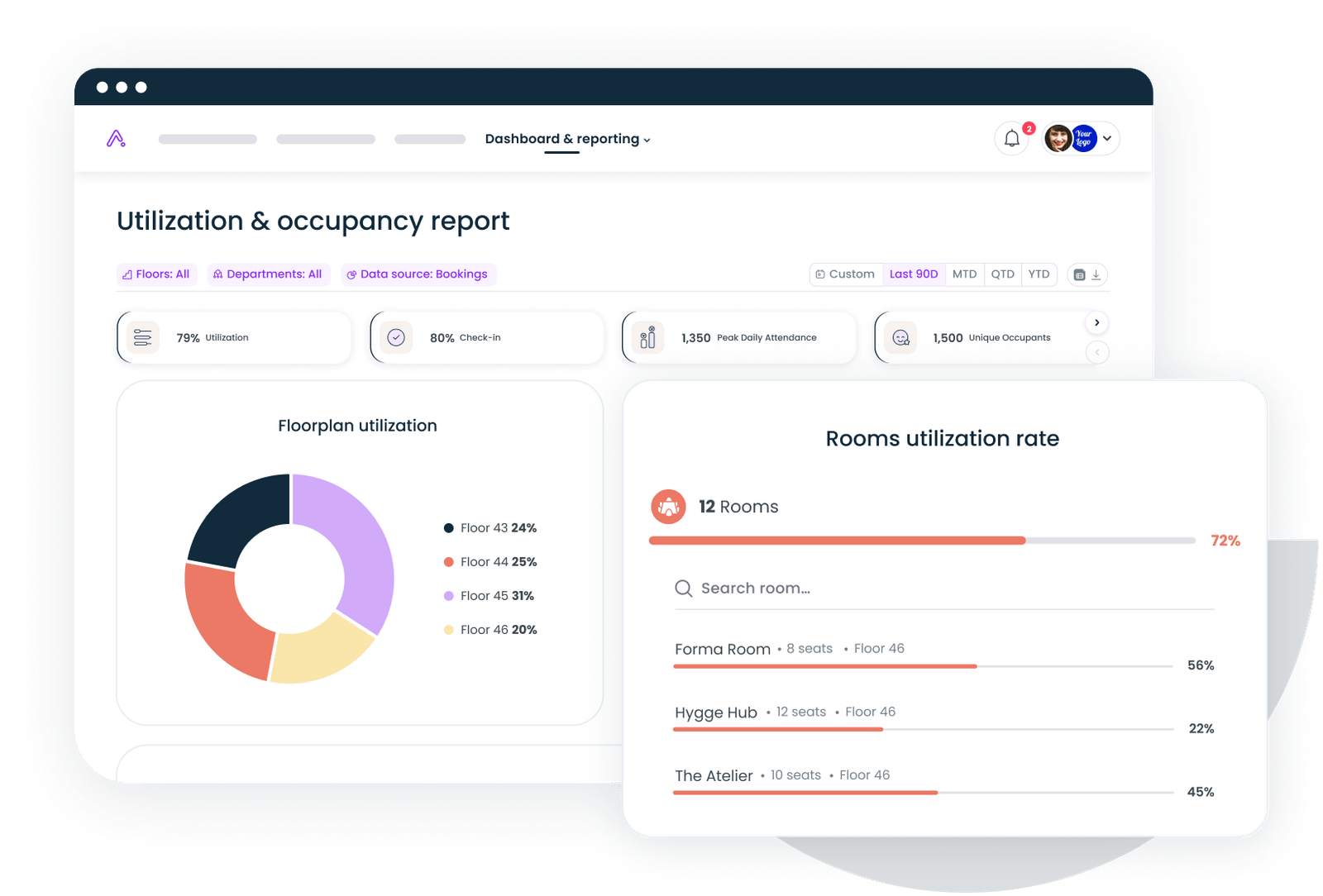
From audit findings to a 90-day action plan
An audit without an action plan is just an expensive spreadsheet. Here's how to turn findings into outcomes.
Step 1: Rank findings by impact and effort. Create a simple 2x2 matrix. High impact, low effort items go first. Low impact, high effort items go last (or get dropped entirely). Be honest about effort; "renegotiate the janitorial contract" sounds simple but takes 60 days if you need to run an RFP.
Step 2: Assign owners, not teams. Every action item gets a single person's name on it. "The facilities team will address this" means nobody will address this. Name the person. Set the deadline.
Step 3: Set 30/60/90-day milestones. Break each action into three checkpoints. At 30 days, what should be done? At 60? At 90? This prevents the common pattern where everything gets pushed to day 89.
Step 4: Define success metrics. For each action, specify what "fixed" looks like in measurable terms. "Improve meeting room utilization" isn't a success metric. "Reduce meeting room no-show rate from 42% to 25%" is.
Step 5: Schedule the follow-up. Put the 90-day review on the calendar now. Not "we'll schedule it later." Now. This is the accountability mechanism that makes the whole process work.
Example action items from a real audit:
Common mistakes that undermine workplace audits
Auditing your own work. The person who manages vendors shouldn't be the one auditing vendor performance. Build cross-functional audit teams, or bring in an outside perspective for the dimensions where objectivity matters most.
Collecting data without benchmarks. Knowing your utilization rate is 47% is meaningless without context. Is that good? Bad? Normal for your industry and work model? Always pair your numbers with external benchmarks or your own historical trends.
Treating the audit as a one-time event. A single audit gives you a snapshot. Value comes from the trend line across multiple audits. That's why cadence matters, and why you should keep your methodology consistent so you're comparing apples to apples.
Skipping the experience dimension. It's tempting to focus on cost and space because they're quantifiable. But employee experience is the leading indicator. By the time dissatisfaction shows up in your cost numbers (through lower attendance, higher turnover, or resistance to in-office policies), you've already lost months.
Not closing the loop. The most common failure mode: the audit produces a beautiful report, leadership nods approvingly, and nothing changes. The 90-day action plan with named owners and scheduled follow-ups is what separates audits that matter from audits that don't.
The workplace audit as a strategic tool
A well-run workplace audit isn't just a health check. It's the foundation for every major workplace decision you'll make in the next year.
Considering an office consolidation strategy? Your space dimension data tells you which locations are candidates. Renegotiating vendor contracts? Your vendor scorecards give you leverage. Building a business case for new technology? Your operations data shows where manual processes are breaking down.
The audit also gives you credibility with leadership. When you walk into a budget meeting with a scored framework, trend data, and a prioritized action plan, you're not asking for money based on anecdotes. You're presenting evidence. That's a different conversation entirely.
Start with the framework. Run the first audit. Accept that it'll be messy. The second one will be cleaner. By the third, you'll have a repeatable process that makes the workplace function measurable, accountable, and strategically relevant.
From desk booking analytics to real-time utilization data, Gable gives workplace leaders the inputs they need for audits that drive action.
Get a demo

