.svg)


.svg)
- Your office carbon footprint spans three scopes: direct fuel, purchased energy, and employee commuting
- Employee commuting is often the largest emissions category for hybrid offices
- Underutilized buildings inflate per-person carbon intensity; occupancy data fixes the math
- A two-day-plus hybrid schedule cuts emissions 11-29% with zero capital cost
- Benchmark against per-employee intensity (tCO2e/FTE/year) to track real progress
Measuring your office carbon footprint isn't optional anymore. Between ESG disclosure requirements, investor pressure, and employees who actually care where their company stands, you need real numbers. This guide walks through each step: defining your measurement boundary, calculating Scope 1, 2, and 3 emissions, benchmarking against peers, and prioritizing reductions that make financial sense.
Why your office carbon footprint matters now
The pressure isn't theoretical. Building operations account for 28% of global energy-related CO2 emissions. That's not a rounding error. And if your company has any ESG reporting obligations, or plans to pursue them, you'll need a defensible methodology for measuring what your offices contribute.
Here's the thing most workplace leaders miss: carbon measurement isn't just a sustainability exercise. It's a real estate efficiency exercise. When you measure emissions per employee, you quickly see that half-empty buildings are carbon disasters. A 200-person office running at 40% occupancy doesn't produce 40% of the emissions. It produces nearly the same HVAC load, the same lighting draw, the same base energy consumption, spread across fewer people. Your office occupancy rate directly determines your per-person carbon intensity.
That connection between utilization and emissions is why workplace teams, not just sustainability officers, should own this measurement.
Understanding scope 1, 2, and 3 for office operations
The GHG Protocol Corporate Standard is the framework you'll use. It divides emissions into three scopes, and each one maps to specific office operations.
Scope 1: Direct emissions. These come from sources your company owns or controls. In an office context, that means natural gas for heating, propane for backup generators, diesel for emergency power, and refrigerant leaks from HVAC systems. Refrigerant leakage is the one people forget; it can represent 10% or more of your total Scope 1.
Scope 2: Purchased energy. This is your electricity bill. Lighting, cooling, heating (if electric), plug loads from computers and monitors, elevators, server rooms. For most offices, Scope 2 is the largest single category you directly control.
Scope 3: Indirect emissions. This is the big one for hybrid offices. Employee commuting (Category 7 in GHG Protocol terms) often accounts for 40-50% of total office-related emissions. Business travel, waste disposal, purchased goods, and water treatment also fall here. But commuting is where the real leverage lives, especially if you're running a hybrid work model.
Think of it this way: Scope 1 and 2 are about the building. Scope 3 is about the people getting to and from it.
Step 1: Define your measurement boundary and baseline
Before you measure anything, you need to decide what you're measuring. This sounds obvious, but it's where most companies stumble.
Which facilities? Include every office your company operates: headquarters, satellite offices, coworking memberships, and on-demand spaces. If you're in a multi-tenant building, you'll need to determine your proportional share of common-area energy (lobbies, shared HVAC, parking garages). Your lease should specify this, but if it doesn't, ask your landlord for the building's total energy consumption and calculate your share by square footage.
Operational vs. financial control. The GHG Protocol gives you two approaches. Operational control means you count emissions from facilities you operate, even if you don't own them. Financial control means you count emissions from facilities where you have the ability to direct financial and operating policies. For most companies leasing office space, operational control is the simpler and more common choice.
Set a baseline year. Pick a recent year with reliable data. This becomes your reference point for tracking reductions. If your company went through major changes (office consolidation, a shift to hybrid), choose a year that reflects your current operating model. Comparing against a pre-pandemic baseline when everyone was in the office five days a week isn't useful if that's never happening again.
Document everything. Write down your boundary decisions, data sources, and assumptions. You'll need this for any ESG reporting and for internal credibility when you present results to leadership.
Step 2: Measure scope 1 Emissions (direct sources)
Scope 1 is the most straightforward to calculate because the data comes from your own records.
Natural gas. Pull your utility bills for the measurement period. You need total consumption in therms or cubic feet. Then apply the emission factor:
> Natural gas consumption (therms) × 0.005302 metric tons CO2/therm = CO2 emissions
On-site fuel. If you have backup generators running on diesel, or propane heating, collect fuel purchase records. Diesel emission factor: 0.01021 metric tons CO2 per gallon. Propane: 0.005740 metric tons CO2 per gallon.
Refrigerant leakage. This one requires maintenance records from your HVAC contractor. You need the type of refrigerant (R-410A, R-134a, etc.) and the amount recharged during the year. Each refrigerant has a Global Warming Potential (GWP) multiplier. R-410A, for example, has a GWP of 2,088, meaning one kilogram of leaked R-410A equals 2,088 kg of CO2 equivalent.
Pro tip: If you're in a leased space and don't control the HVAC system, your landlord's maintenance team should have refrigerant recharge records. Ask for them. If they can't provide them, estimate based on system age and type; older systems leak more.

Once you've measured your footprint, the next step is designing spaces that reduce it. This guide covers practical strategies beyond LEED certification.
Read the guide
Step 3: Measure scope 2 Emissions (purchased electricity)
Electricity is usually the largest emissions source you can directly influence through building operations. The calculation is simple; the nuance is in which method you choose.
Gather your electricity data. Pull 12 months of utility bills. You need total kilowatt-hours (kWh) consumed. If you're in a multi-tenant building with a single meter, work with your landlord to get your proportional share. U.S. offices average about 15 kWh per square foot annually, so if your landlord can't provide exact data, you can estimate using your leased square footage.
Location-based method. This uses the average grid emission factor for your region. The EPA publishes eGRID factors annually by subregion. The formula:
> Electricity (kWh) × Regional grid emission factor (kg CO2/kWh) = CO2 emissions
For example, if your New York office consumed 500,000 kWh and the NYUP subregion factor is 0.22 kg CO2/kWh, your Scope 2 emissions are 110 metric tons CO2.
Market-based method. If you've purchased renewable energy certificates (RECs) or have a power purchase agreement (PPA) with a wind or solar provider, you can use the supplier-specific emission factor instead. This often results in lower reported emissions, but you need contractual proof.
Which method should you use? Report both. The GHG Protocol recommends dual reporting. The location-based number shows your actual grid impact. The market-based number reflects your purchasing decisions. Most ESG frameworks expect to see both.
Don't forget plug loads. Computers, monitors, kitchen appliances, and phone chargers collectively add up. In a typical office, plug loads account for 25-30% of total electricity consumption. You can't easily measure each device, but you can estimate based on equipment inventories and average wattage ratings.
Connecting this to space utilization data matters here. If you know that Floor 3 runs at 20% occupancy on Fridays, you can calculate how much energy that floor consumes for essentially no productive purpose. That's actionable information for both your carbon report and your real estate strategy.
Step 4: Measure scope 3 Emissions (commuting and travel)
This is where hybrid offices have both their biggest challenge and their biggest opportunity. Employee commuting is typically the single largest emissions category for knowledge-work offices, and it's the one most directly affected by your workplace policy.
Commuting emissions: the math. You need three data points per employee: distance to office (one way), commute mode (car, transit, bike, walk), and number of commute days per year.
The formula for car commuters:
> Round-trip distance (miles) × Days commuted/year × Emission factor (kg CO2/mile) = Annual commuting CO2
For a solo driver, the average emission factor is roughly 0.39 kg CO2 per mile (based on average U.S. passenger vehicle efficiency). Public transit is significantly lower: about 0.10-0.15 kg CO2 per passenger-mile depending on the system.
How to collect the data. Send a short survey asking employees for their home zip code (not full address), primary commute mode, and typical commute days per week. You don't need GPS-level precision. Zip code to office distance, calculated via a mapping API, gets you within 5-10% accuracy, which is more than sufficient for carbon accounting.
If you have badge-swipe or access control data, use it to validate survey responses. People tend to overestimate how often they come in. Actual badge data from your workplace analytics platform gives you ground truth.
The hybrid advantage. This is where policy design directly reduces emissions. A two-to-four-day remote schedule cuts emissions by 11-29%, primarily from reduced commuting. But there's a catch: a one-day-per-week remote policy barely moves the needle (less than 2% reduction) because the building still runs at full capacity and employees still commute four days.
The real lever is combining fewer commute days with seat-sharing. When two employees share one desk on alternating days, you don't just cut commuting; you cut the real estate footprint those employees require. That's a double reduction: less driving and less building to heat, cool, and light.
Business travel. Don't ignore flights and hotel stays. Pull data from your travel management system or expense reports. Air travel emission factors vary by distance and class: short-haul economy is roughly 0.255 kg CO2 per passenger-mile; long-haul economy drops to about 0.195 kg CO2 per passenger-mile due to fuel efficiency at cruise altitude.
Step 5: Calculate per-employee carbon intensity
Raw tonnage numbers are hard to act on. Normalizing emissions per employee gives you a metric you can benchmark, track over time, and use to compare across locations.
The formula:
> Total office CO2e (Scope 1 + 2 + 3) ÷ Number of employees = tCO2e per FTE per year
Why this matters for hybrid offices. A 50,000 sq ft office with 300 assigned employees but average daily occupancy of 120 people has very different per-person intensity than the same building running at 280 people daily. The building's total emissions might be similar (HVAC doesn't scale linearly with occupancy), but the per-person number tells you how efficiently you're using that carbon budget.
This is where Gable's occupancy and utilization data becomes a carbon measurement input, not just a space planning tool. If your booking system shows that Building A runs at 75% utilization and Building B runs at 35%, you can calculate per-person intensity for each location and make informed decisions about consolidation.
Rough benchmark. Energy-intensive offices (older buildings, extreme climates) typically land around 2.5-3.5 tCO2e per FTE per year including commuting. Efficient buildings with hybrid policies can get below 1.5 tCO2e per FTE. Your number will depend on climate zone, building age, grid carbon intensity, and commute patterns.
Break it down by location. If you manage multiple office locations, calculate per-employee intensity for each one. This reveals which buildings are your carbon hotspots and where interventions will have the most impact.
Carbon intensity per employee is one of five metrics every workplace leader should monitor. See how it connects to cost, utilization, and experience.
Learn more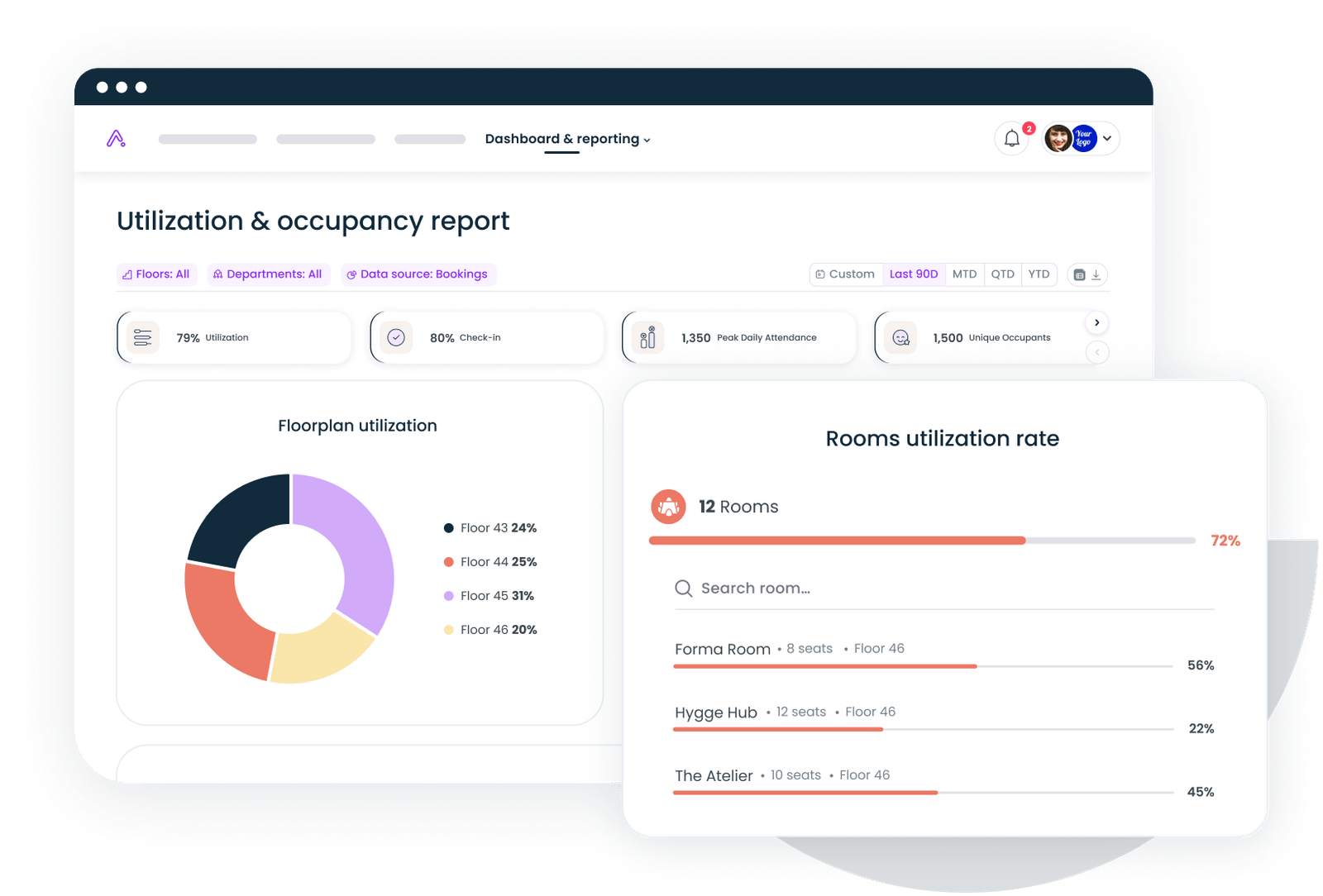
Step 6: Benchmark against industry standards
Your numbers mean nothing without context. Benchmarking tells you whether you're ahead, behind, or in line with peers.
Frameworks to use:
- ENERGY STAR Portfolio Manager. Free tool from the EPA. Enter your building's energy data and get a 1-100 score relative to similar buildings nationwide. A score of 75 or above qualifies for ENERGY STAR certification.
- GRESB. The Global Real Estate Sustainability Benchmark. If your company owns real estate or your landlord participates, GRESB scores provide peer comparison across property types and regions.
- Science Based Targets initiative (SBTi). Sets reduction targets aligned with limiting warming to 1.5°C. Useful for setting goals, not just measuring current state.
- CDP (formerly Carbon Disclosure Project). If your company reports to CDP, their sector benchmarks show where you stand relative to peers who disclose.
What "good" looks like. There's no single universal benchmark for office carbon intensity because it depends on too many variables (climate, grid mix, building age, hybrid policy). But directionally: if your per-FTE number is above 3.0 tCO2e/year and you're in a temperate climate with a modern building, something's off. If you're below 1.5 tCO2e/year with a hybrid workforce, you're in strong shape.
Compare your locations to each other. Internal benchmarking is often more actionable than external. If your Austin office runs at 1.8 tCO2e/FTE and your Chicago office runs at 3.2 tCO2e/FTE, dig into why. Is it the grid? The building? The commute patterns? The occupancy rate? This analysis drives your corporate real estate strategy decisions.
Step 7: Prioritize reductions by cost per ton avoided
Measurement without action is just accounting. The final step is ranking your reduction opportunities by cost-effectiveness.
Zero-cost and low-cost interventions:
- Optimize HVAC schedules. If your building runs full HVAC from 6 AM to 8 PM but nobody arrives before 9 AM, you're heating or cooling empty space for three hours daily. Adjust schedules based on actual occupancy patterns.
- Implement a two-plus-day hybrid policy. Hybrid models have reduced energy usage by nearly 19% through more efficient space use. The capital cost is zero if you already have the infrastructure. The carbon savings come from reduced commuting and the ability to consolidate into fewer floors or buildings.
- LED lighting retrofit. LEDs use roughly 75% less energy than fluorescent tubes. Payback period is typically 12-18 months. After that, it's pure savings on both your electricity bill and your Scope 2 emissions.
- Seat-sharing. When employees share desks on alternating days, you can reduce your real estate footprint without reducing headcount. Fewer square feet means less energy, less maintenance, and lower Scope 1 and 2 emissions.
Medium-cost interventions:
- Renewable energy procurement. Signing a virtual PPA or purchasing RECs reduces your market-based Scope 2 to near zero. Costs vary, but corporate PPA prices have stabilized in many markets.
- Building envelope improvements. Better insulation, window upgrades, and air sealing reduce heating and cooling loads. These typically have 3-7 year payback periods.
- Commuter benefits redesign. Subsidizing transit passes, e-bike purchases, or commuter benefits for hybrid workers shifts commute modes away from solo driving. The per-ton cost is low relative to building retrofits.
High-cost, high-impact interventions:
- Facility consolidation. If occupancy data shows you're running three half-empty offices, consolidating into two well-used ones can cut total emissions by 30-40%. The cost is the move itself and any lease-break penalties, but the ongoing savings (both financial and carbon) are substantial.
- Electrification. Replacing gas-fired heating with electric heat pumps eliminates Scope 1 from natural gas. Combined with renewable electricity, this can zero out building operational emissions. Capital costs are significant but declining.
Build a marginal abatement cost curve. For each intervention, calculate the cost per metric ton of CO2 avoided. Plot them from cheapest to most expensive. This gives leadership a clear visual: "Here's what we can eliminate for free, here's what costs $50/ton, and here's what costs $200/ton." It turns a sustainability conversation into a capital allocation conversation, which is the only way it gets funded.
Putting it all together: Your measurement checklist
Here's a summary of what you need to collect and calculate across all three scopes:
The measurement is the strategy
Most companies treat carbon measurement as a compliance exercise: something the sustainability team does once a year for a report nobody reads. That's a missed opportunity. When you measure your office carbon footprint properly, broken down by scope, normalized per employee, and compared across locations, you're actually building the analytical foundation for smarter real estate decisions.
The office running at 35% occupancy isn't just wasting money. It's wasting carbon. The commute policy that brings everyone in five days a week isn't just unpopular. It's your largest single emissions source. The building with the ancient HVAC system isn't just uncomfortable. It's your most expensive ton of CO2.
Measurement connects these dots. And once you see the connections, the reduction priorities become obvious: right-size your space, optimize your hybrid policy, and invest in building efficiency where the per-ton cost makes sense. That's not a sustainability strategy. That's just good workplace management.
Gable turns occupancy, booking, and utilization data into actionable insights, including the inputs you need for accurate carbon measurement.
Get a demo