.svg)


.svg)
- A hybrid job splits your time between working remotely and working from a physical office, with schedules varying by company
- 52% of remote-capable U.S. employees now work hybrid, making it the dominant work arrangement in 2026
- Stanford research found that hybrid workers are just as productive and promotable as full-time office workers, with 33% lower resignation rates
- Workers value hybrid flexibility at roughly the equivalent of an 8% pay raise, meaning many would accept lower compensation to keep the arrangement
- 24% of new job postings now offer hybrid schedules, while fully remote roles have stabilized at 12%
A hybrid job is a position where you split your working time between a company office (or other physical location) and a remote setting, typically your home. Unlike fully remote roles, hybrid jobs include regular in-person days, and unlike traditional office jobs, they give you the flexibility to work from wherever suits you best for part of the week. With more than half of all remote-capable employees now working hybrid and the majority saying it's their preferred arrangement, this model has become the standard for knowledge workers across nearly every industry.
What is a hybrid job, and how is it different from remote work?
The simplest way to think about a hybrid job: you have a home base (an office) and the freedom to work from elsewhere on certain days. The specifics vary widely. Some companies ask for two office days a week. Others set a minimum of four. Some let you choose which days, while others assign them.
Remote work, by contrast, means you have no expectation of showing up to a physical workplace at all. You might live in a different city or even a different country from your employer's headquarters. There's no commute, no assigned desk, no in-office days on the calendar.
The practical difference matters more than the label. In a hybrid role, you still need to live within commuting distance of an office (or be willing to travel periodically). You'll attend in-person meetings, collaborate face-to-face with colleagues, and participate in the social rhythms of an office environment. On remote days, you handle deep-focus work, independent projects, and virtual meetings from wherever you're most productive.
The distinction has gotten muddier as return-to-office policies have shifted the landscape. Some roles labeled "remote" now require quarterly on-site visits. Some "hybrid" roles expect you in the office four days a week, which feels functionally full-time. The takeaway: always read the fine print on a job posting and ask about the actual schedule before assuming what "hybrid" means at a particular company.
It's also worth noting that "hybrid job" can mean something entirely different in some contexts. In workforce development, a hybrid job (or hybrid role) refers to a position that combines responsibilities from two traditionally separate functions, like a marketing analyst who also handles data engineering. For this article, we're focused on the more common usage: hybrid as a flexible work arrangement that blends remote and in-office time.
Types of hybrid work schedules
Not all hybrid jobs work the same way. Companies design their hybrid schedules around different priorities, from maximizing employee autonomy to ensuring teams are in the same room at the same time. Here are the most common models you'll encounter.
Fixed-schedule hybrid is the most structured approach. Your company specifies exactly which days you're in the office and which days you work remotely. Google, for example, requires employees to be on-site Tuesday through Thursday. This model makes it easy for teams to plan around shared office days, but it offers the least individual flexibility. Many companies with hybrid work models use this approach because it balances predictability with some remote flexibility.
Flexible hybrid gives you the autonomy to choose when you come in, as long as you meet a minimum number of office days per week or month. You might be asked to show up three days a week, but you pick which three. This works well for people who want to schedule around personal commitments, childcare, or varying workloads.
Office-first hybrid leans heavily toward in-person presence, typically four office days with one remote day. Companies using this model view the office as the default and treat remote work as a perk rather than a core part of the schedule.
Remote-first hybrid flips the script. The default is working from home, with occasional in-office time for specific purposes like team planning sessions, all-hands meetings, or collaborative workshops. Spotify's "Work From Anywhere" policy is a well-known example of this approach.
Project-based hybrid ties your schedule to the work itself rather than a fixed calendar. You might spend two weeks fully remote while doing independent research, then come into the office daily for a product launch sprint. This model is common in consulting, creative agencies, and product teams.
Research suggests there's a sweet spot: satisfaction and engagement tend to peak when employees spend about three days in the office and two at home. But the right schedule depends on your role, your team's needs, and your own work style.
Hybrid jobs by industry: where hybrid works and where it doesn't
Hybrid work is widespread, but it's not evenly distributed across industries. Understanding which sectors embrace hybrid scheduling can help you target your job search more effectively.
Technology leads the pack. Software engineering, product management, UX design, and data science roles have been hybrid-friendly since well before the pandemic. Most tech companies now offer some form of flexible scheduling, and 24% of all new job postings offer hybrid arrangements across industries. In tech specifically, that number is even higher.
Financial services have increasingly adopted hybrid models, particularly for roles in corporate finance, accounting, compliance, and analysis. Major banks initially pushed hard for full return-to-office, but many have settled into structured hybrid schedules of three to four office days. Client-facing roles like wealth management and investment banking still skew heavily toward in-person work.
Professional services (consulting, law, marketing agencies) tend to use project-based hybrid models. When you're collaborating on a client deliverable or preparing for a presentation, you come in. When you're doing research, writing, or individual analysis, you work from home.
Healthcare is a clear divider. Clinical roles (nurses, physicians, technicians) require physical presence. But administrative, billing, telehealth, and health IT roles have widely adopted hybrid schedules. If you're in healthcare and want hybrid, look at the operational side of the organization.
Manufacturing, retail, and hospitality remain largely on-site by necessity. You can't assemble products, serve customers, or manage a hotel lobby from home. However, corporate functions within these industries (HR, marketing, finance, IT) are often hybrid.
Education is evolving. Higher education administration and edtech companies have embraced hybrid work, while K-12 teaching remains on-site. Many universities now offer hybrid schedules for non-teaching staff, including admissions, financial aid, and academic advising.
For job seekers, the pattern is clear: if your role involves primarily knowledge work, communication, or digital tools, there's a good chance a hybrid option exists. If it requires physical presence, the role will likely stay on-site. Companies that have adopted hot desking and flexible seating are usually a sign that hybrid is built into the culture, not just a policy on paper.

Amazon's RTO mandate cost them trust, talent, and millions in wasted real estate. Here's what the data says about top-down office policies.
Read the analysis
Benefits of a hybrid job
Hybrid work isn't just popular because it sounds nice. The research backing its benefits has gotten increasingly strong over the past few years.
Flexibility without isolation. The biggest advantage hybrid has over both fully remote and fully in-office work is the blend. You get focused, uninterrupted time at home for deep work, and you get face-to-face collaboration, mentorship, and social connection in the office. According to recent workplace data, hybrid workers report higher engagement than their fully in-office peers.
Productivity stays the same (or improves). One of the most rigorous studies on hybrid work, a randomized controlled trial published in Nature by Stanford economist Nicholas Bloom, tracked 1,612 employees at a major technology company over two years. The result: employees who worked from home two days a week were just as productive as their full-time office counterparts. Managers in the study actually changed their minds about hybrid work's effect on output, shifting from expecting a negative impact to perceiving a slight positive one.
Better retention. That same Stanford study found that resignations dropped by 33% among employees who switched from full-time office work to a hybrid schedule. The reduction was especially pronounced among non-managers, women, and people with long commutes. For job seekers, this means companies offering hybrid roles are more likely to retain talent, creating more stable teams and better work environments.
Real salary value. Bloom's research also quantifies what hybrid flexibility is worth financially: employees value it at roughly 8% of their salary. That means many workers would accept an 8% pay cut to keep their hybrid arrangement, or conversely, they'd need an 8% raise to give it up. Other surveys put the number even higher, with employees saying they'd need a 25% salary bump to go back to the office full-time.
Work-life balance. Cutting even two or three commute days per week adds hours back to your life. Hybrid employees consistently report less burnout, more time with family, and better physical health than those commuting five days a week. The flexibility to handle a midday appointment, pick up kids from school, or simply avoid rush-hour traffic is one of the most cited reasons people prefer hybrid arrangements.
Challenges of a hybrid job and how to navigate them
Hybrid work isn't without friction. Here are the most common challenges, along with practical ways to handle them.
Proximity bias is the tendency for managers to favor employees they see in the office more often. If your manager is in-office daily and you come in twice a week, you might get fewer high-visibility assignments or less face time during promotion discussions. The fix: be intentional about your in-office days. Schedule them to overlap with key stakeholders, team meetings, and decision-making conversations. Make your remote-day output visible through regular updates and documentation.
Schedule misalignment happens when your hybrid schedule doesn't match your team's. You show up on Wednesday, but half your team works from home that day. The result: empty collaboration spaces and virtual meetings you could have taken from your couch. McKinsey's research found that 17% of employees who recently quit cited changes to office policies as a primary reason, suggesting that poorly coordinated hybrid setups push people out. Before accepting a hybrid job, ask how teams coordinate their in-office days.
The workspace challenge. Not everyone has a great home office setup, and commuting to a company office every in-person day isn't always practical, especially if you live far from headquarters. This is where flexible workspaces come in. Many hybrid workers now use coworking spaces and on-demand offices for their in-person days, either booked by their employer or chosen independently. Platforms like Gable On-Demand give hybrid employees access to over 14,000 coworking spaces globally, making it easier to find a professional workspace near home when the company office isn't convenient. According to Gable's data, 72% of workspace bookings are for team gatherings, which underscores a broader trend: the office is shifting from a place you sit at a desk to a place you go for collaboration.
Communication gaps. When some people are remote and others are in-office, information flows unevenly. Hallway conversations happen that remote workers miss. Meeting dynamics shift when half the room is on a screen. The solution is structured communication: shared documentation, async updates, and making sure every important conversation happens in a channel everyone can access, not just the people who happened to be in the building.
Career development concerns. Some professionals worry that working remotely part of the week will slow their growth. Bloom's Stanford study addressed this directly: hybrid workers were promoted at the same rate as full-time office workers. If your company has a healthy hybrid culture, your career trajectory shouldn't suffer. If it doesn't, that's a sign of organizational issues, not a flaw in the hybrid arrangement itself.
Companies that invest in desk sharing systems and thoughtful office space planning tend to handle these challenges better because they're designing their physical environment to match how hybrid teams actually work.
Gable On-Demand gives you access to 20,000+ coworking spaces worldwide, so you can work from a professional environment near home on your remote days.
Learn more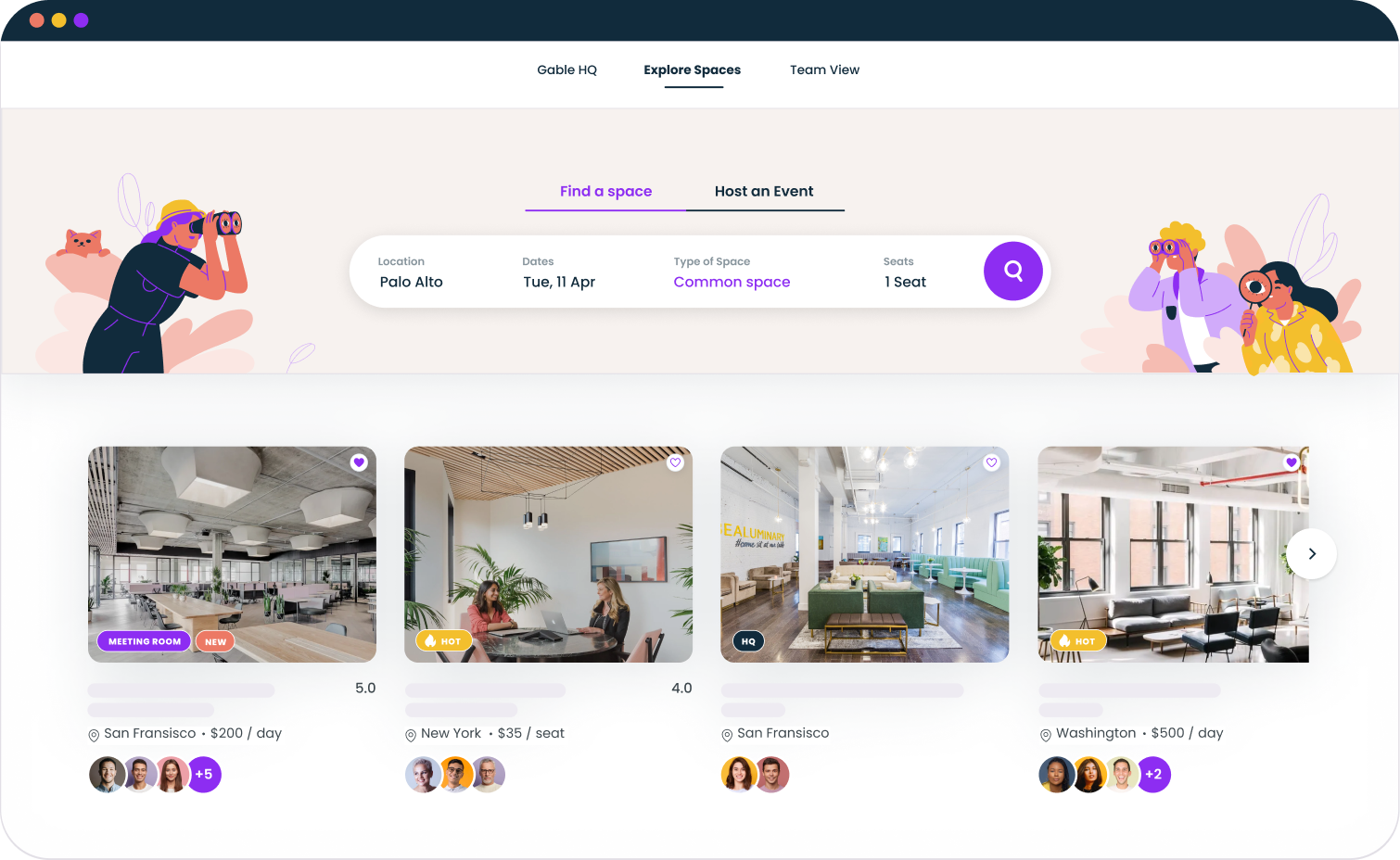
Questions to ask before accepting a hybrid job
A job posting that says "hybrid" can mean almost anything. Before you accept a hybrid role, get clarity on the specifics. Here are the questions worth asking during the interview process.
"What does your hybrid schedule actually look like?" Get concrete details. How many days per week are expected in-office? Are specific days required, or can you choose? Does the policy vary by team? Some companies advertise "hybrid" but expect four office days, which is functionally full-time with a work-from-home Friday.
"How does the team coordinate in-office days?" Find out whether your future team aligns their schedules. A hybrid job where you come in alone defeats the purpose of in-person time. The best hybrid setups have teams in the office on the same days, which makes collaboration intentional rather than accidental.
"Is the hybrid policy stable, or is it likely to change?" High-profile return-to-office mandates from companies like Amazon and JPMorgan have made this question essential. Ask about the company's recent history with remote and hybrid policies. If they've changed the policy twice in the last year, expect more changes.
"What tools and support do you provide for remote work?" Look for companies that invest in the infrastructure, not just the policy. Home office stipends, reliable video conferencing, async communication tools, and clear documentation practices are all signals that the company takes hybrid seriously.
"How do you evaluate performance for hybrid employees?" This gets at the proximity bias question. You want to hear about outcome-based performance reviews, not time-in-seat metrics. If the answer focuses on visibility and office presence, that's a red flag.
"Where do employees work on their in-office days?" Some companies have dedicated desks for everyone. Others use shared seating, hot desking, or coworking spaces. Understanding the physical setup helps you picture your actual day-to-day experience and whether the company has invested in making in-person time worthwhile.
Hybrid jobs are here to stay
The data is unambiguous: hybrid work is the dominant model for knowledge workers in 2026, and it's not going anywhere. More than half of remote-capable employees work hybrid, the majority say it's their preferred arrangement, and companies that offer it see lower turnover, equal (or better) productivity, and stronger engagement.
For job seekers, the practical takeaway is straightforward. If you want flexibility, you have more options than ever. But "hybrid" is a broad label, and the quality of a hybrid job depends entirely on how the company implements it. Ask the right questions, look for data-driven workplace cultures, and pay attention to whether in-office time is intentional or just attendance theater.
Gable On-Demand helps companies and employees make hybrid work actually work by providing access to 14,000+ coworking and on-demand workspaces globally. Whether you need a quiet desk near home for focused work or a meeting space for a team gathering, flexible workspace access removes one of the biggest friction points in hybrid work.
See how Gable helps companies build flexible workplace strategies that keep hybrid employees productive and engaged.
Get a demo