.svg)


.svg)
- Modern badge systems do far more than open doors: they issue mobile credentials, log every entry, and feed occupancy data to workplace decisions.
- Gable is the top pick for offices that want badge data connected to desk booking, visitor management, and occupancy analytics; it's the platform layer, not the hardware.
- Tailgating is the most common access-control failure, named by 61% of security professionals.
- Cloud-managed systems with mobile credentials are now the default for new deployments.
- Pick hardware for your doors, and a platform for your data.
A security badge system controls who gets through your doors, and increasingly, what your company learns from it. The stakes are concrete: tailgating is the most common access-control failure, cited by 61% of security professionals, and only 8% of organizations reported zero access-control failures in the past six months, per an ASIS International survey. With the average data breach now costing $4.44 million globally, according to IBM, the lobby is part of the security perimeter. This guide compares the 10 best security badge systems for large office buildings in 2026, covering one platform layer and nine access-control vendors.
What modern office badge systems do
The badge itself is the least interesting part. Modern systems issue credentials to phones and smartwatches as readily as plastic cards, with mobile credentials already deployed by 37% of organizations and planned by another 32%, per HID's 2025 industry report.
More importantly, badge systems became data systems. Every entry event is a timestamped record of who was where, which makes badge data the backbone of office occupancy measurement, attendance reporting, and space planning. And they became connected systems: a modern deployment links the physical access control system to visitor management, desk booking, and HR directories, so credentials follow people automatically through onboarding, role changes, and exits. The market reflects the shift: access control is projected to grow from $10.62 billion in 2025 to $15.80 billion by 2030, per MarketsandMarkets.
What to look for in a security badge system
- Credential flexibility: plastic badges, mobile wallets, and PINs, so you can migrate gradually.
- Cloud management: multi-site administration from one dashboard, without on-prem servers at every building.
- Visitor handling: temporary credentials and a visitor access management system that issues, tracks, and expires guest badges.
- Integrations: HR directory sync, SSO, video, and workplace platforms, so access data doesn't live in a silo.
- Auditability: entry logs, role-based admin permissions, and certifications such as SOC 2 or ISO 27001, verified on the vendor's trust page.
10 Best Security Badge Systems for Offices and Hybrid HQs
We weighed office and enterprise fit, credential options, cloud architecture, integrations, and real user reviews. One note on category: Gable leads the list as the platform layer that makes badge data useful, and works with several of the hardware vendors below it.
1. Gable
Gable is not a badge hardware vendor. It's the workplace platform layer that sits on top of your access control system, integrating with vendors like Brivo, Verkada, and Kisi, and turns badge data into something your workplace team can use: occupancy analytics, desk booking that reflects who's in, and visitor management with badge printing.
Security teams keep their hardware; workplace teams finally get the data. Gable is SOC 2 Type II compliant and GDPR-ready, with SSO and role-based access.
- Integrates with access control systems, including Brivo, Verkada, and Kisi
- Connects badge and access data to desk booking and occupancy analytics
- Visitor management with badge printing, pre-registration, and host alerts
- SOC 2 Type II, GDPR, SSO, and role-based access controls
- Pricing: Visitor Management from $99 per location per month; Office Management from $2.50 per user per month
- G2 rating: 4.5/5 (131 reviews)
2. Brivo
Brivo pioneered cloud access control as a service, and its per-door subscription model suits multi-site portfolios, standardizing on one system without server rooms.
- Mobile credentials via Brivo Mobile Pass
- Fully cloud-hosted with multi-site Global View administration
- SOC 2 Type II certified; integrates with Gable visitor management
- Pricing: quote-based, per-door subscription
- G2 rating: 4.6/5 (35 reviews)
3. Verkada
Verkada unifies access control, cameras, and sensors in one cloud dashboard, which appeals to IT-led teams that want video-verified entry events without stitching vendors together.
- Badge, mobile, and PIN credentials with cloud-native door controllers
- Access events paired with video in one Command dashboard
- SOC 2 Type II and ISO 27001 certified
- Pricing: quote-based, hardware plus per-door license
- G2 rating: 4.7/5 (141 reviews)
4. Kisi
Kisi is the mobile-first pick for modern offices: phones as primary credentials, badges where needed, and a clean cloud dashboard with unlimited users on a platform license.
- Mobile, badge, and link-based credentials
- Cloud dashboard with hardware sold a la carte
- SOC 2 Type II and ISO 27001 certified; integrates with Gable
- Pricing: quote-based
- G2 rating: 4.5/5 (37 reviews)
5. Avigilon Alta
Avigilon Alta, formerly Openpath and now part of Motorola Solutions, leads in frictionless entry: hands-free Bluetooth door release with a claimed 94% adoption of mobile credentials among its users.
- Touchless, hands-free mobile entry
- Cloud management with Avigilon video integration
- ISO 27001 certified; open API
- Pricing: quote-based
- G2 rating: 4.6/5 (34 reviews)
6. Genea
Genea delivers cloud access control on non-proprietary Mercury and HID hardware, so buildings can modernize their software without ripping out existing panels.
- Hardware-agnostic, runs on existing Mercury-based infrastructure
- Multi-location management with mobile wallet credentials
- Strong fit for commercial real estate and tenant scenarios
- Pricing: quote-based annual subscription
- G2 rating: 4.4/5 (101 reviews)
7. Genetec
Genetec's Security Center unifies access control (Synergis), video, and license plate recognition for enterprises with strict security requirements, deployable cloud, on-prem, or hybrid.
- Open-hardware support across Mercury, HID, and Axis
- Unified platform with deep audit and compliance tooling
- SOC 2 Type II and ISO 27001 certified
- Pricing: quote-based, channel-sold
- G2 rating: 4.4/5 (30 reviews)

Our definitive guide to badge access control systems explains how the technology works, the components involved, and how to choose between deployment models.
Read the guide
8. HID Global
HID is the credential infrastructure giant: the Seos cards, Signo readers, and FARGO badge printers behind many other systems on this list, plus mobile credentials in Apple and Google Wallet.
- Industry-standard readers and smart credentials
- Mobile access via Apple and Google Wallet
- FARGO line for in-house badge printing and issuance
- Pricing: quote-based, sold through channel partners
- G2 rating: limited G2 presence; evaluate via references
9. LenelS2
LenelS2, under Honeywell since 2024, builds the enterprise heavyweights OnGuard and NetBox, the systems behind many large campuses and regulated facilities with complex legacy integrations.
- OnGuard for deep enterprise deployments, NetBox for web-native management
- Large certified integration ecosystem
- Built-in badge ID management and mobile credentials
- Pricing: quote-based, integrator-sold
- G2 rating: limited G2 presence; evaluate via references
10. Salto
Salto specializes in wireless electronic locks, ideal for the interior doors, suites, and storage that would be expensive to wire, managed from its KS cloud or Space on-prem platform.
- Battery-powered wireless smart locks, no cabling required
- RFID, NFC, and mobile credentials
- ISO 27001 certified
- Pricing: quote-based
- G2 rating: limited G2 presence; evaluate via references
How badge data feeds workplace strategy
The security case for badge systems is obvious; the strategy case is underused. Three ways access data earns its keep beyond the door:
- Occupancy truth-telling. Badge entries are the most reliable attendance record most companies have. Connected to a workplace platform, they show real utilization by building, floor, and day, which is the evidence base for right-sizing decisions.
- Attendance pattern diagnosis. When hybrid attendance falls short of policy, badge data shows where the gap concentrates, by team, day, and location, turning a compliance argument into a solvable problem.
- Visitor and employee flows together. Linking badge data with visitor records provides a single picture of who is in the building at any given moment, which matters for evacuation, office security, and compliance audits alike.
This is the layer where Gable lives: hardware vendors secure the doors, and the platform turns what the doors know into workplace decisions.
Gable connects your access control system to desk booking, visitor management, and occupancy analytics, so security data becomes workplace intelligence.
Learn more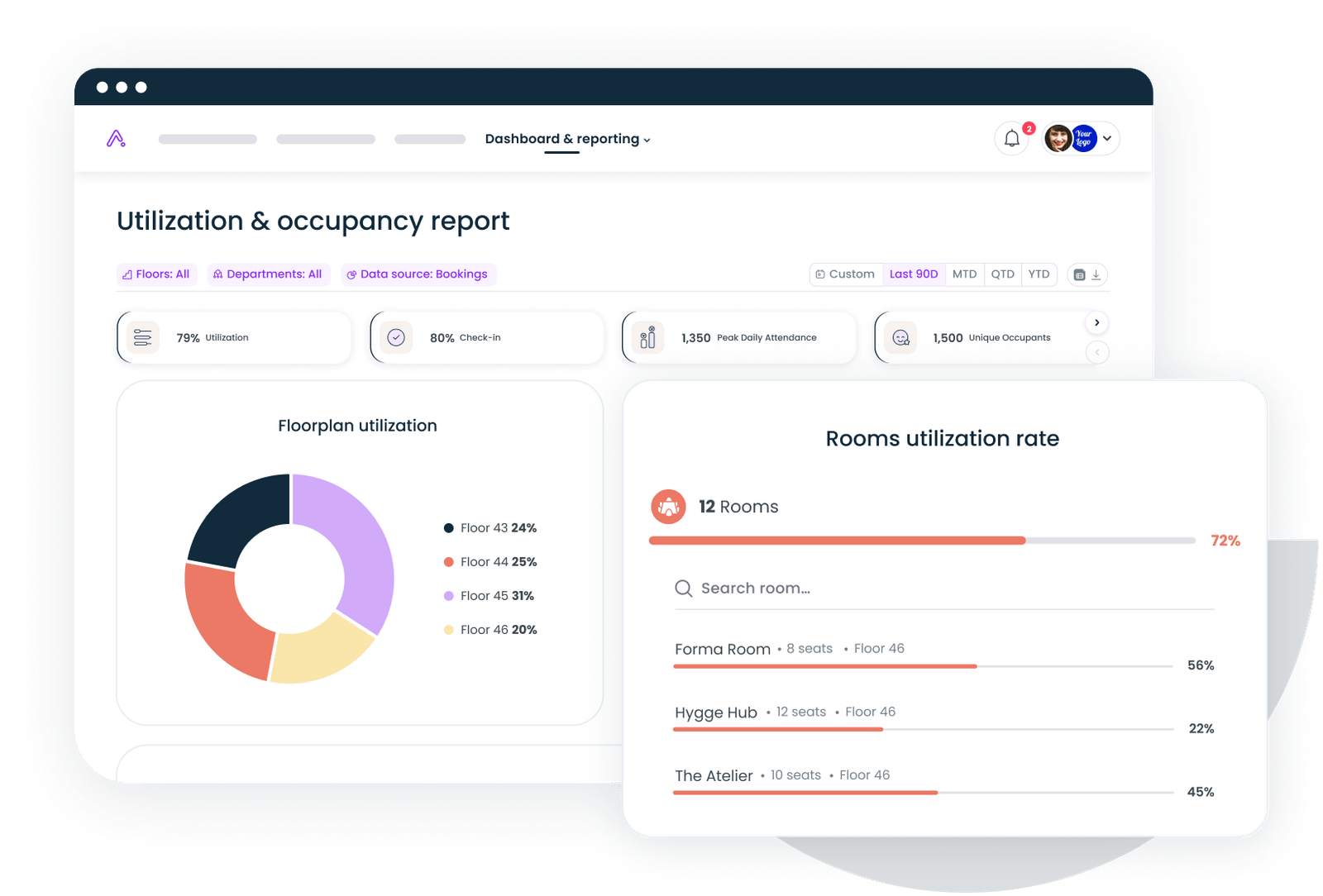
Which security badge system fits your building
For the doors themselves, the shortlist is straightforward: Brivo, Verkada, or Kisi for cloud-first offices, Genea to modernize existing Mercury hardware, Genetec or LenelS2 at strict-requirements enterprise scale, HID for credentials and printing, and Salto for wireless interior doors.
The more consequential choice is what happens above the hardware. Badge systems generate the best workplace data most companies own, and most of it goes unused. Pairing your access control with a platform like Gable puts that data to work in booking, visitor management, and the occupancy numbers that drive real estate decisions, without changing a single reader on the wall.
Book a demo and we'll show how Gable connects to your badge system and turns entry data into occupancy insight, visitor workflows, and better space decisions.
Get a demo