.svg)


.svg)
- Office space management software turns floor plans, bookings, and badge data into decisions about how much space you need and how it's used.
- Gable is the top pick for hybrid teams managing office space across multiple locations, with booking, analytics, and flex access in one platform.
- The field splits into workplace platforms and heavyweight IWMS suites; most teams need the former.
- Offices run at about 56% of target utilization, so the savings case is real.
- Match the tool to your workplace strategy: fully in-office, hub-and-spoke, or fully distributed.
Office space management software helps workplace and real estate teams plan, allocate, and optimize physical space: who sits where, which floors earn their rent, and how much office you'll need next year. It pulls floor plans, desk and room bookings, and badge data into one picture.
The stakes have grown: offices now run at 56% of target utilization, and the gap between planned and actual use, while narrowing, still sits at 18 percentage points, according to JLL. This guide compares the 9 best office space management software tools of 2026: what each does, who it fits, and what it costs.
Why office space management software has become essential
Three forces pushed space management from a facilities afterthought to a board-level topic.
- Hybrid work made demand unpredictable. With 52% of remote-capable employees working hybrid, per Gallup, attendance swings by weekday. CBRE finds 73% of organizations say their offices are effectively full on peak days, but only 34% say so on average days, per its 2025 occupier survey. Planning for the average guarantees midweek overflow; planning for the peak wastes money the rest of the week.
- Underutilized real estate is expensive. Global office utilization climbed to 53% in 2025, up from 38% the year before, according to CBRE. Better, but still: nearly half of a typical rent bill pays for space nobody is using that day.
- Manual overhead doesn't scale. Spreadsheet seating charts and CAD files in email threads break down the moment teams share desks across locations. Organizations are responding by densifying, planning to cut space per person from 165 to 132 square feet and raise seat sharing from 1.1 to 1.3 people per seat, per the same JLL benchmark. You can't manage that with a spreadsheet.
What to look for in office space management software
Five criteria separate the contenders:
- Interactive floor plans: a live map of every seat, room, and neighborhood, not a static CAD export.
- Booking built in: desk and room reservations that feed your utilization data, ideally from Slack, Teams, and mobile.
- Real utilization analytics: booking, badge, and sensor data combined, so you measure who showed up, not who planned to.
- Scenario and move planning: model a reorganization, a downsizing, or a new floor before you commit to it.
- Room to grow: visitor management, flex-space access, and integrations with HR and access control systems, without bolting on three more vendors.
9 best office space management software tools in 2026
We selected these nine based on space-planning depth, utilization analytics, real user reviews, and how well they fit different workplace strategies. Gable leads the list; the rest span workplace platforms and enterprise IWMS suites.
1. Gable
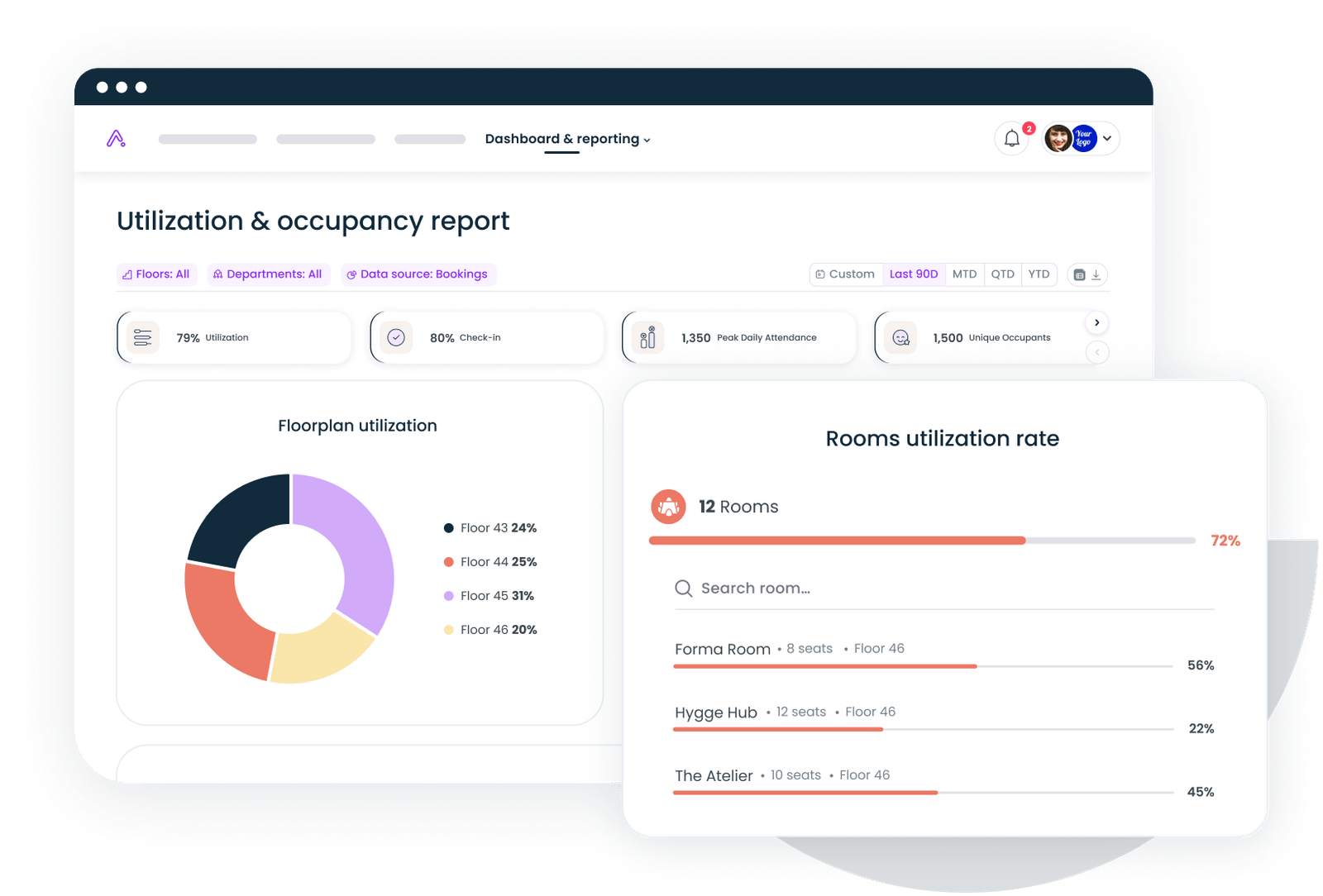
Gable is an all-in-one workplace management platform that connects people, spaces, and data. Workplace teams manage interactive floor plans and desk and room booking, employees book from Slack, Teams, or mobile, and leaders get utilization analytics with an AI copilot that answers space questions in plain language.
Uniquely, Gable also covers teams beyond your walls with on-demand access to 20,000+ workspaces in 900+ cities, so one platform handles HQ and everywhere else. Teams using Gable's office management software have cut unused space by 32%.
- Interactive floor plans with desk, room, and neighborhood management
- Booking from Slack, Microsoft Teams, desktop, and mobile
- Workplace analytics and AI copilot for utilization and cost decisions
- Visitor management and on-demand flex space in the same platform
- Pricing: Office Management from $2.50 per user per month; all-in-one custom
- G2 rating: 4.5/5 (131 reviews)

Gable combines floor plans, booking, visitor management, and utilization analytics, so your space decisions run on data instead of guesswork.
Learn more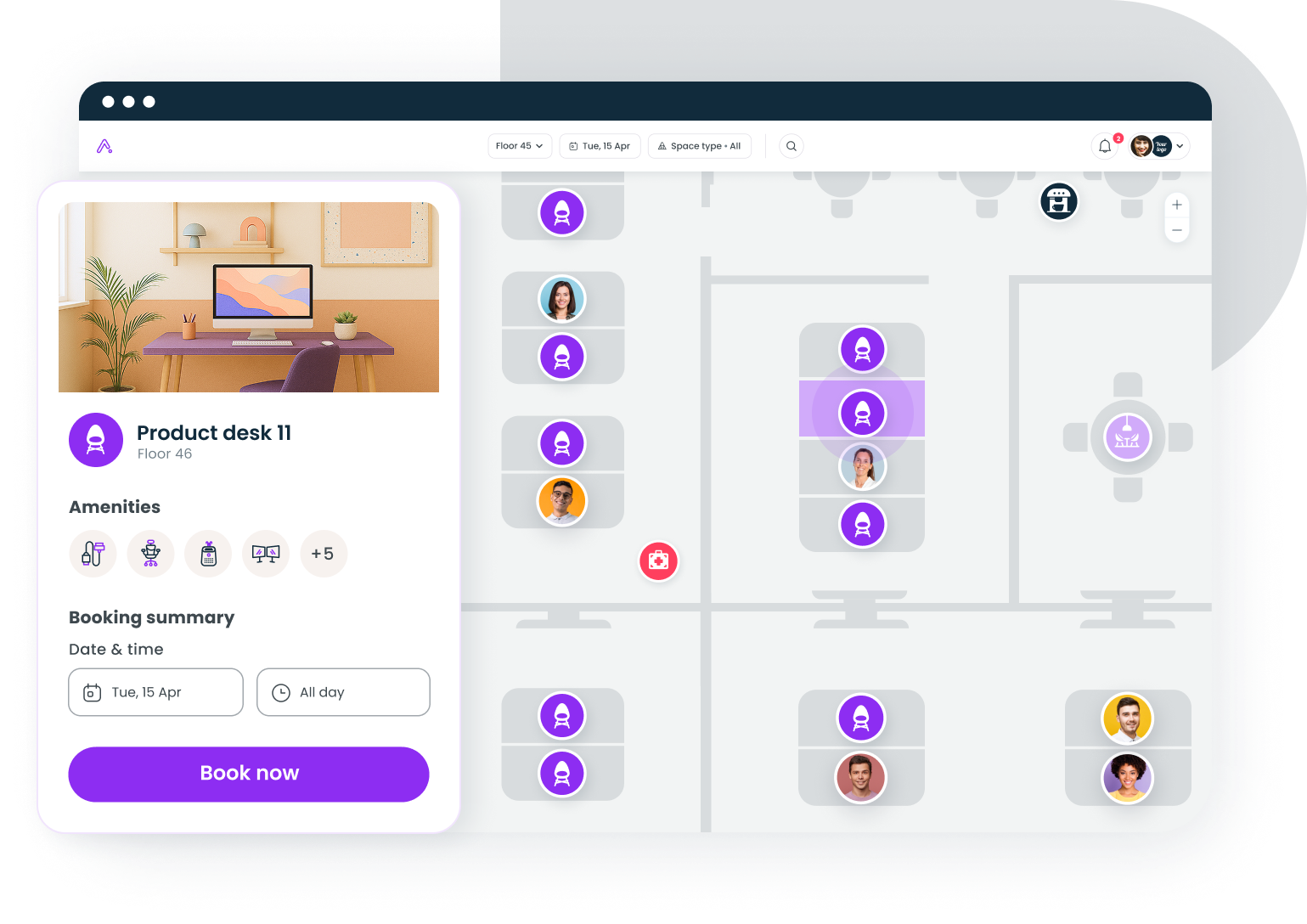
2. OfficeSpace Software
OfficeSpace builds everything around the visual floor plan: planning, moves, and booking live on one canvas. It suits organizations that treat space as a portfolio to engineer, with scenario and stack planning plus an AI assistant, Ossie.
- Interactive floor plans with a visual employee directory
- Scenario and stack planning plus move management
- Utilization analytics fed by badge and sensor data
- Pricing: quote-based
- G2 rating: 4.7/5 (126 reviews)
3. Robin
Robin approaches space management through the employee experience: a map-based booking people enjoy using, which keeps the utilization data flowing. Its analytics show office activity by day and space type.
- Desk and room booking on interactive maps
- Office activity and workweek analytics
- Space planning insights from booking patterns
- Pricing: quote-based
- G2 rating: 4.4/5 (211 reviews)
4. Envoy Workplace
Envoy unifies its visitor-management heritage with desk and room booking and occupancy analytics on shared maps. It fits companies that want space data and workplace security from one vendor.
- Desk and room booking on interactive maps
- Occupancy and space analytics dashboards
- Badge and access control integrations
- Pricing: entry plans from about $109 per month; analytics tiers are quote-based
- G2 rating: 4.4/5 (163 reviews)
Tools work best with a plan behind them. Our guide to space management covers the data-driven path to workplace optimization.
Read the guide
5. Eptura Workplace
Eptura, formed from iOFFICE, SpaceIQ, and Condeco, is the enterprise worktech suite of this list. It spans space planning through facility operations, which suits enterprises consolidating workplace and asset management under one vendor.
- Space planning and management across large portfolios
- Desk and room reservations with move management
- Utilization analytics tied to the broader Eptura suite
- Pricing: quote-based
- G2 rating: 4.3/5 (168 reviews)
6. Archibus
Archibus is the legacy IWMS heavyweight, with CAD- and BIM-connected space inventory. Large real estate teams use it for space chargeback by department and move/add/change workflows at scale.
- CAD/BIM-linked floor plans and space inventory
- Space chargeback and departmental allocation
- Move and portfolio management
- Pricing: quote-based
- G2 rating: 4.0/5, from only 19 reviews, so treat it as a thin signal
7. FM:Systems
FM:Systems (FMS:Workplace), part of Johnson Controls, is a modular IWMS aimed at facilities teams in regulated and campus environments such as healthcare, government, and higher education.
- Space management with scenario planning
- Move management and hoteling
- Sensor-fed utilization analytics
- Pricing: quote-based
- G2 rating: 4.2/5 (26 reviews)
8. Wisp
Wisp, built at design firm Gensler and now operated by Apex42, pairs space management software with a managed service: their team keeps your floor plans current, with unlimited CAD updates included.
- Polylined floor plans maintained for you
- Seat assignment and move management
- Space inventory, allocation, and utilization reporting
- Pricing: quote-based annual subscription, implementation included
- G2 rating: 4.8/5 (40 reviews)
9. Skedda
Skedda is the budget-friendly entry, priced per space rather than per user. Its rules engine controls exactly who can book what, which suits single offices and smaller teams that want fast setup and predictable cost.
- Interactive floor plan maps with booking rules and quotas
- Desk and room booking with utilization insights
- Visitor management as an add-on
- Pricing: from $99 per month for 15 bookable spaces
- G2 rating: 4.8/5 (283 reviews)
How your workplace strategy shapes the software you need
The right pick depends less on features and more on how your company works.
- Fully in-office: your problem is allocation, not coordination. Space management systems with strong floor plans, move management, and chargeback (OfficeSpace, Archibus, FM:Systems) fit best, and space utilization data tells you when to densify.
- Hub-and-spoke hybrid: you need booking that employees adopt, peak-day analytics, and desk booking that feeds planning. Gable, Robin, and Envoy live here; Gable adds the spoke side with on-demand space where you have people but no office.
- Fully distributed: you barely need floor plans, but your people still need places to meet. Gable's on-demand network turns space from a lease into a variable cost, while analytics show what distributed teams book when they gather.
Whichever profile fits, anchor the decision in your broader workplace strategy rather than a feature checklist. For adjacent comparisons, see our roundups of the best office management software and workplace management software, which cover the operations and platform angles.
Which office space management software fits your team
For most hybrid companies, the practical answer is a workplace management platform that people adopt willingly, because adoption is what makes the space data trustworthy. That's Gable's case: booking employees like, analytics leaders trust, and flex space for everyone in between, in one office management platform. The IWMS suites earn their place at enterprise portfolio scale, and Skedda wins on simplicity for a single office. With 92% of corporate real estate teams now piloting AI, per JLL, the gap between teams that measure their space and teams that guess will only widen.
Book a demo and we'll show you how Gable manages space, people, and cost across every office you run, plus everywhere you don't.
Get a demo