
.svg)


.svg)
- Only 12% of employees (Gallup) say their company does a great job with onboarding, yet structured programs improve retention by 82% and productivity by over 70%
- Hybrid onboarding outperforms both remote and in-office formats, with 75% of hybrid-onboarded employees reporting satisfaction (TalentLMS & BambooHR, 2025)
- New hires decide whether to stay or leave within their first six months, making a structured onboarding timeline from preboarding through 90 days non-negotiable
- The best onboarding programs cover three distinct tracks (remote, hybrid, in-office) with shared foundations: clear role expectations, manager involvement, and intentional culture building
- Measuring onboarding through retention rates, time-to-productivity, and satisfaction scores turns a "nice to have" into a provable business investment
Employee onboarding is the structured process of integrating new hires into your organization, covering everything from preboarding paperwork to the cultural immersion, role-specific training, and relationship building that happens over the first 90 days and beyond. Unlike a one-day orientation, effective onboarding is an extended program designed to make new employees productive, engaged, and connected to their team. In 2026, that means building distinct onboarding tracks for remote, hybrid, and in-office employees because each work model presents different challenges. This guide breaks down all three.
What is employee onboarding (and why most companies get it wrong)
Let's start with the distinction that trips up most organizations: onboarding is not orientation. Orientation is the administrative process of collecting tax forms, setting up payroll, handing out a laptop, and walking someone through the employee handbook. It's necessary, but it's a fraction of what new hires actually need.
Employee onboarding is the broader, longer process of helping someone become effective in their role and integrated into your company's culture. It spans preboarding (before day one), the first week, the first month, and ideally extends through the first 90 days or longer. It involves HR, the hiring manager, IT, teammates, and often a dedicated buddy or mentor.
Here's the problem: most companies think they're onboarding when they're actually just orienting. According to Gallup, only 12% of employees strongly agree that their employer does a great job of onboarding new hires. That means 88% of your new employees are walking into an experience that falls short of their expectations.
The stakes are real. Research from Brandon Hall Group found that a structured onboarding process improves new hire retention by 82% and productivity by over 70%. On the flip side, organizations that treat onboarding as a checklist to complete rather than a strategy to execute are losing people. Enboarder's 2025 data shows that 86% of new hires decide how long they'll stay with a company within the first six months.
So what separates a great onboarding experience from a mediocre one? Three things consistently show up in the research:
Manager involvement matters more than anything else. When managers are actively involved in the onboarding process, new hires are 3.4 times more likely (Gallup) to describe their experience as exceptional. That means managers can't delegate onboarding entirely to HR. They need to be present, setting expectations, providing feedback, and checking in regularly during the first 90 days.
One-size-fits-all doesn't work anymore. If you have remote employees in Austin, hybrid team members splitting time between home and a coworking space in London, and a fully in-office team in New York, you can't give them all the same onboarding experience and expect equal outcomes. Each work model requires its own playbook.
Onboarding is a cultural signal. The way you bring someone into the organization is their first real experience of your company culture. If that experience is disorganized, impersonal, or clearly an afterthought, you've already started eroding the trust and engagement you worked so hard to build during recruiting.
The employee onboarding timeline: what happens when
The biggest mistake organizations make with onboarding timelines is ending too early. The average new hire takes six to seven months (InsightGlobal) to feel settled in their role, yet most onboarding programs wrap up within the first month. That's a gap where productivity, engagement, and retention all suffer.
Here's what a research-backed onboarding timeline looks like, broken into the milestones that matter.
Preboarding (offer acceptance through day one)
Preboarding starts the moment someone signs their offer letter. This is your chance to maintain momentum and prevent the anxiety that builds between accepting a job and actually starting it. Effective preboarding includes:
- Send a welcome message from the hiring manager within 48 hours of offer acceptance (not a template from HR, a personal note)
- Ship equipment and access credentials so everything is ready on day one
- Share a clear first-week schedule with meeting times, names of people they'll meet, and what to expect
- Complete as much administrative paperwork digitally as possible (W-4, direct deposit, benefits enrollment) so day one isn't buried in forms
- Add the new hire to relevant Slack channels or Teams groups with a brief introduction post
Day one
Day one sets the tone. If a new hire spends eight hours in back-to-back orientation presentations, they'll leave feeling drained, not excited. Structure day one around three priorities:
- Connection: A one-on-one with their manager (30 minutes minimum) to discuss role expectations, communication preferences, and immediate priorities
- Context: An overview of the team's current projects, how their role fits, and who they'll be working with most closely
- Logistics: IT setup verification, building/workspace access, and a tour of relevant tools and systems
Week one
By the end of week one, a new hire should understand what success looks like in their first 30 days. Assign a buddy or peer mentor who's outside the direct reporting line. This person answers the "where do I find that" and "is this normal" questions that new hires often hesitate to ask their manager.
Schedule a 15-minute daily check-in for the first two weeks. It sounds like a lot, but these brief touchpoints catch small problems before they become reasons to quit.
30-day milestone
At 30 days, the new hire should have completed all required training modules, met with key cross-functional stakeholders, and delivered at least one small, tangible contribution. This is also the right time for the first formal feedback conversation: what's going well, what's confusing, what needs adjustment.
60-day milestone
By 60 days, the employee should be operating with increasing independence. They're taking ownership of defined projects, participating actively in team meetings, and building relationships beyond their immediate team. Check in on whether the role matches what was described during the interview process. Misalignment here is a top driver of early turnover.
90-day milestone
The 90-day mark is the traditional end of the probationary period, and it should include a formal review. Evaluate performance against the goals set in week one. Gather feedback from the employee about their onboarding experience (this data is gold for improving the process). Discuss a longer-term development plan.
But don't stop here. The best employee experience strategies extend structured touchpoints to six months and even 12 months after start date. A quarterly check-in at the six-month mark can catch the drift that happens when the initial onboarding energy fades but the employee hasn't yet built deep organizational roots.
How to onboard remote employees
Remote onboarding requires more structure, not less. When there's no physical office to walk into, no desk neighbor to ask questions, and no lunchroom to overhear conversations, every interaction has to be intentional. Nothing happens organically in a remote setting.
The core challenge is isolation. A new remote hire can go days without a meaningful conversation if nobody's specifically tasked with reaching out. That's why the buddy system is even more critical for remote employees. Pair each new hire with a tenured team member who checks in daily during the first two weeks and weekly for the first 90 days.
Documentation over meetings
Remote onboarding should lean heavily on async-first communication. Create a "new hire hub" (a Notion page, Confluence space, or shared Google Drive folder) that includes:
- An organizational chart with photos and brief role descriptions
- A "who to ask for what" guide mapping common questions to specific people
- Recorded walkthroughs of key tools and workflows (so the new hire can revisit them)
- A glossary of company-specific acronyms and terminology
This doesn't replace live conversations. It supplements them so new hires aren't entirely dependent on synchronous availability to get answers.
Structure the first two weeks tightly
For remote hires, schedule the first two weeks with more structure than you'd provide in-office. Include:
- Daily 15-minute check-ins with the manager
- A virtual coffee with a different team member each day during week one
- Dedicated "focus time" blocks where the new hire can work through training materials without feeling pressured to attend meetings
- An end-of-week one recap meeting where the manager addresses questions and adjusts the plan if needed
Common remote onboarding pitfalls
Overloading with video calls. Back-to-back Zoom meetings on day one is just as exhausting remotely as marathon orientation sessions in person. Limit live meetings to three hours on day one and increase gradually.
Assuming the new hire will ask for help. They won't, especially in the first week. Proactively check in and explicitly say, "there are no stupid questions, and you're expected to have a lot of them right now."
Skipping the social layer. Remote onboarding that's purely task-focused misses the relationship building that makes someone feel like part of a team. Schedule at least one purely social interaction per week during the first month, whether that's a virtual lunch, a Slack-based icebreaker, or a team trivia session.
For a detailed walkthrough of the remote onboarding process, including phase-by-phase checklists, see this comprehensive remote onboarding checklist.

Building an onboarding program for remote employees? This step-by-step guide walks through every phase, from preboarding to ongoing integration, so your distributed hires feel set up for success.
Read the guide
Hybrid onboarding: the format that works best
Here's something most onboarding guides don't tell you: hybrid onboarding consistently outperforms both fully remote and fully in-office formats.
A 2025 research report from TalentLMS and BambooHR found that 75% of hybrid-onboarded employees were satisfied with their experience, compared to 73% for in-person and 71% for remote. Even more telling, 73% of hybrid-onboarded employees said the experience accelerated their ability to perform in their role, versus 69% for in-person and just 61% for remote.
Why does hybrid onboarding work better? Because it combines the best of both worlds. New hires get the in-person connection, spontaneous conversations, and team bonding that remote onboarding can't replicate, along with the focused learning time, flexible scheduling, and documentation access that in-office-only programs often lack.
The equitability challenge
The biggest risk with hybrid work models is creating a two-tier experience where the people who happen to be in the office get better onboarding than those who aren't. To avoid this:
- Decide in advance which moments are in-person. Team kickoffs, the first meeting with the manager, and cross-functional introductions benefit from face-to-face interaction. Policy reviews, tool training, and document walkthroughs work just as well (sometimes better) asynchronously.
- Record everything. If a presentation happens in the office, record it for anyone who's remote that day. Shared context is what makes hybrid teams work.
- Don't let "in-office days" become optional for new hires. During the first two weeks, specifically schedule in-person days and communicate the purpose of each one: "Tuesday is for meeting the product team in person" or "Thursday we're doing a team lunch for your first week."
Solving the space problem for distributed teams
Here's where it gets interesting for organizations without a central office (or where the new hire lives far from HQ). How do you deliver in-person onboarding moments when there's no office to come into?
This is exactly the problem that on-demand workspace platforms solve. With Gable On-Demand, companies can book coworking spaces, meeting rooms, and private offices in over 14,000 locations globally. For onboarding, this means a new hire in Denver can meet their manager (who's based in Chicago) at a professional workspace for a two-day onboarding intensive, without anyone needing to fly to headquarters.
The data supports this approach. Gable's platform data shows that 72% of bookings are for team gatherings, which means companies are already using on-demand spaces to bring distributed teams together for exactly these kinds of high-impact, in-person moments.
Structuring the hybrid onboarding week
A practical hybrid onboarding schedule for week one might look like:
- Monday (in-person): Manager one-on-one, team introductions, workspace tour, team lunch
- Tuesday (remote): Complete administrative onboarding tasks, review documentation, set up tools
- Wednesday (in-person): Cross-functional meetings, buddy pairing introduction, collaborative work session
- Thursday (remote): Self-paced training modules, first small task assignment, async Q&A
- Friday (flexible): Week-one recap with manager, social activity (virtual or in-person), plan for week two
This rhythm gives new hires three distinct types of experiences: connection (in-person), focus (remote), and flexibility (choice). It also signals from day one that the company trusts employees to work effectively across settings.
In-office onboarding in 2026
Even fully in-office onboarding needs intentional design in 2026. Just because someone is physically present doesn't mean they feel welcome, informed, or set up to succeed. The proximity trap, the assumption that being nearby means everything's fine, is one of the most common onboarding failures.
The physical environment matters
First impressions are literal. When a new hire walks in on day one, their workspace should be ready: desk clean, monitor set up, login credentials printed or sent, and maybe a small welcome kit (company swag, a handwritten note from the team, a plant). This sounds basic, but a surprising number of companies still have new hires sitting in a random conference room for half the day while IT scrambles to set up their laptop.
Make the buddy system work
The buddy program is standard advice, but execution makes the difference. Pair the new hire with someone who:
- Is at a similar career level (peers feel safer to ask questions than senior leaders)
- Has been at the company for at least six months (long enough to know the culture, not so long they've forgotten what being new feels like)
- Is on a different project or team if possible (this expands the new hire's network beyond their immediate group)
Schedule the buddy relationship, don't leave it to chance. A 30-minute coffee on day one, a 15-minute check-in at the end of each day during week one, and a weekly lunch for the first month gives the relationship enough structure to actually be useful.
Build culture through rituals, not presentations
In-office onboarding has an advantage: you can use the physical space to immerse people in company culture. But a two-hour presentation about "our values" is the least effective way to do that. Instead:
- Shadow sessions. Have the new hire sit in on a team standup, a client call, or a design review in their first week. Seeing how people actually work teaches culture faster than any slide deck.
- Team lunch on day one. Not optional, not "if schedules align." Block it on the calendar and make it happen.
- First contribution within week one. Give the new hire a small, achievable task that lets them contribute real work early. The feeling of adding value is one of the strongest engagement drivers in the first month.
Keeping in-office employees engaged over the long term requires the same intentionality, so treat onboarding as the foundation of your broader engagement strategy.
Whether your new hires are in New York or Nairobi, Gable On-Demand gives them access to 14,000+ professional workspaces for in-person onboarding moments, team gatherings, and collaborative sessions.
Learn more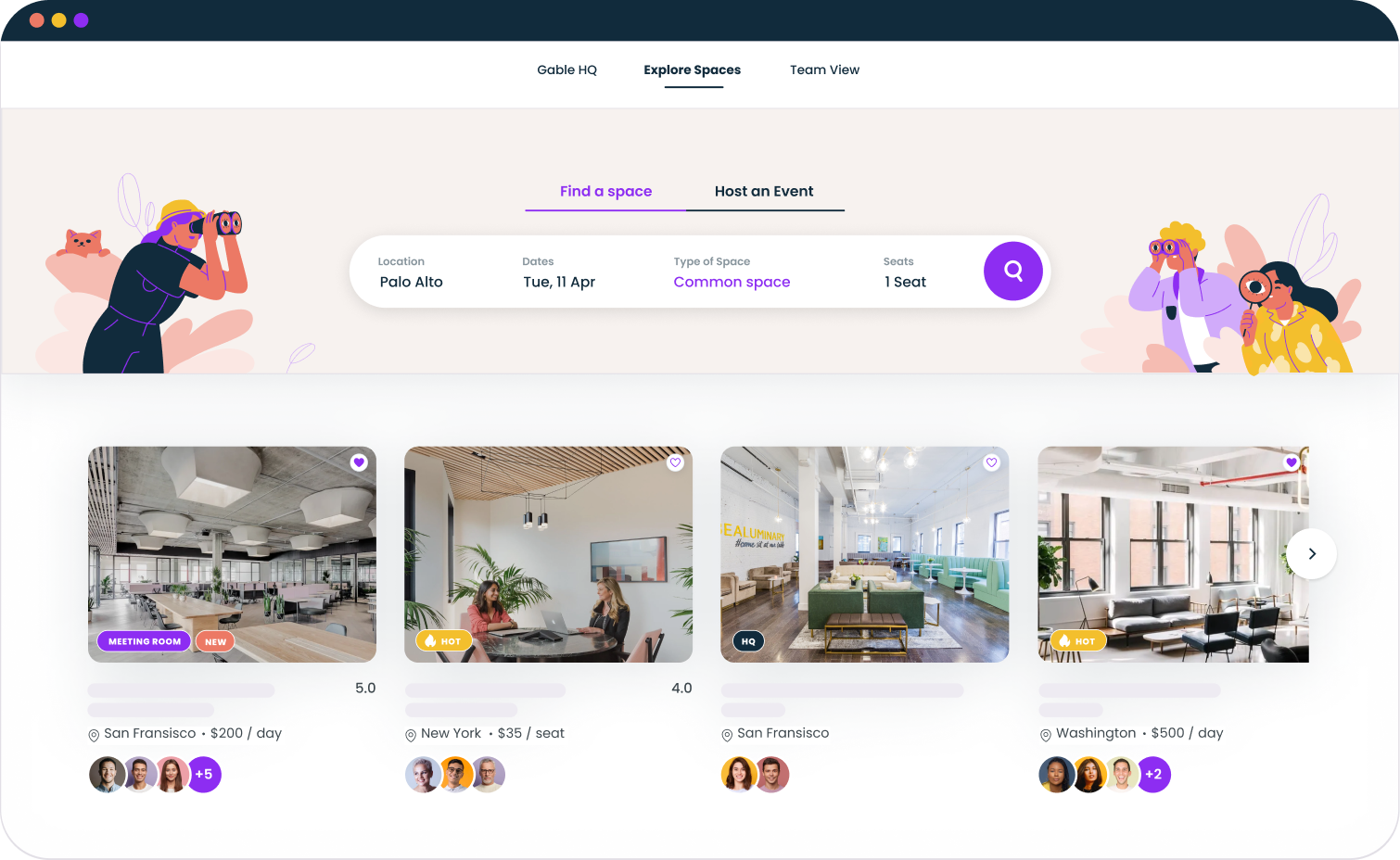
Building your employee onboarding checklist
The average new hire has 54 onboarding tasks (Sapling) to complete. Without a checklist, things get missed. Here's a master checklist organized by phase and adapted for all three work models.
Preboarding checklist (all work models)
- Send personalized welcome message from the hiring manager
- Ship laptop, peripherals, and any company swag
- Set up email, Slack/Teams, and core tool accounts
- Share first-week schedule with meeting links and contact names
- Complete digital paperwork (tax forms, benefits enrollment, emergency contacts)
- Add new hire to relevant channels and distribution lists
- Brief the team on the new hire's start date and role
- Assign a buddy and introduce them via email before day one
Day one checklist
In-office:
- Desk/workspace is ready with equipment and welcome materials
- Building access badge or key card is activated
- Manager one-on-one to discuss role, expectations, and 30-day goals
- Team introductions (in-person, not just email)
- Team lunch
Hybrid:
- Confirm whether day one is in-person or remote (in-person strongly recommended)
- If in-person: follow in-office checklist above
- If remote: follow remote checklist below
- Explain the hybrid schedule and what's expected on in-office vs. remote days
Remote:
- Video call with manager (camera on, 30+ minutes)
- Virtual team introduction via video call or recorded welcome video
- Walk through the new hire hub documentation
- Test all tools, video conferencing setup, and VPN access
- Schedule daily check-ins for week one
Week one checklist (all work models)
- Daily 15-minute manager check-in
- Meet with buddy at least three times
- Complete required compliance training
- Introduction meetings with key cross-functional partners
- Review team's current projects and priorities
- First small task assigned and completed
- End-of-week feedback conversation with manager
30-60-90 day milestones
30 days:
- All required training completed
- First formal performance check-in
- New hire can navigate core tools and processes independently
- Feedback collected from new hire on onboarding experience
60 days:
- Operating with increasing independence on defined projects
- Participating actively in team meetings and decisions
- Cross-functional relationships forming
- Role-expectation alignment check (does the job match what was described?)
90 days:
- Formal performance review against goals set in week one
- Development plan discussed for the next six months
- Onboarding satisfaction survey completed
- Buddy relationship transitions to informal mentorship
Choosing the right HR tools to automate and track this checklist makes a measurable difference. Platforms that handle task assignments, reminders, and progress tracking prevent the most common onboarding failure: things falling through the cracks because nobody owned them.
How to measure onboarding success
If you can't measure your onboarding program, you can't improve it. And most companies don't measure it at all. Here are the four metrics that matter most, along with how to track them.
Time-to-productivity
This is the number of days or weeks it takes a new hire to reach a defined performance benchmark. The specific benchmark depends on the role (first closed deal, first code shipped, first project managed independently), but every role should have one.
How to track it: Define the benchmark before the hire starts. Log the date they hit it. Compare across cohorts and work models. If your remote hires consistently take 30% longer to reach productivity than hybrid hires, that's a signal your remote onboarding needs work.
New hire retention at 90 days and six months
What percentage of new hires are still with the company at the 90-day and six-month marks? This is the clearest signal of onboarding effectiveness because 86% of new hires (Enboarder, 2025) decide whether to stay within their first six months.
How to track it: Calculate the percentage of hires who remain at each milestone. Break it down by department, manager, work model, and start-date cohort. If one team consistently loses new hires at 60 days, the problem likely isn't the new hires. A strong employee retention strategy connects onboarding data to longer-term retention patterns.
Onboarding satisfaction score
Send a short survey (five to seven questions, max) at the end of week one, at 30 days, and at 90 days. Ask about clarity of role expectations, manager support, access to resources, and overall experience. Use a consistent scale so you can track changes over time.
How to track it: Average the scores by cohort. Identify questions where scores consistently dip (that's where your process needs improvement). Share the results with hiring managers so they see the direct impact of their involvement.
Cost and efficiency metrics
Track your cost-per-new-hire-onboarded, including HR time, manager time, tool costs, and any travel or workspace expenses. Compare this against the retention and productivity data. An onboarding program that costs more per hire but produces 30% faster time-to-productivity and 20% higher 90-day retention is a bargain.
Using employee engagement tools that integrate onboarding surveys with ongoing engagement data gives you a complete picture of how the onboarding experience shapes long-term employee outcomes.
Onboarding is a strategy, not a checklist
The data is clear: organizations that treat employee onboarding as a strategic investment rather than an administrative task see dramatically better outcomes in retention, productivity, and engagement. The 82% improvement in retention from structured onboarding isn't a marginal gain. It's a transformation.
What makes onboarding work in 2026 is recognizing that your workforce isn't monolithic. Remote employees need async-first documentation and intentional social connection. In-office employees need more than a desk assignment and a day of presentations. And hybrid employees, the group that data shows benefits most from structured onboarding, need a deliberate blend of in-person moments and focused remote time.
For organizations with distributed teams, the challenge of providing in-person onboarding experiences doesn't require a physical headquarters. Platforms like Gable On-Demand make it possible to book professional workspaces in thousands of locations, so a new hire's first team meeting can happen face-to-face even when the team spans multiple cities or countries.
Start with the timeline. Build the checklist. Measure the results. Then iterate. The companies that win the talent game in 2026 won't be the ones with the fanciest orientation presentations. They'll be the ones that made every new hire feel like they belonged from day one, regardless of where they work.
See how Gable helps workplace leaders bring distributed teams together for the moments that matter, from onboarding to offsites and everything in between.
Get a demo