.svg)


.svg)
- Building workplace software costs a median $132K and takes 13 months; buying deploys in 4-8 weeks
- 45% of custom software projects run over budget before launch
- Maintenance eats 15-40% of total lifetime cost every year after go-live
- A unified platform eliminates integration sprawl better than low-code or point solutions
- Most hybrid teams should buy, unless their workflow is a genuine competitive differentiator
Your CEO asked whether the engineering team should build an internal workplace management tool or you should buy one. It's the wrong question. The build vs buy workplace software decision is no longer binary, and framing it that way is how companies end up spending $200K on a custom booking tool that still can't tell you which floor to consolidate. This guide gives you the framework to make the call, the real numbers behind each path, and the scenarios where each option wins.
What workplace software is, and why this decision costs more than it used to
The workplace management software market is projected to grow from $4.9 billion to over $21 billion by 2032. That growth reflects how much complexity hybrid work has dumped on facilities, people, and finance teams in the last three years.
Workplace management software now covers desk booking, meeting room scheduling, visitor check-in, on-demand coworking access, event coordination, and real-time occupancy analytics. Five years ago, you could get away with a shared Google Sheet and a Slack channel called #who-is-in-office. That stopped working when your company hit 200 people across three time zones.
The stakes of the build vs buy decision have scaled with the market. Get it wrong and you're not out the development cost alone. You're sitting on a tool nobody uses, bleeding real estate spend on floors that badge data says are 12% occupied, with no analytics to prove it to the CFO.
The five factors that determine whether to build or buy
Every framework you'll find online lists the same inputs: cost, timeline, customization, expertise, strategic value. That's fine. The problem is most frameworks treat these factors as equal weights on a scorecard. They're not.
Factor 1: Total cost of ownership, not sticker price
Industry benchmarks put the median custom software project at roughly $132,000 and 13 months to complete. That's the median. Your project isn't median. It's the one with the VP who adds visitor management halfway through sprint 4.
More than half of software projects experience scope creep, which adds an average 27% cost overrun when requirements aren't locked down. So your $132K project is now $168K, and you still don't have calendar integration.
Buying a SaaS platform runs $3-12 per employee per month for desk booking alone. Add visitor management, analytics, and room scheduling from different vendors and you're looking at $8-20 per employee across three to five contracts, plus the integration work to make them talk to each other.
Factor 2: Time to value, not time to launch
Companies that bought their solutions consistently achieve roughly 50% faster time-to-market compared to those who built from scratch. For workplace software specifically, "time to market" means "how many months until the facilities team can see which desks are booked on Tuesday."
A custom build gets you an MVP in 6-9 months if your engineering team is good and not pulled onto revenue-generating work. Production-grade with integrations? 12-18 months. A SaaS platform deploys in 4-8 weeks, including floor plan setup, SSO configuration, and calendar sync.
Those 10-14 months of delta aren't free. They're months where you're still manually tracking occupancy, overpaying on leases, and making real estate decisions based on gut feel.
Factor 3: Customization needs vs. customization wants
This is where build advocates win the argument in the meeting and lose it in the budget review six months later. "We need custom workflows" may be the costliest sentence in enterprise software.
Genuine customization needs exist. If your workplace operates under specific regulatory requirements, handles classified visitors, or runs a manufacturing floor with unique shift patterns, off-the-shelf may not cut it. That's real.
What's not real: needing a custom desk booking tool because your company uses a particular naming convention for conference rooms. That's a configuration, not a customization. Every mature SaaS platform handles it.
Factor 4: Engineering capacity you have, not capacity on paper
Your engineering team has a backlog. It's 18 months long. Adding a workplace management build means either hiring dedicated developers at $150-250K fully loaded per head, or pulling existing engineers off product work that generates revenue.
Three to four full-time engineers for 12 months. That's the realistic staffing for a workplace platform that handles desk booking, room scheduling, and basic analytics. No visitor management, no event coordination, no mobile app. Those are each another quarter of work.
Factor 5: Strategic differentiation, honestly assessed
Here's the test: does your workplace management tool create competitive advantage that directly impacts revenue or talent retention in a way no purchased tool can replicate? For Uber, building internal logistics software was a core differentiator. For a 600-person SaaS company, a desk booking system is not.
Be honest about this one. Accurate self-assessment here saves more money than any other factor in the framework.
What building workplace software costs: the numbers nobody puts in the pitch deck
$132,000 median cost sounds manageable until you unpack what "median" means. That figure covers projects of all sizes and complexity levels. A workplace management platform with desk booking, room scheduling, floor plans, visitor management, analytics dashboards, mobile apps, and integrations with Slack, Teams, Outlook, Google Calendar, Okta, Workday, and your badge system? That's not a median project.
Realistic estimates for a production-grade workplace platform:
- Development: $200K-400K for a cross-platform tool with core features
- Design and UX: $30K-60K, unless you want adoption rates below 30%
- Infrastructure: $2K-8K/month for hosting, monitoring, and security
- Integrations: $15K-50K per integration with third-party systems (calendar, HRIS, access control, WiFi)
- Maintenance: 15-40% of total build cost annually, every year, forever
That last line is what kills custom builds. A $300K platform costs $45K-120K per year to keep running. Security patches, API changes from Slack or Google, new OS versions breaking your mobile app, employee requests that start as "small tweaks" and become sprints.
The 60/60 rule holds: maintenance consumes 60% of total lifecycle costs while accounting for 60% of developer time spent on the project over its lifetime. Your workplace platform isn't done when it launches. It's barely started.

See how hybrid teams evaluate workplace management platforms, feature by feature, with real cost and capability data.
Read the comparison guide
What buying workplace software costs, and the hidden tax of point-solution sprawl
SaaS pricing for workplace tools runs on per-employee-per-month models, typically $3-15 depending on feature depth. For a 500-person company, that's $18K-90K annually. Compared to a $300K build plus $60K/year maintenance, the math is straightforward for the first three years.
But here's the cost nobody talks about in the buy column: integration sprawl.
Most companies don't buy one workplace tool. They buy four or five:
- A desk booking platform
- A separate visitor management system
- A room scheduling tool that came bundled with their calendar provider
- An analytics dashboard they built in Looker because none of the other tools had good reporting
- An on-demand coworking broker for remote employees
Each of those has its own contract, its own admin console, its own data model, and its own support team that doesn't know about the other four tools. Integrating them costs $30K-80K in middleware, developer time, or iPaaS subscriptions, and the data still doesn't unify cleanly.
This is the "buy and stitch" trap. You avoided the build, but you recreated half the complexity through integration work. When your CEO asks "what's our average office utilization across all locations including coworking," nobody can answer without pulling data from three systems into a spreadsheet.
The smarter buy decision isn't "which point solution is best in each category." It's "which platform covers enough categories natively that I don't need the integration layer at all."
The real timeline comparison, including the part after launch
Everyone compares build (12 months) vs. buy (6 weeks) and moves on. The more interesting comparison is what happens in months 13-36.
Custom build, months 13-36
- Month 14: Mobile app crashes on Android 16 update. Two developers spend a sprint fixing it.
- Month 17: Finance wants spending reports by department. That's a new feature, not a bug fix. Three weeks.
- Month 20: Company acquires a 50-person team in London. Your tool doesn't support multi-location or currency. Eight weeks of development.
- Month 24: The lead developer who architected the system leaves. Knowledge transfer takes six weeks. Some of it doesn't transfer.
- Month 30: Leadership asks for AI-powered occupancy predictions. Your team has never built ML features. You're now evaluating buying a tool to bolt onto the tool you built.
SaaS platform, months 13-36
- Month 14: Vendor pushes an update. You get the new features automatically.
- Month 17: Finance exports the spending report that's been in the analytics tab since day one.
- Month 20: You add the London office as a new location in the admin panel. Takes 45 minutes including the floor plan.
- Month 24: Your admin leaves. The new hire learns the platform in a week because there's documentation and a support team.
- Month 30: The vendor ships an AI copilot. You didn't have to build it or pay extra.
That's not a hypothetical comparison. It's a compressed version of what I've watched happen at three different companies.
The buy-then-customize trap: more expensive than building from scratch
Heavy post-purchase customization is common, and when it happens, something strange occurs: the total cost exceeds what a custom build would have cost, and the result is worse.
Here's why. SaaS platforms are built on shared codebases. When you customize heavily (through custom API integrations, forked workflows, or bolted-on features) you're fighting the architecture. Every vendor update risks breaking your customizations. Every new feature they ship may conflict with your modifications.
You end up with the maintenance burden of a custom build plus the licensing cost of the SaaS platform. Worst of both worlds.
The way to avoid this trap is brutal prioritization during vendor selection. If a platform requires more than 10-15% customization to meet your core workflows, it's the wrong platform. Find one that fits natively, or build.
Gable unifies desk booking, room scheduling, visitor management, on-demand coworking, events, and analytics so you skip the integration tax entirely.
Learn more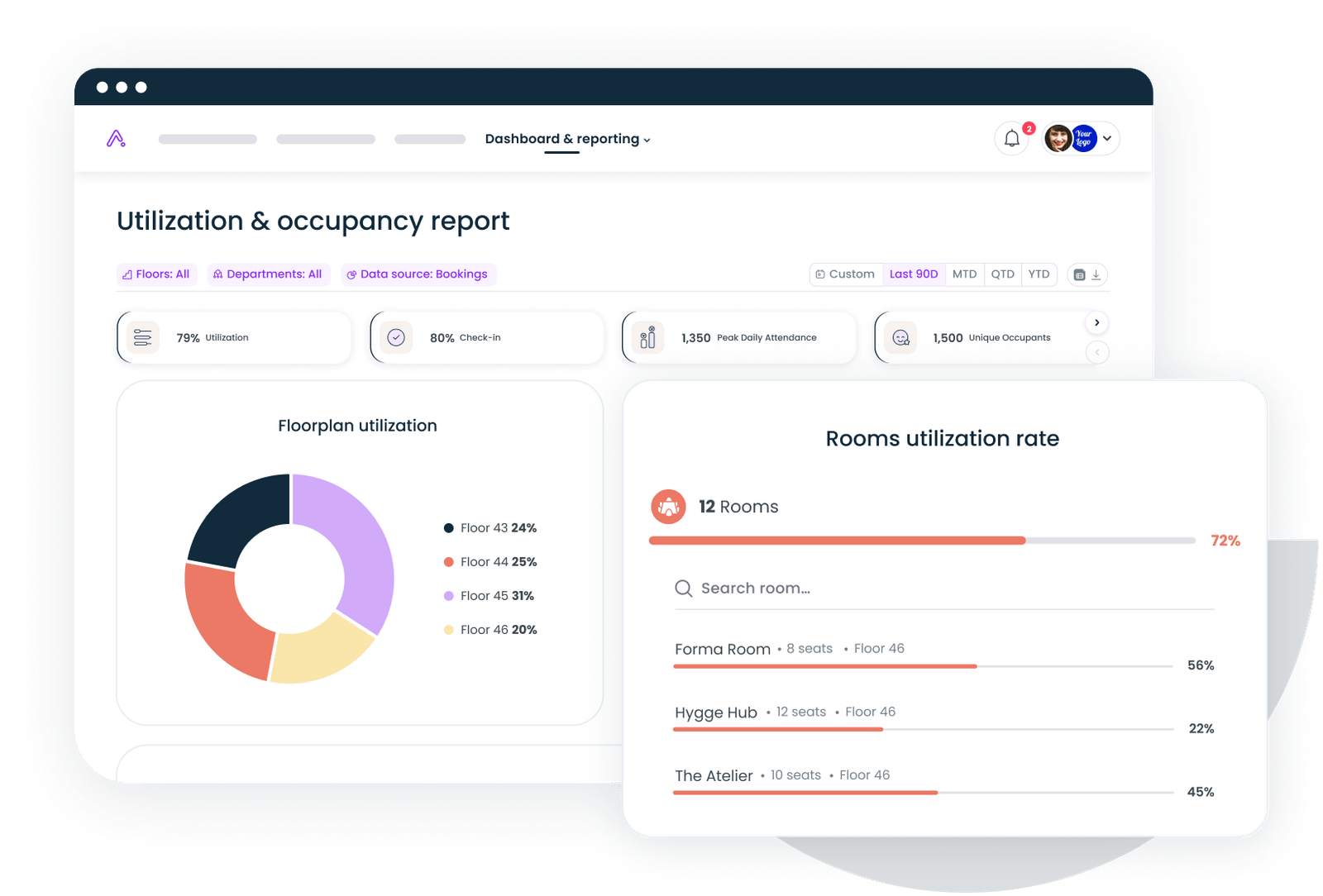
Red flags that say "buy"
Not every decision needs a six-week evaluation. If three or more of these describe your situation, buy:
- Your engineering team's backlog exceeds 12 months. They won't prioritize a workplace tool over revenue features.
- Your workflows are standard. Desk booking, room scheduling, visitor check-in, occupancy reporting. These are solved problems.
- You operate in fewer than 10 locations. The complexity doesn't justify custom architecture.
- You need results in under 90 days. A lease decision is coming, a new office is opening, or leadership wants utilization data for next quarter's board meeting.
- Your workplace strategy is still evolving. Building locks in assumptions about how people work. Buying lets you adapt as hybrid policies shift.
- Nobody on the team has maintained a production SaaS app. Building is the easy part. Maintaining is where projects die.
Red flags that say "consider building"
These are rarer than most CTOs think, but they're real:
- Your workplace workflow is a genuine competitive moat. You're a co-living company and workspace management is your product. You're a biotech with clean room scheduling requirements no vendor supports.
- You have 5,000+ employees and a dedicated engineering team with capacity. At that scale, per-seat SaaS costs add up and custom build economics start to pencil out by year 3-4.
- You need to integrate with deeply proprietary internal systems that no vendor supports and no API can bridge. Think custom-built ERP, legacy access control hardware with no modern APIs, or classified network requirements.
- You're already maintaining similar internal tools and have the DevOps infrastructure, CI/CD pipelines, and institutional knowledge to absorb another application.
For everyone else, which is most companies between 100 and 5,000 employees operating standard hybrid models, the buy path wins on time, cost, and risk.
The third option nobody frames correctly: unified platforms vs. point solutions
Low-code platforms like Microsoft Power Apps or Quickbase get positioned as the "third way" between building and buying. They can reduce build timelines and upfront costs. Fair enough.
But for workplace management specifically, low-code is a distraction. You're not building a simple form or a basic workflow. You're building a system that needs:
- Interactive floor plans
- Real-time calendar sync across Outlook and Google
- Badge and WiFi data ingestion for occupancy analytics
- Mobile apps on iOS and Android
- Slack and Teams integrations
- HRIS connections for department-level reporting
- Visitor management with badge printing
Low-code platforms buckle under that complexity.
The real third option is a unified platform that covers the full workplace management surface area natively. Instead of buying a desk booking tool, a separate visitor management system, a coworking broker, and an analytics platform, then spending $50K integrating them, you buy one platform that was architected to handle all of it from a single data model.
This is what separates a genuine platform decision from a point-solution shopping spree. When your desk booking data, visitor logs, on-demand coworking usage, event attendance, and badge swipes all live in the same system, the analytics work. You can answer "what's our real utilization across owned offices and flex spaces" without a data engineer and a two-week project. Gable was built on this premise, combining desk booking, room scheduling, visitor management, on-demand coworking, events, and AI-powered analytics in one system that connects to tools like Slack, Okta, Workday, and Brivo.
How to run the evaluation in practice
Stop debating philosophy. Run the numbers for your specific situation. Here's a 30-day process:
Week 1: Inventory your current state
List every tool, spreadsheet, and manual process involved in managing your workplace. Count the systems. Count the people-hours. Document what's broken.
Week 2: Define your requirements
Not a 200-line RFP. A one-page list of the 10 capabilities you need in 90 days and the 10 you'd want within 12 months. Be honest about which are requirements and which are preferences.
Week 3: Get real quotes
Price out the build with your engineering lead, including maintenance estimates at 20% annually for five years. Get two to three SaaS demos and pricing proposals. If a vendor can't give you a price within a week, that tells you something about their sales process and your future support experience.
Week 4: Model the five-year TCO
Not year one. Five years. Include maintenance, headcount, integration costs, and the opportunity cost of engineering time. The build option almost always looks cheaper in year one and more expensive by year three.
Present the comparison to your CFO with three scenarios: build, buy point solutions, buy unified platform. Let the numbers talk.
The decision most hybrid teams should make in 2026
For companies between 100 and 5,000 employees running hybrid or distributed work models, buying a unified workplace platform is the right call in the vast majority of cases. The math, the timeline, and the risk profile all point in the same direction.
The minority who should build know who they are. Their workplace operations are a core product differentiator, they have dedicated engineering capacity, and they've modeled the five-year TCO honestly.
Everyone else: stop spending six months debating the decision. The cost of indecision (running on spreadsheets and fragmented tools while your leases auto-renew and your utilization data stays invisible) is higher than either option. Pick a platform that covers your full workplace surface area, deploy it in six weeks, and start making real estate and workplace decisions with data instead of calendar invites and hallway conversations.
Gable brings desk booking, visitor management, on-demand coworking, events, and AI-powered analytics into a single platform. Companies like Stripe, Snowflake, and HubSpot use it.
Get a demo