.svg)


.svg)
- Most teams automate the wrong things first; start with repetitive space and visitor workflows
- 40% of employees waste 30 minutes daily finding a place to sit
- Audit before you buy; map every manual step, then eliminate the dumbest ones
- Unified data from badges, WiFi, and bookings beats gut-feel real estate decisions
- Pilot in 4 to 8 weeks, full rollout in 3 to 6 months
Your facilities coordinator shouldn't be spending Tuesday mornings manually releasing ghost-booked conference rooms. That's the premise behind workplace automation, and it's also the reason most companies start in the wrong place. They buy an AI tool for knowledge work when the real bleeding is 400 employees each losing half an hour a day to basic operational friction.
This guide walks you through where to start, what to automate first, and how to avoid the common traps that turn a promising pilot into shelfware.
What workplace automation means for hybrid teams
69% of organizations have started implementing some form of automation, with spending forecast to reach $200 billion by 2025. That sounds impressive until you realize most of that automation lives in finance departments and IT ticketing systems. The physical workplace (the desks, meeting rooms, visitor lobbies, and flex spaces your people use every day) is still shockingly manual.
Workplace automation, in the context this article cares about, means using software to eliminate repetitive human steps in how your spaces operate. Not chatbots. Not robotic arms. The mundane stuff: booking a desk, checking in a visitor, releasing an unused room, flagging that Floor 3 has hit 11% occupancy three Fridays in a row.
For hybrid teams, this matters more than it does for fully in-office companies. When people come in two or three days a week, the coordination tax is enormous. Who's in on Thursday? Is there a room for six near the product team's neighborhood? Can the client visit next Tuesday without someone manually emailing the front desk?
71% of organizations now report regular use of generative AI in at least one business function. Most teams already know automation matters. The challenge is knowing which function to tackle first.
Why your team should care about automating operations
The hidden time tax on your team
40% of employees waste up to 30 minutes per day looking for meeting space. At a 500-person company, that's 250 hours of lost productivity every single day. Convert that to salary costs and you're looking at roughly $1.5 million a year evaporating into hallway wandering and Slack messages asking "is the big room free at 2?"
That number doesn't include the admin side, either. Your workplace ops team is probably spending 10+ hours a month reconciling booking data, manually adjusting floor plans, and chasing down no-shows.
Cost savings that finance notices
AI-powered automation can reduce operational costs by 30%. In workplace operations specifically, the savings show up in three places:
- Real estate right-sizing. When you know that your 40,000-square-foot office averages 55% peak utilization, you can shed a floor instead of guessing.
- Admin headcount reallocation. You're not firing the office manager. You're freeing them to work on culture and experience instead of spreadsheet reconciliation.
- Vendor consolidation. Five point solutions for desks, rooms, visitors, analytics, and flex space cost more than one platform that handles all of them.
Employee experience is a hard metric now
72% of workers believe automation will make their jobs easier, not replace them. When someone walks into the office and their desk is ready, their meeting room is confirmed, and they can see which teammates are in the building, that's baseline competence. Teams losing talent often have offices where showing up still feels like a logistics puzzle.
Improving workplace experience through automation doesn't require a massive budget. It requires removing friction from the three or four interactions every employee has with the physical space each day.

Our data-driven comparison breaks down what to look for in 2026, before you commit to a platform.
Read the comparison
The four types of workplace automation worth knowing
Not all automation is the same, and mixing up the categories leads to bad purchasing decisions. Here's the breakdown that matters for workplace teams.
Workflow automation
The bread and butter. This is "if X happens, then do Y" logic applied to operational processes. A desk booking gets cancelled 10 minutes before the reservation? The system releases it and notifies waitlisted employees. A visitor pre-registers? The system sends them a QR code, notifies the host, and queues a badge print.
No AI required. Rules, triggers, and integrations. This is where 80% of teams should start.
AI-driven automation
This is where pattern recognition and prediction come in. An AI copilot that analyzes six months of booking data and tells you that your engineering team clusters on Tuesdays and Wednesdays, so you should schedule cross-functional meetings on those days. Or one that generates an exec-ready utilization report from a natural language question like "how did Q1 occupancy compare to Q4?"
Valuable, but only after you've got clean data flowing from workflow automation.
Robotic process automation (RPA)
Software bots that mimic human actions in legacy systems. Useful for finance teams processing invoices or HR teams moving data between an ATS and HRIS. Less relevant for physical workplace operations unless you're stuck with a facilities management system from 2009 that doesn't have an API.
Physical-digital automation
The intersection of IoT sensors, access control systems, WiFi data, and software. Badge swipes feed occupancy dashboards. WiFi connections confirm who's at a desk versus who booked one and didn't show. Unified workplace data from these sources creates a picture of how your space gets used, not how people say it gets used.
By 2026, 30% of enterprises will have automated more than half of their operations. The teams getting there fastest are combining workflow automation with physical-digital data rather than chasing the latest generative AI feature.
How to implement workplace automation: step by step
Step 1: Audit your current workflows (week 1 to 2)
Before you touch a single tool, document every manual process your workplace team runs. Every one. The goal is to see the full landscape so you can pick the right starting point.
Use a simple spreadsheet with four columns:
You'll likely end up with 20 to 40 line items. That's normal. 54% of office workers spend more time searching for files than on work that moves projects forward, and the same principle applies to workplace processes: most of the time goes to finding, coordinating, and confirming rather than doing.
Step 2: Score and prioritize (week 2 to 3)
Not every task deserves automation. Score each one on three criteria:
Frequency × Time × Error Risk = Automation Priority
A task that happens 50 times a week, takes 10 minutes each time, and regularly produces mistakes (like double-booked rooms) scores high. A task that happens once a quarter and takes 20 minutes scores low regardless of how annoying it is.
Sort your list. The top five items are your pilot candidates.
For most hybrid teams, the top five looks something like this:
- Desk and room booking
- Visitor check-in and host notification
- Occupancy reporting
- No-show room release
- New hire space assignment
Step 3: Start with one pilot, not five (week 3 to 6)
Pick the single highest-priority item and automate it properly. Don't try to boil the ocean. A 200-person company that automates desk booking in four weeks learns more than a 2,000-person company that spends six months evaluating enterprise platforms.
Your pilot should have:
- Clear success metrics. "Reduce average desk-finding time from 12 minutes to under 2 minutes" is specific. "Improve efficiency" is not.
- A defined user group. Start with one floor, one team, or one office. Not the entire company.
- A feedback loop. Weekly check-ins with the pilot group for the first month. What's broken? What's confusing? What do they wish it did?
Automated employee onboarding systems can cut onboarding time in half when paired with proper workflow design. You won't hit that number in week one. But a well-scoped pilot establishes the baseline you'll improve against.
Step 4: Choose the right tool for the job (concurrent with step 3)
Here's where most teams get it wrong. They evaluate tools based on feature lists instead of integration depth. A desk booking tool that doesn't talk to your calendar, Slack, and HRIS creates a new silo. You've moved the manual work from one system to another.
What to look for in a workplace management platform:
- Native integrations with your existing stack (Google Calendar, Outlook, Slack, Teams, Okta, Workday, Rippling)
- Unified data model that combines booking data, access control, and WiFi signals into one view
- Permissions and budget controls so finance doesn't get a surprise invoice
- Mobile-first booking because nobody's going to open a laptop to reserve a desk
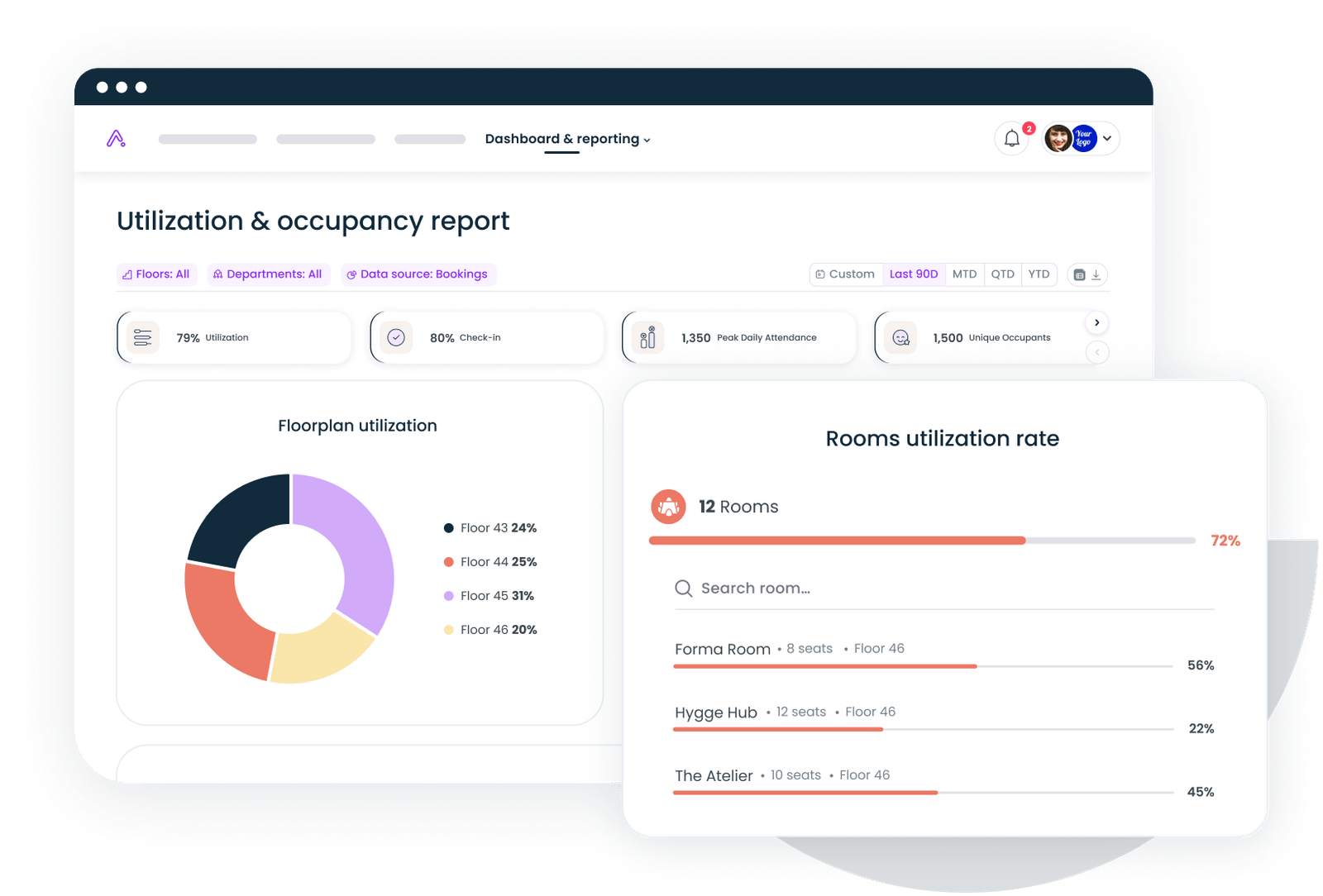
Gable handles this as a single platform: desk and room booking, visitor management, on-demand flex space, event coordination, and AI-powered workplace intelligence all feeding into one analytics layer. That matters because the real value of automation comes from the data those workflows generate when they're connected.
Step 5: Manage the change (ongoing)
Automation fails when people don't use it. Period. The best system in the world is worthless if your team keeps DMing the office manager instead of booking through the platform.
Three things that drive adoption:
- Make the automated path easier than the manual one. If booking a desk via the app takes three taps and booking manually requires a Slack message plus a five-minute wait, people will use the app.
- Show employees what's in it for them. "You can see who's in the office before you commute" is more compelling than "we're improving space utilization."
- Kill the old process. Don't leave the manual workaround alive. If desk booking is now in the system, stop honoring Slack requests. This sounds harsh. It's necessary.
Step 6: Measure, learn, expand (month 2 to 6)
After your pilot stabilizes, measure against your success metrics. Then expand to the next item on your priority list. A typical rollout timeline:
- Weeks 1 to 6: Single workflow pilot (e.g., desk booking for one floor)
- Weeks 7 to 10: Expand to full office; add meeting room automation
- Weeks 11 to 14: Layer in visitor management and occupancy reporting
- Months 4 to 6: Connect analytics, roll out to additional offices, introduce AI-driven insights
Real workplace automation examples by function
Office operations
This is the highest-impact category for workplace teams. Specific automations that pay for themselves quickly:
- Desk booking with neighborhood logic. Employees book desks near their team based on HRIS department data and historical patterns. No seating chart required.
- Ghost booking elimination. If a meeting room isn't checked into within 10 minutes of the reservation start time, the system releases it and notifies the waitlist. At a company with 30 conference rooms, this recovers 8 to 12 room-hours per day.
- Visitor workflows. Guest pre-registers online, receives a QR code, scans it at an iPad kiosk on arrival, gets a printed badge, and their host gets a Slack notification. Zero receptionist time for standard visits.
- Occupancy-triggered flex space. When your office space planning data shows consistent overflow on Wednesdays, the system suggests on-demand coworking spaces nearby for the spillover teams.
HR and people operations
- Onboarding space setup. New hire starts Monday; the system auto-assigns a desk in their team's neighborhood, books a welcome meeting room, and sends them floor plan directions via the mobile app.
- Hybrid schedule coordination. Employees set their in-office days; the system surfaces when teammates overlap and suggests optimal collaboration days. Not mandated. Suggested.
Finance and procurement
- Automated spend tracking. Every on-demand workspace booking, every event venue, every office supply order flows into a single dashboard segmented by department, location, and time period. Finance stops chasing receipts.
- Budget alerts. When a team hits 80% of their monthly flex space budget, their manager gets notified. No manual monitoring required.
Events and team gatherings
- Event creation to promotion in one flow. Set up an offsite, pick a venue from an integrated marketplace, send invitations through Slack and email, collect RSVPs, and track attendance, all without leaving the platform.
- Post-event feedback automation. Surveys deploy 24 hours after an event ends. Results aggregate into analytics dashboards alongside attendance and cost data.
Gable connects your people, spaces, and data with AI insights for better collaboration and savings.
Learn more
Common workplace automation challenges (and how to not get stuck)
"Our employees will resist this"
They won't resist automation. They'll resist bad automation. If the new system adds steps or feels clunky, of course people will route around it. Making the automated experience genuinely better than the manual one solves most resistance. Test with five people before you roll out to 500.
"Our legacy systems won't integrate"
This is real, but it's also a convenient excuse to delay. Modern workplace platforms connect via API, SSO, and standard protocols. If your access control system and WiFi infrastructure can export data (even as CSV files) you can feed that into an analytics layer. Perfect integration on day one isn't the goal. Directionally useful data is.
"We can't justify the cost"
A single floor of underutilized office space in a major metro costs $500,000 to $1.5 million annually. If automation gives you the occupancy data to shed that floor six months earlier than you would have otherwise, the ROI math isn't close. Frame the business case around real estate savings, not software features.
"We don't know what to automate"
Go back to Step 1. The audit takes two weeks, not two months. If you're stuck, ask your office manager what they wish they could stop doing. The answer is your automation roadmap.
Where workplace automation is heading in 2026 and beyond
Generative AI is changing what's possible, but not in the way most vendors pitch it. The real shift isn't "AI writes your emails." It's "AI turns six months of occupancy, booking, and access control data into a paragraph that tells your CFO which lease to renegotiate." Skip the dashboards, ask a natural language question, get an instant answer grounded in your workplace data. That's not a future-state vision. It's shipping now.
Three trends worth watching:
- Predictive space allocation. Instead of reacting to utilization reports monthly, AI models will forecast demand and pre-allocate space weekly. Your Tuesday engineering cluster gets assigned to a neighborhood with enough desks and two adjacent meeting rooms.
- Hyperautomation across the portfolio. Connected owned offices, flex spaces, and event venues form a single automated layer. When occupancy drops below a threshold in your HQ, the system suggests shifting budget to on-demand spaces in cities where your remote employees are clustering.
- Augmentation, not replacement. The workplace coordinator role is evolving from "manually release conference rooms and restock snacks" to "analyze collaboration patterns and design experiences that bring distributed teams together." Automation handles the operational floor so humans can work on the strategic ceiling.
Start with the task your team complains about most
Teams that stall on workplace automation often share one trait: they try to build a grand strategy before automating a single workflow. Don't do that. Find the one process that wastes the most time, automate it in four weeks, measure the result, and use that win to fund the next one. By month six, you'll have a connected system that generates the data your leadership team has been asking for: utilization numbers, real cost-per-seat figures, and collaboration patterns that inform where your next office should be.
See how Gable connects desk booking, visitor management, flex space, and AI-powered insights into one platform.
Get a demo