.svg)


.svg)
- Envoy started as visitor management; desk booking came later and lagged.
- Per-user, per-module pricing makes Envoy expensive as teams and features grow.
- Gable is our top Envoy alternative: desk booking plus the whole workplace, one invoice.
- The 6 best alternatives span all-in-one platforms, booking-first tools, and rules engines.
- Match the alternative to your size, locations, and how you book.
Envoy is a big name in workplace management. The platform has built its reputation on visitor management and expanded into desk booking, room scheduling, and workplace analytics. But for many teams, the reality of using Envoy falls short of expectations.
Maybe you're dealing with Envoy pricing that keeps climbing as your team grows. Maybe the setup feels too complex for what you actually need. Or perhaps you're watching adoption stall because employees find the platform overwhelming. Whatever brought you here, you're not alone in your search for the best Envoy alternative that better fits your hybrid workplace.
This guide breaks down everything you need to know about Envoy competitors in 2026, including detailed feature comparisons, real pricing data, and a clear framework for choosing the perfect fit for your organization.
Why teams are looking for Envoy alternatives
Before diving into alternatives, it's worth understanding why so many companies are reconsidering their workplace management platform. According to McKinsey research, hybrid work isn't a trend anymore. It's the dominant workplace model, with 88% of employers now offering some form of flexible work arrangement.
This shift has fundamentally changed what teams need from their office tools. And for many organizations, Envoy's original strengths have become limitations.
Pricing that scales with headcount, not value
Envoy's pricing structure often forces teams into higher tiers to unlock advanced features they need. The per-user model starts at $5 per active user per month for desk and room booking, which adds up quickly for larger hybrid teams where not everyone uses the office daily. Companies watching their bottom line often find themselves overpaying for features they don't use.
For companies with 300 employees sharing 100 desks (a common ratio in hybrid workplaces), the math doesn't favor per-user pricing. You're paying for every employee, whether they book desks weekly or monthly.
Complexity that slows adoption
User-friendly workplace management solutions should require minimal training and technical support for implementation and daily use. Many teams report that Envoy requires iPads and mounting hardware for room display setups, making installation complex and expensive. For medium-sized businesses, this extensive feature set can feel like overkill when all you need is straightforward desk reservations and visitor check-ins.
Simplicity in design and functionality often leads to higher user adoption. When employees need to learn a new system, they need something intuitive. A user-friendly platform makes all the difference between a tool that gets used and one that gets abandoned.
Integration gaps that create friction
Envoy integrates with popular tools like Google Workspace, Microsoft Outlook, and Slack. But many users prefer solutions that integrate seamlessly with tools they already use without additional configuration headaches. Envoy's integrations with other tools aren't always plug-and-play, leading to user frustration when calendars don't sync properly or notifications don't appear.
User experience is crucial, and platforms should provide intuitive interfaces that do not require extensive training. When your booking system doesn't integrate reliably with your calendar, employees lose trust in the platform.
Performance issues across multiple locations
For organizations operating across multiple locations, Envoy's user experience can lag, leading to performance issues that frustrate both office managers and employees. Real-time availability becomes critical when teams coordinate in-person days, and delays in seeing accurate desk or room status create scheduling conflicts.
What to look for in a workplace management platform
Before evaluating specific Envoy competitors, establish clear criteria based on your organization's needs. Here's what matters most:
Transparent pricing without nickel-and-diming: Look for platforms with clear, predictable costs that don't surprise you with add-on fees for essential features. The best Envoy alternative for your team will offer straightforward pricing that scales sensibly.
Ease of setup and use: Solutions that offer offline capabilities can enhance usability in environments with unreliable internet access. More importantly, the platform should work where your employees already work, whether that's Slack, Microsoft Teams, or mobile devices.
Comprehensive solution for hybrid needs: Your platform should handle desk booking, room booking, visitor management, and analytics without requiring multiple vendors. One holistic solution reduces complexity and provides better data insights.
Smart booking features: User-friendly platforms often include features that streamline processes, such as smart booking recommendations and conflict prevention. Look for interactive floor plans, automated notifications, and check-in options that make booking effortless.
Envoy alternatives at a glance
| # | Tool | Best for | Starting price | G2 rating |
|---|---|---|---|---|
| 1 | Gable | All-in-one Envoy replacement | $2.50/user/mo | 4.5 (127) |
| 2 | Robin | Polished desk and room booking | Quote-based | 4.4 (211) |
| 3 | deskbird | Mobile-first, easy adoption | From ~$3.75/user/mo | 4.5 (307) |
| 4 | Skedda | Rule-based booking at scale | From $99/mo (per space) | 4.8 (283) |
| 5 | Tactic | Low-cost breadth | From $3/user/mo | 4.6 (554) |
| 6 | Kadence | Team-day coordination | Quote-based | 4.5 (143) |
G2 ratings are out of 5 with review counts in parentheses, current as of June 2026.
The 6 best Envoy alternatives for desk booking
1. Gable
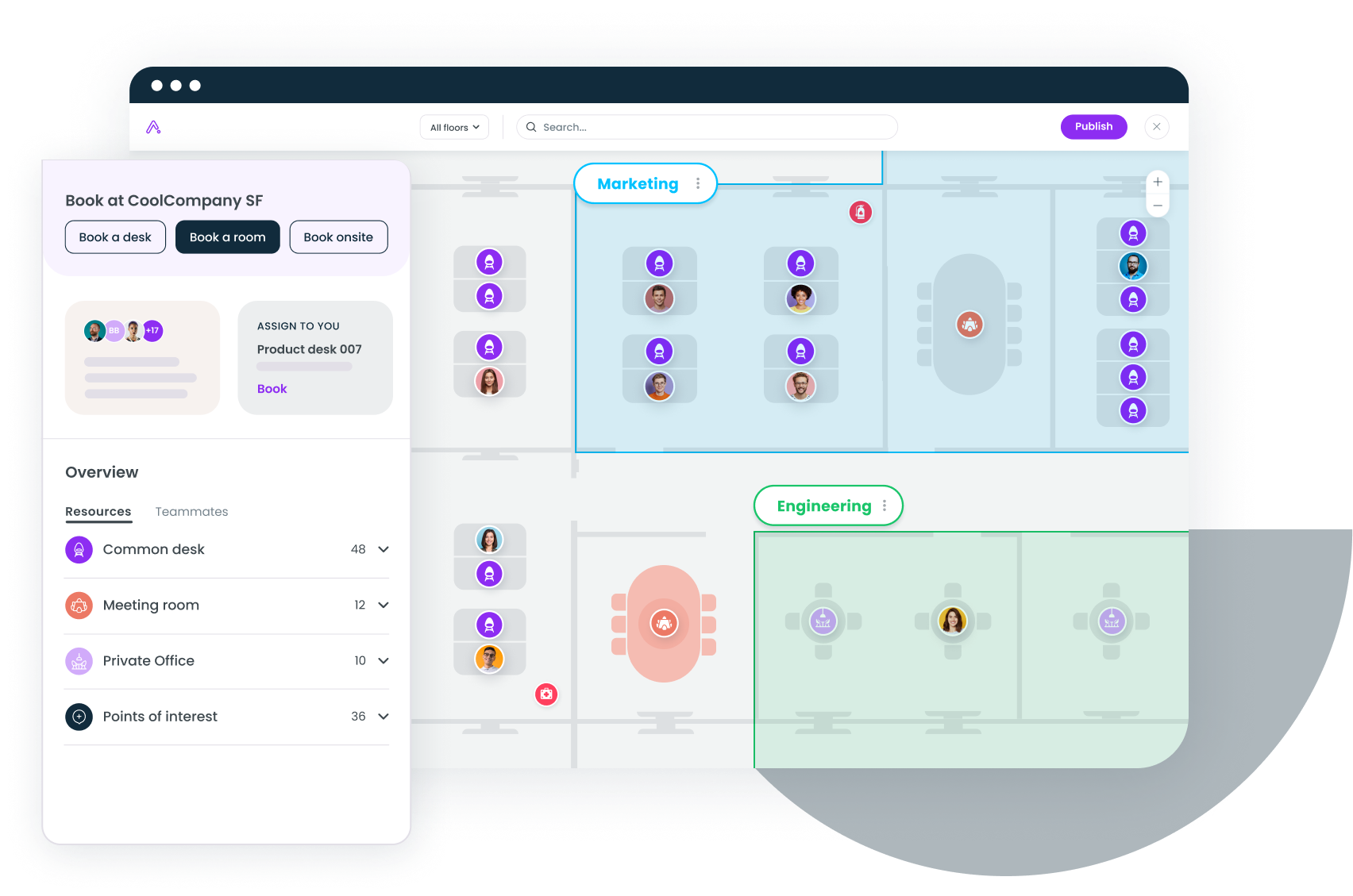
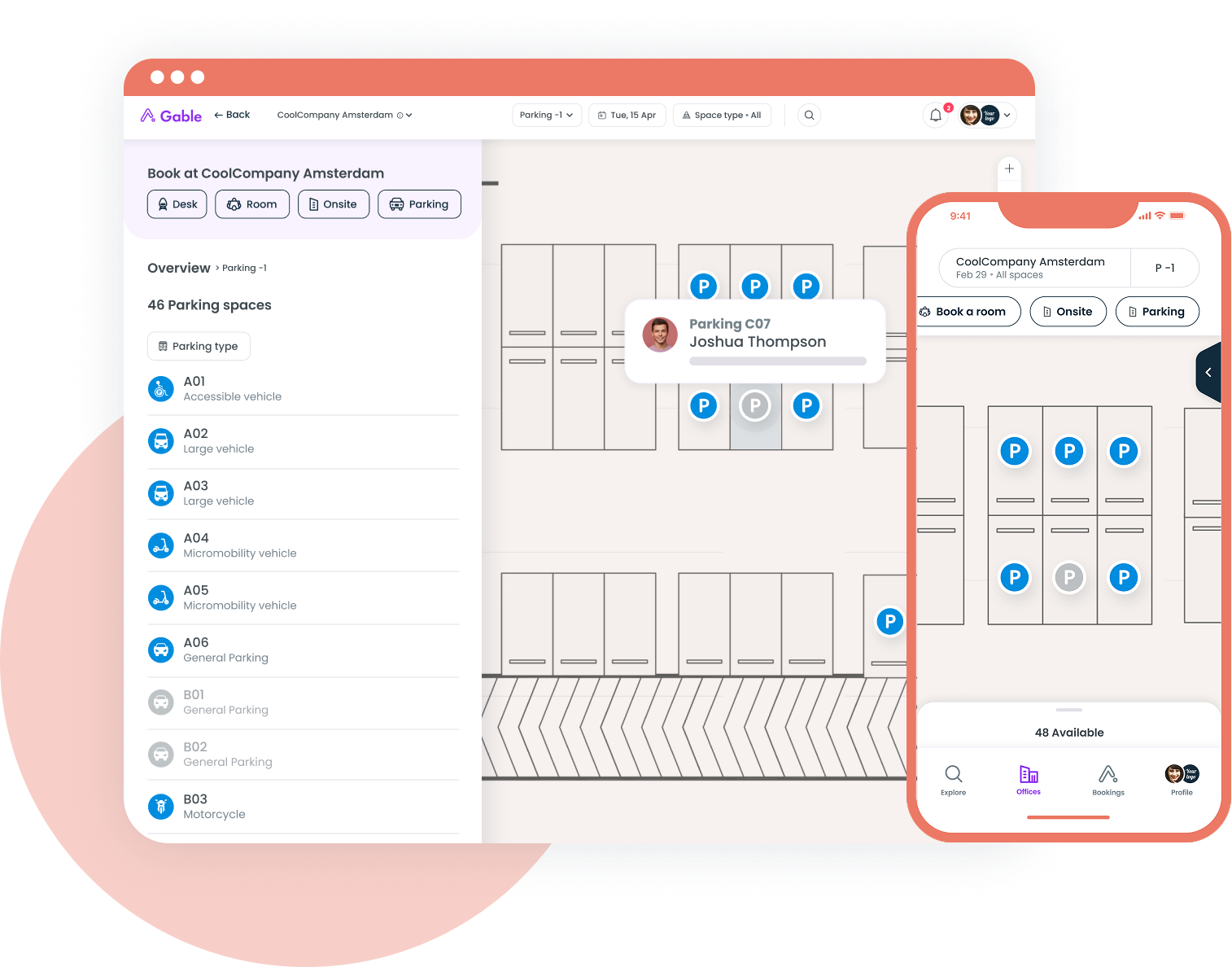
Gable is the best Envoy alternative for teams that want desk booking inside one platform that also handles rooms, visitors, on-demand coworking, and analytics, on a single invoice. Where Envoy grew out of visitor management and bolted desk booking on later, Gable treats booking, presence, and utilization as one system. Employees reserve desks and rooms from Slack, Teams, or mobile, and admins manage interactive floor plans and see real usage instead of guesses. That visibility is why Ironclad switched from Envoy to Gable, and why teams using Gable cut unused space by 32%. Crucially, you get all of it without per-module pricing: Gable's office management software starts at $2.50 per user per month.
- Best for: hybrid teams that want desk booking plus rooms, visitors, on-demand access, and analytics in one platform.
- Key features: desk and room booking from Slack, Teams, and mobile; visitor management and on-demand access to 20,000+ workspaces in 900+ cities; workplace analytics.
- Pricing: Office Management from $2.50 per user per month; the all-in-one plan is custom.
- G2 rating: 4.5/5 (127 reviews).

From desk booking to real-time analytics and AI-powered insights, see how Gable streamlines workplace management and boosts collaboration.
Learn more
2. Robin
Robin is one of the most polished desk-and-room booking tools, and a common landing spot for teams that liked Envoy's interface but wanted booking to be the main event, not an add-on. It turns booking data into attendance and utilization reporting.
- Best for: mid-market teams wanting refined desk and room booking with attendance insight.
- Key features: desk and room booking; team-day coordination; utilization and attendance reporting.
- Pricing: quote-based, by seats or desks.
- G2 rating: 4.4/5 (211 reviews).
3. deskbird
deskbird is a mobile-first booking app teams tend to adopt without training, which makes it a strong Envoy alternative for offices where adoption stalled. Floor plans show who's in, and desks auto-cancel if no one checks in, so the occupancy data stays honest.
- Best for: teams that want an intuitive, mobile and Teams-friendly booking experience.
- Key features: floor plans with colleague presence; week planning; auto-cancel on no check-in.
- Pricing: Business from about $3.75 per active user per month; higher tiers custom.
- G2 rating: 4.5/5 (307 reviews).
4. Skedda
Skedda is the pick when booking rules matter more than extras. Its rules engine controls who can book what, when, and under which conditions, and it prices per space rather than per user, which can come in cheaper than Envoy for large teams sharing limited desks.
- Best for: organizations that need granular, admin-controlled booking rules.
- Key features: rule-based desk and room booking; interactive floor plans; utilization reporting.
- Pricing: from $99 per month (per space, billed annually), with unlimited users.
- G2 rating: 4.8/5 (283 reviews).
5. Tactic
Tactic packs desk booking, room scheduling, and visitor management into a low per-seat price, which appeals to teams that found Envoy's modular billing expensive. AI features sit in its higher tier.
- Best for: teams wanting wide functionality at a low per-user cost.
- Key features: desk and room booking; colleague visibility; visitor management and an AI assistant (Pro).
- Pricing: Core from $3 per user per month; Pro $4; Enterprise custom.
- G2 rating: 4.6/5 (554 reviews).
6. Kadence
Kadence leads with team coordination: you see where your team plans to be and pick a day that lines up, with desk and room booking on top. It suits teams whose main Envoy frustration was syncing who's in, not only reserving space.
- Best for: teams that prioritize coordinating people over standalone booking.
- Key features: team-day visibility and coordination; desk and room booking; visual office maps.
- Pricing: quote-based (active-user billing).
- G2 rating: 4.5/5 (143 reviews).
Feature comparison: Gable vs Envoy
When evaluating the best Envoy alternative for your organization, a direct feature comparison helps clarify where each platform excels.
| Feature | Gable | Envoy |
|---|---|---|
| Desk booking | Yes – Book desks remotely or on-site with real-time availability and easy cancellations | Yes – Advanced booking with interactive maps |
| Room booking | Yes – Book meeting rooms globally, manage availability, and track usage | Yes – Simplifies room booking and frees unused rooms |
| Recurring bookings | Yes – Set a recurring desk or room booking once for consistent office days | No – Desks must be booked each time |
| Visitor management | Yes – Fast check-in and visitor tracking | Yes – Pre-registration, badge access, and notifications |
| Space utilization | Yes – Real-time analytics on workspace usage, employee engagement, and cost optimization | Yes – Unified view of space usage data from multiple sources |
| Event orchestration | Yes – Plan and manage onsite or offsite events from a single platform | No |
| Integration capabilities | Yes – Deep integrations with Slack, Microsoft Teams, Google Calendar, and other tools | Yes – Integrates with popular tools like Slack, Teams, and access control systems |
| Analytics and insights | Yes – Comprehensive data on bookings, space utilization, and budget management | Yes – Occupancy and space utilization analytics |
The recurring bookings gap matters more than it might seem. When employees have consistent office days (like every Tuesday), they shouldn't need to manually book each week. Gable's recurring booking feature eliminates this friction entirely.
How to evaluate your workplace management needs
Choosing the right platform requires understanding your specific situation. Stanford research indicates that well-organized hybrid work environments can deliver productivity improvements of up to 5% when employees can maximize collaborative time and minimize commute friction.
Here's a framework for evaluation:
Assess your current state
- How many employees need office access?
- What's your current desk-to-employee ratio?
- How many locations do you manage?
- What tools does your team already use daily?
Identify your pain points
- Is pricing unpredictable or climbing?
- Are employees struggling with adoption?
- Do you lack visibility into space utilization?
- Are visitor sign ins creating security gaps?
Define your requirements
Must-have features should include the basics: desk booking, room booking, and visitor management. But consider whether you also need parking spot management, event capabilities, or access to on-demand coworking spaces for remote team members.
Calculate the total cost of ownership
Don't just compare subscription prices. Factor in:
- Hardware requirements (iPads, displays, mounting equipment)
- Integration costs and IT support time
- Training time for employees and administrators
- Potential productivity losses during transition
Making the switch from Envoy
Moving off Envoy is rarely as disruptive as teams fear. Most alternatives offer guided onboarding and can import your floor plans, employee profiles, and historical booking data, with full deployment typically taking two to four weeks. Start with a pilot floor or team, connect your calendar and SSO, and communicate the why before the rollout. Because hybrid work is now the norm, with about half of remote-capable employees working hybrid per Gallup, the tool your team adopts easily will pay off every week.
Change management tips:
- Communicate the "why" clearly to employees
- Start with a pilot group before full rollout
- Provide quick-reference guides for common tasks
- Designate internal champions who can answer peer questions
Data migration: Your visitor experience history, employee profiles, and booking data can typically be exported from Envoy. Work with your new vendor's support team to ensure clean data transfer.
Gable gives you desk booking, rooms, visitor management, and analytics in one platform that hybrid teams at Stripe, Snowflake, and HubSpot trust. See the head-to-head.
Learn more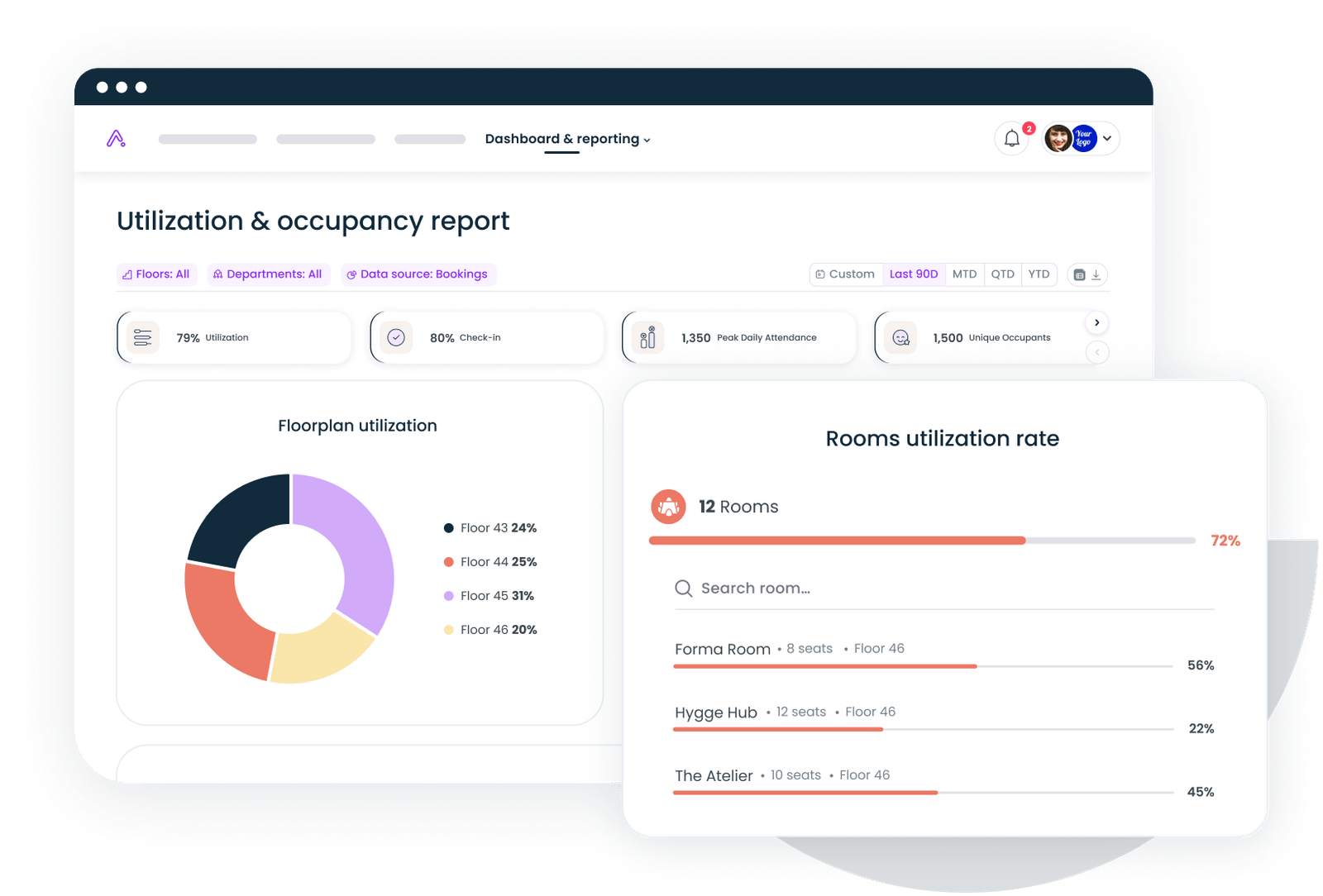
The case for a unified platform
Many companies watching their bottom line try to piece together multiple point solutions. One tool for desk booking, another for visitor management, a third for analytics. This approach creates several problems.
Data silos: When your systems don't talk to each other, you can't see the full picture. You might know how many desks get booked, but not how that correlates with visitor traffic or team collaboration patterns.
Integration overhead: Every additional tool requires setup, maintenance, and troubleshooting. IT teams end up managing a growing stack of workplace software instead of focusing on strategic initiatives.
Inconsistent check-in experience: Employees and visitors encounter different interfaces for different tasks. This fragmentation undermines the smooth, professional visitor experience you're trying to create.
A comprehensive solution like Gable eliminates these issues by providing a single platform for all workplace management needs. When your desk booking system shares data with your visitor management and analytics tools, you can make truly informed decisions about your office space utilization.
What the data tells us about hybrid work adoption
Understanding broader workplace trends helps contextualize your platform choice. According to McKinsey's 2025 research, 68% of workers are now mostly in-person, up from 34% in 2023. But this return to offices hasn't eliminated the need for flexibility.
Key statistics that should inform your platform decision:
- 90% of employers plan to offer some hybrid model going forward
- 58% of employees report increased productivity with hybrid arrangements
- 38% of mothers with young children say they would have reduced hours or left their jobs without workplace flexibility
- Office utilization rates remain around 38%, highlighting the continued need for flexible seating models
These numbers underscore why workplace analytics matter so much. You need visibility into how space is actually being used to make smart decisions about real estate, policies, and employee experience.
Building your business case for a new platform
If you're preparing to advocate for switching from Envoy to a better alternative, here's how to build a compelling case:
Quantify current pain points:
- Calculate the annual cost of the current platform, including all add-ons
- Estimate IT hours spent on troubleshooting and maintenance
- Survey employees about satisfaction and adoption challenges
Project potential savings:
- Compare per-seat pricing across alternatives
- Factor in reduced hardware requirements
- Consider productivity gains from better adoption
Highlight strategic benefits:
- Better data for real estate decisions
- Improved visitor experience for clients and partners
- Enhanced ability to support hybrid work policies
Which Envoy alternative is right for you
The right pick depends on your team:
- Small or mid-sized office that wants simplicity: deskbird or Tactic give you easy desk booking without Envoy's hardware requirements or modular fees.
- Enterprise or multi-location team that wants one system: Gable is the strongest fit, since desk booking, rooms, visitors, on-demand access, and analytics share one platform and one invoice, with the data to right-size real estate.
- Booking-rules-heavy office with many bookable spaces: Skedda's rules engine and per-space pricing scale better than per-user models.
For most organizations evaluating Envoy competitors, Gable offers the best combination of features, pricing, and ease of use. The unified platform approach eliminates the complexity of managing multiple vendors while providing the flexibility that modern hybrid workplaces demand.
Book a demo and we'll show how Gable handles desk booking, rooms, and visitors for a hybrid team like yours, on one invoice.
Get a demo