.svg)


.svg)
- Workplace analytics software measures how your office space gets used, not employee time.
- Two camps: workplace platforms with built-in analytics, and sensor-based occupancy tools.
- Gable unifies booking, badge, and WiFi data into one utilization view.
- Sensor vendors are accurate but thin on public reviews; platforms have the track record.
- Match the tool to your real question: space waste or attendance patterns.
Workplace analytics software measures how your physical workplace gets used: which desks, rooms, and floors are occupied, when, and by how many people. It turns badge swipes, booking data, WiFi signals, and sensor counts into decisions about space, leases, and office design. The category matters more in 2026 because the numbers finally moved: global office utilization climbed to 53%, up from 38% in 2024, according to CBRE. This guide compares the 10 best workplace analytics tools of 2026: what each measures, who it fits, and what it costs.
What is workplace analytics software?
Workplace analytics software collects data on how a physical workplace operates and turns it into actionable reports. It answers questions like how many people came in on Tuesday, which meeting rooms sit empty, and whether you're paying for floors nobody uses. The data comes from desk and room bookings, badge swipes, WiFi connections, and occupancy sensors. For the fundamentals of what to track and why, our complete guide to workplace analytics goes deeper; this guide focuses on the tools.
It's a different category from workforce analytics software or employee productivity analytics, which track how individuals spend time and how engaged they are (global engagement sits at 20%, per Gallup). Those tools watch people; workplace analytics watches the building. And the building has a problem: offices run at about 56% of target capacity, an 18-point gap between planned and actual use, according to JLL. As hybrid work statistics keep showing, the office is a part-time destination, so that empty space is easy to miss and expensive to keep.
How we picked these tools
We weighed each tool on five factors:
- What it measures: booking-based utilization, sensor-based occupancy, or both.
- Data sources: whether it reads your bookings, badge, and WiFi, or needs its own hardware.
- Accuracy versus effort: sensors give ground truth but cost more to install; booking data is free but assumes people book what they use.
- Scale: a single office versus a multi-location, multi-floor portfolio.
- Track record: how much real-world validation exists, including public reviews.
One note on honesty: Gable is our product, so we put it first and tell you where another tool fits better. We also flag where a vendor looks strong but has almost no public reviews to back it up.
Workplace analytics software at a glance

If you're weighing complete workplace platforms and not only analytics, our roundup of the best workplace management software covers the wider field.
Read the comparison
The 10 Best Workplace Analytics Software Tools
1. Gable
Gable is an all-in-one workplace platform that measures space, people, and cost in one place, instead of stitching together a booking tool, a badge system, and an occupancy sensor. It combines desk and room bookings with badge, WiFi, and HR data, so a workplace lead sees real utilization without exporting four spreadsheets. Teams using Gable's office space management software have cut unused space by 32%.
- Best for: hybrid teams (200 to 5,000 employees) that want space and people analytics in one platform, not a stack of point tools.
- Key features: workplace intelligence dashboards; an AI copilot that answers utilization questions in plain language; unified booking, badge, and WiFi data.
- Pricing: Office Management edition from $2.50 per user per month; the all-in-one plan is custom.
- G2 rating: 4.5/5 (127 reviews).
2. Robin
Robin built its name on desk and room booking, and its analytics suite turns that booking data into utilization, attendance, and peak-day reporting. Because it leans on bookings rather than sensors, it's quick to deploy but assumes people book the space they use.
- Key features: desk and room utilization dashboards; attendance and peak-day trends; usage forecasting from booking history.
- Pricing: quote-based, priced by seats or desks.
- G2 rating: 4.4/5 (211 reviews).
3. OfficeSpace Software
OfficeSpace focuses on space management for larger real estate teams, and its workplace intelligence layer blends WiFi, badge, and booking data into utilization benchmarking. That multi-source approach paints a fuller picture than booking data alone.
- Key features: utilization dashboards; WiFi, badge, and booking data blending; space benchmarking for RTO and lease decisions.
- Pricing: quote-based.
- G2 rating: 4.7/5 (126 reviews).
4. Envoy
Envoy covers desks, rooms, and visitors in one platform, with workplace analytics on space usage and occupancy across multiple locations. The analytics sit in higher tiers, so the entry price understates what a data-focused team will pay.
- Key features: desk and room occupancy by location; peak usage and booking trend reports; real-time occupancy views.
- Pricing: from about $109 per month on the entry Workplace plan; analytics-heavy use lands in higher, quote-based tiers.
- G2 rating: 4.4/5 (163 reviews).
5. Eptura
Eptura is the IWMS option, formed from iOffice and Condeco. It pairs workplace analytics (desk and room utilization, hybrid scheduling) with asset and maintenance management, so facilities and space data live in one system.
- Key features: space utilization dashboards; asset and maintenance analytics; hybrid scheduling with Microsoft 365 usage data.
- Pricing: quote-based, by modules and headcount.
- G2 rating: 4.3/5 (168 reviews).
6. Density
Density replaces guesswork with sensors. Its radar-based people counters measure real occupancy anonymously, then model the cost savings of right-sizing each space. It's one of the recognized names in sensor-based occupancy, though its public review base is still small.
- Key features: anonymous people counting; utilization by space type; capacity and cost-savings analysis.
- Pricing: quote-based (hardware plus a software subscription).
- G2 rating: 4.5/5, but from only 4 reviews, so treat it as a thin signal.
7. VergeSense
VergeSense uses computer-vision area sensors to deliver what it calls spatial intelligence: occupancy accurate to the seat, by zone and by day. It can also fold in existing WiFi and building-system data, and its assistant suggests where to add or cut space.
- Key features: anonymous computer-vision occupancy; zone and day-level utilization; AI recommendations on space changes.
- Pricing: quote-based (hardware plus platform; software-only if using existing building data).
- G2 rating: no G2 reviews yet, so there's no public score to lean on.
8. Butlr
Butlr takes a privacy-first route: body-heat thermal sensors that count people without cameras or any personal data. The output (headcount, movement, dwell time) feeds your existing dashboards through an open API rather than locking you into one portal.
- Key features: thermal, no-camera people counting; movement and dwell-time data; open API into existing analytics or building systems.
- Pricing: quote-based (hardware plus subscription).
- G2 rating: no G2 reviews yet.
9. Freespace
Freespace bundles its own sensors with a workplace analytics portal, an employee app, and even air-quality and energy data, aiming to be the whole stack from one vendor. That breadth is the appeal and the risk: it's a bigger commitment than a single analytics layer.
- Key features: real-time occupancy and people counting; planned-versus-actual-versus-predicted occupancy; air-quality and energy analytics.
- Pricing: quote-based; a paid multi-month occupancy trial is available.
- G2 rating: 3.7/5, but from only 3 reviews, so it isn't a reliable signal.
10. XY Sense
XY Sense uses wide-area computer-vision sensors, each covering up to a few thousand square feet, to track live occupancy and utilization across big open-plan floors. Fewer sensors for more coverage keeps the hardware count down.
- Key features: live occupancy views; building, floor, desk, and room utilization; neighborhood and capacity planning.
- Pricing: quote-based (hardware plus platform).
- G2 rating: only 2 reviews on an unclaimed profile, so there's no usable score yet.
Gable's analytics turn desk bookings, badge swipes, and WiFi data into utilization insights you can act on without chasing four reports.
Learn more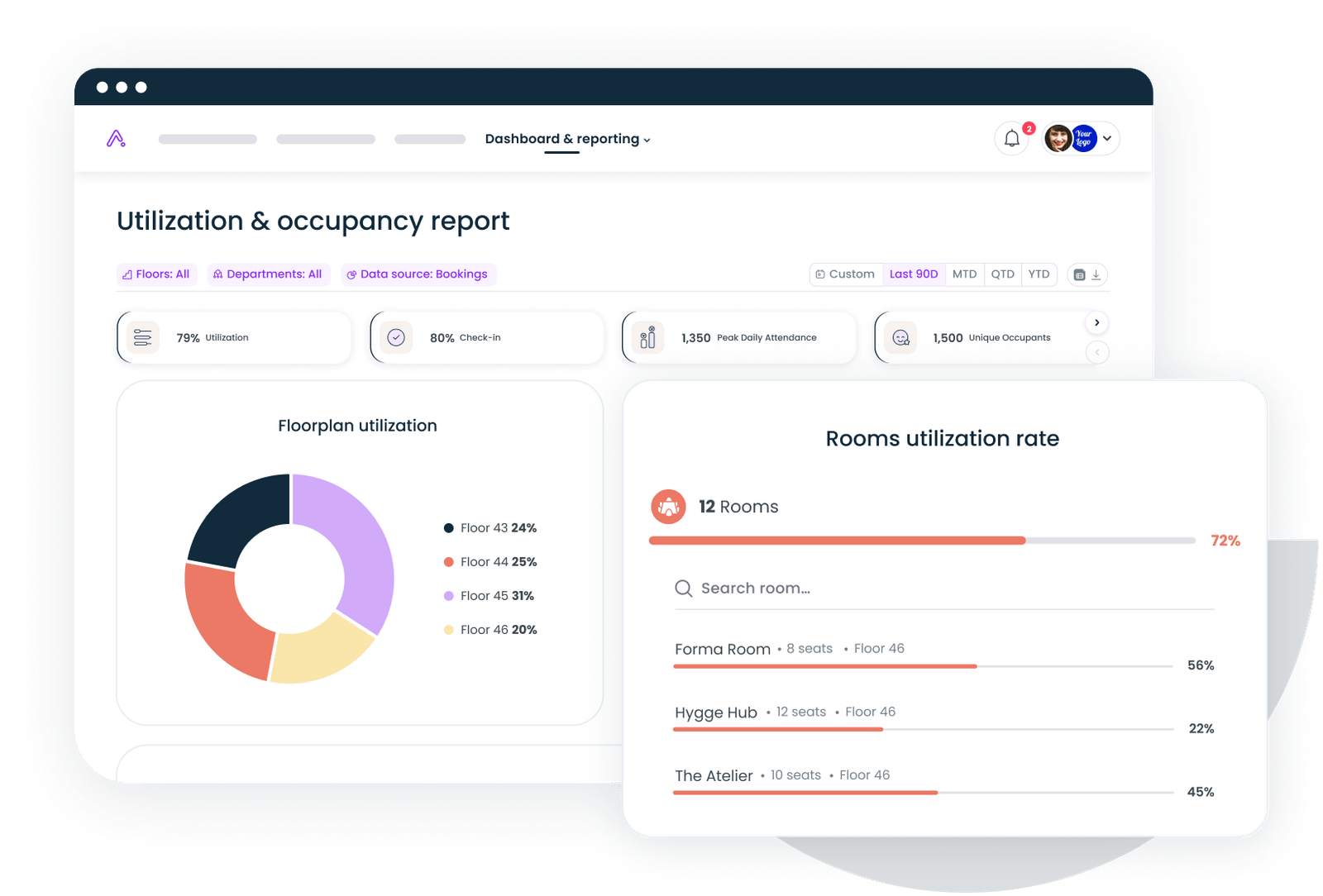
How to choose the right workplace analytics software
The right tool depends on what you're trying to learn.
- Decide between platform analytics and sensors. If you already run desk and room booking, a platform like Gable, Robin, or Envoy turns that booking data into space utilization and office occupancy rate reporting with no new hardware. If you need ground truth (who's in the office, not who booked), sensors from Density, VergeSense, or Butlr measure it directly.
- Check the data sources. A tool that reads your calendar, HRIS, badge, and WiFi shows more than one that only sees bookings. This is where a connected workplace management software platform beats a single-purpose dashboard, and where a desk booking layer that already captures usage saves you a separate feed.
- Match it to your footprint. One office can start with booking analytics or a handful of sensors. A multi-floor, multi-city portfolio needs consolidated reporting and a plan for office space planning across sites.
- Weigh accuracy against budget and effort. Booking analytics are cheap and immediate, but assume people book what they use. Sensors are accurate but carry hardware and install costs. AI features are becoming standard, with 92% of CRE teams now piloting AI, up from under 5% in 2023, per JLL. And in hybrid offices the stakes are real: hybrid schedules cut resignations by a third with no hit to performance, so the goal is using space well, not forcing attendance.
Which workplace analytics tool fits your team
There's no single best workplace analytics tool, because they answer different questions. Platforms like Robin, OfficeSpace, Envoy, and Eptura turn the booking and badge data you already have into utilization reporting. Sensor vendors like Density, VergeSense, and Butlr measure occupancy directly, with more accuracy and more hardware. Gable's pitch is that you shouldn't have to choose: booking, badge, and WiFi data land in one view, so you see how space is used without running two systems. Whatever you pick, the point is to stop guessing about workplace efficiency and start deciding with data.
Book a demo and we'll show you how Gable turns your space and people data into decisions, using your own offices as the example.
Get a demo