.svg)


.svg)
- OfficeSpace costs $22,000-$96,000/year, but alternatives like Gable start at $2.25/seat/month with more bundled features
- The 2026 workplace software market is consolidating toward all-in-one platforms that combine desk booking, visitor management, and analytics
- A 25-point gap between current office utilization (54%) and target (79%) means most companies are overspending on space they don't use well
- This guide compares 10 OfficeSpace alternatives with updated Q2 2026 pricing, feature breakdowns, and a decision framework to help you choose
- The cheapest option isn't always the best; total cost of ownership includes implementation time, integrations, and admin overhead
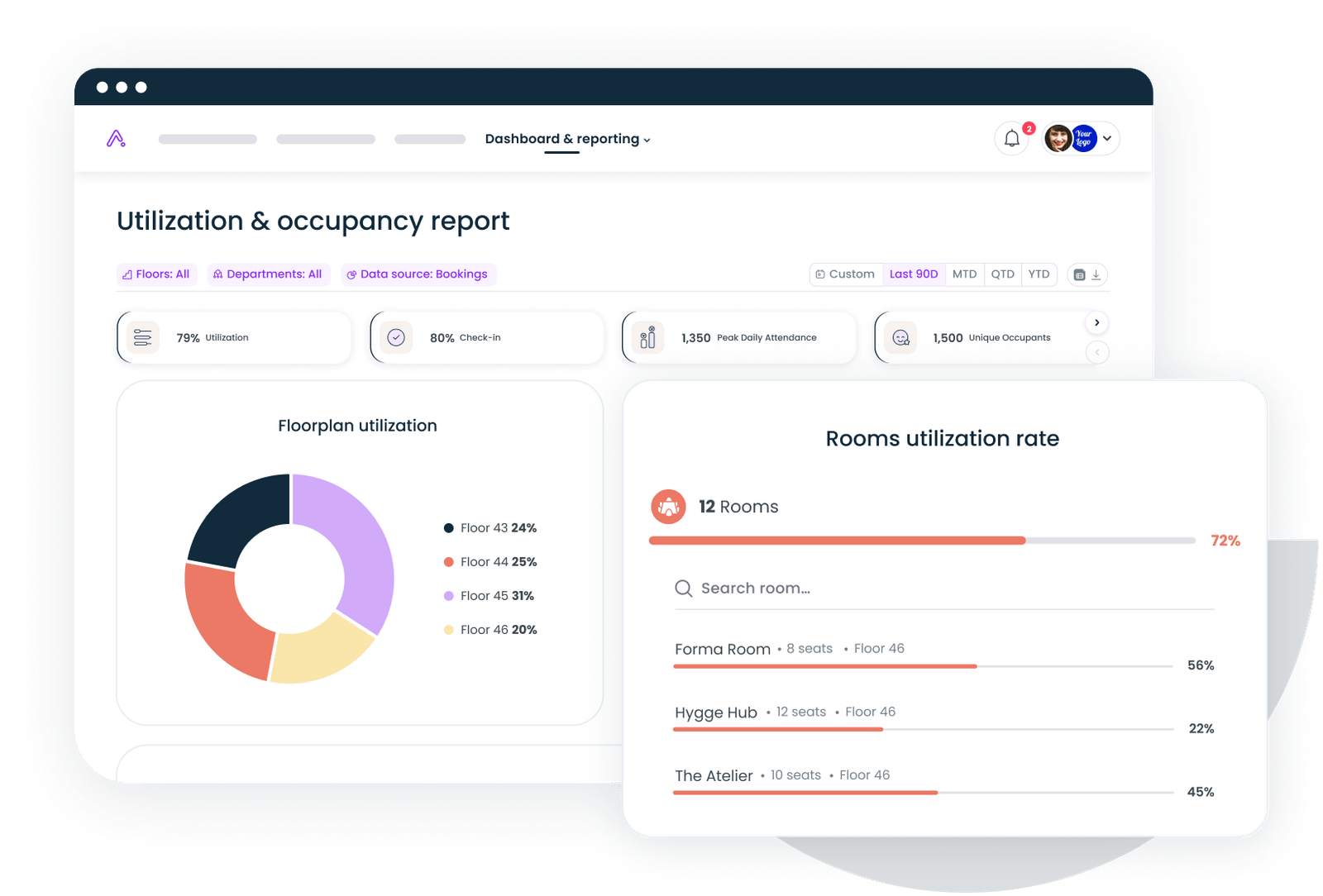
If you're evaluating OfficeSpace Software alternatives, you're likely hitting one of a few friction points: opaque pricing, rigid per-user models, or a feature set that doesn't match how your hybrid team actually works. You're not alone. According to CBRE's 2026 Global Workplace Insights, global office utilization reached only 54% in 2025, while target utilization climbed to 79%. That 25-point gap is a significant cost problem for organizations paying for space that sits empty, and it's driving demand for smarter, more flexible workplace software.
The market has shifted since early 2026. Buyers are increasingly consolidating desk booking, meeting rooms, visitor management, parking, and reporting into a single platform. That move from point solutions to workplace operations platforms is the defining buying pattern this year, and it changes what you should look for in an OfficeSpace replacement.
This guide breaks down 10 alternatives with current pricing, feature comparisons, and a decision framework so you can find the right fit for your team size, tech stack, and budget.
Why companies look for OfficeSpace alternatives
OfficeSpace Software is a well-known player in space planning and move management, particularly for large enterprises. But several recurring pain points push workplace leaders to explore other options:
Pricing that's hard to predict
Vendr's 2026 pricing report puts the average annual cost at about $22,000, with some implementations reaching $96,000. There's no public pricing page, so you won't know your cost until after a demo and custom quote process.
Per-user models that penalize growth
OfficeSpace's per-user pricing means costs scale linearly with headcount, even if many employees rarely use the office. For hybrid teams where only 40-60% of staff come in on any given day, you're paying for seats that go unused.
Feature gaps for hybrid-first teams
OfficeSpace excels at space planning and move management for large campuses. But if your priorities are desk booking, on-demand coworking access, or event coordination, you may find yourself stitching together multiple tools to cover the gaps.
Implementation complexity
Enterprise-grade tools often come with enterprise-grade onboarding timelines. Teams looking for faster time-to-value, especially mid-market companies with 50-500 employees, often find lighter-weight alternatives more practical.
Quick-scan comparison table
Before diving into individual profiles, here's a side-by-side view of how these officespace alternatives stack up on pricing, team size fit, and key differentiators.
Detailed profiles of each alternative
Gable
Gable takes a bundled approach to workplace management. At $2.25/seat/month, it includes desk booking, room scheduling, visitor management, event planning, and access to 20,000+ on-demand coworking spaces globally. That consolidation matters: internal data shows 72% of bookings are for team gatherings, and organizations using Gable's data-driven management see a 32% reduction in unused space.
Where Gable stands out is the combination of owned-office management (through Gable Offices) and flexible workspace access in a single platform. For distributed teams that need both HQ optimization and satellite options, that's a meaningful differentiator. Implementation typically takes under four weeks, and integrations cover Slack, Teams, Outlook, Google Calendar, and major HRIS platforms.
Best for: Mid-market to enterprise hybrid teams that want one platform, one invoice, and both office and on-demand workspace management.
Tactic
Tactic positions itself as an AI-forward workplace platform, with its Tessa AI assistant handling administrative tasks like booking optimization and space recommendations. Pricing starts around $10,000/year, making it an enterprise-focused option.
The platform offers desk and room booking, workplace analytics, and integrations with major calendar and HRIS tools. Tactic's analytics dashboards are among the more detailed in this category, with occupancy heatmaps and utilization trend reporting.
Best for: Enterprise teams (500+) that want AI-powered admin automation and deep analytics.

Understanding the business case for workplace data is critical when evaluating any new platform. See the four pillars that matter most.
Read the guide
Deskbird
Deskbird updated its pricing in April 2026. The Business plan now starts at approximately €2.75/user/month (around $3.75 USD) on annual billing, covering desk booking, mobile apps, and floor plans. The previous free and tiered pricing structure has been replaced with a cleaner per-user model.
Deskbird's strongest selling point in 2026 is its deep Microsoft 365 integration. If your organization runs on Teams, Outlook, and the broader Microsoft ecosystem, Deskbird offers a native experience that competitors often handle through third-party connectors. The platform also includes interactive floor plans and basic analytics.
Best for: Microsoft-first organizations (50-1,000 employees) that want tight Teams integration without enterprise pricing.
Skedda
Skedda takes a different approach to pricing: flat monthly rates ($99-$599/month) based on the number of spaces rather than users. For organizations managing multiple locations or shared spaces, this can be significantly cheaper than per-user models.
The platform is known for fast setup and customizable booking rules. You can configure automated policies for recurring reservations, buffer times between bookings, and access permissions. It's less feature-rich than enterprise platforms, but for SMBs that need reliable desk and room booking without complexity, Skedda delivers.
Best for: Small to mid-sized businesses (20-500 people) managing multiple spaces who want predictable, flat-rate pricing.
Archie
Archie uses resource-based pricing, meaning you pay per desk or room rather than per user. This model works well for organizations where a large percentage of employees are remote and only a fraction use the office on any given day.
The platform includes desk booking, meeting room scheduling, visitor management, and member management features. Archie also offers a coworking management module, making it a fit for companies that operate their own flex spaces alongside traditional offices.
Best for: Mid-market hybrid teams (100-2,000) where resource-based pricing aligns better with actual usage patterns.
Officely
Officely is purpose-built for teams that live in Slack or Microsoft Teams. It's free for teams under 10 users, then $2.49/user/month after that. The entire booking experience happens inside your messaging platform, with no separate app to learn or maintain.
The trade-off is limited admin controls and analytics compared to standalone platforms. Officely handles desk booking and hybrid scheduling well, but if you need visitor management, advanced reporting, or space planning, you'll need to pair it with other tools.
Best for: Small Slack-first teams (10-300) that want the lowest friction path to desk booking.
YAROOMS
YAROOMS targets enterprise organizations with advanced analytics, digital signage integration, and detailed occupancy reporting. Pricing is custom and typically requires a demo conversation.
The platform's analytics capabilities are a standout. YAROOMS customers frequently cite tangible ROI from reducing unused office space and cutting administrative overhead. If your primary motivation for switching from OfficeSpace is better data and reporting, YAROOMS deserves a close look.
Best for: Large enterprises (2,000+) that prioritize deep analytics and are comfortable with custom pricing.
Robin
Robin has been in the workplace software space for years and offers a mature product with strong wayfinding, interactive maps, and a broad integration ecosystem. Pricing is custom and quote-based, positioning it firmly in the enterprise tier.
Robin's strength is handling complex, multi-floor, multi-building environments where employees need help navigating physical space. The platform also offers meeting room analytics and scheduling features. The trade-off is that pricing and implementation timelines tend to be higher than mid-market alternatives.
Best for: Large enterprises (1,000+) with complex campus environments that need advanced wayfinding and deep integrations.
Kadence
Kadence focuses on hybrid schedule coordination, helping teams plan which days they'll be in the office and who they'll overlap with. Pricing is custom and quote-based.
The platform's core value proposition is reducing the "I came in but my team wasn't there" problem that plagues hybrid organizations. Kadence integrates with Slack, Teams, and major calendar tools, and offers neighborhood-based seating to keep teams physically close on shared office days.
Best for: Hybrid teams (100-1,000) where coordination and team overlap are the primary pain points.
Clearooms
Clearooms is a newer entrant gaining traction on G2 and Capterra. The platform offers desk booking with health questionnaires (useful for organizations with ongoing wellness protocols) and automatic no-show release, which frees up desks when employees don't check in.
As an early-stage product, Clearooms has a smaller feature set than established competitors. But for teams that want a simple, focused desk booking tool without the overhead of a full workplace platform, it's worth evaluating.
Best for: Small to mid-sized teams (50-500) that want straightforward desk booking with built-in wellness features.
Gable Offices gives you desk booking, room scheduling, visitor management, and analytics in one affordable platform.
Learn more
Real-world ROI: What cost savings look like
Switching workplace software isn't only about feature checklists. The financial case matters, especially when you're presenting options to finance leadership.
The utilization gap is expensive
CBRE's data shows a 25-point utilization gap between where most organizations are (54%) and where they want to be (79%). Organizations that close even half that gap can redirect significant budget toward higher-impact investments. For a company paying $50/sq ft annually across 50,000 square feet, a 12-point improvement in utilization could free up thousands of square feet of leasable space.
Meeting rooms are a hidden cost sink
According to Worklytics' 2025 benchmarks, 80% of meetings happen in rooms designed for six or fewer people, while boardrooms (17+ seats) see only 12% utilization. Add a 40% no-show rate for booked meetings, and you're looking at massive waste. Tools with AI-powered room scheduling and auto-release features can reclaim that capacity without adding square footage.
Total cost of ownership goes beyond the sticker price
The cheapest per-seat price doesn't always mean the lowest total cost. Factor in:
- Implementation time: Enterprise tools can take 8-12 weeks; lighter platforms deploy in 2-4 weeks
- Integration costs: Does the platform connect natively to your HRIS, calendar, and access control, or do you need middleware?
- Admin overhead: How many hours per month does your workplace team spend managing the tool?
- Consolidation savings: Running separate tools for desk booking, visitor management, and analytics often costs more than a bundled platform
For a deeper dive into building the financial case, see our guide on workplace ROI metrics.
How to choose the right alternative
Rather than defaulting to the most popular option, match your selection to your specific constraints. Here's a decision framework:
- If your hybrid team is under 250 people: Skedda or Officely offer the fastest setup and lowest cost. You can always migrate to a more feature-rich platform as you grow.
- If Microsoft 365 is your primary ecosystem: Deskbird (~$3.75/user/month) gives you the tightest Teams integration. YAROOMS is the enterprise-grade option in this lane.
- If you need visitor management bundled in: Gable and Archie both include visitor management without requiring a separate product or add-on.
- If your team lives in Slack: Officely ($2.49/user/month) is the most native option, though admin controls are limited.
- If complex space planning is your priority: OfficeSpace itself remains strong here. Tactic offers a mid-market alternative with AI-powered planning.
- If you want to pay per resource, not per user: Archie and Skedda both offer models where you pay for desks and rooms rather than headcount.
- If you need both office and on-demand coworking: Gable is the only platform on this list that bundles owned-office management with access to 20,000+ flex workspaces globally.
For organizations going through broader workplace strategy changes, it's worth aligning your software selection with your long-term real estate plans rather than optimizing for today's setup alone.
Making the switch from OfficeSpace
If you've decided to move forward with an alternative, here's what to expect during migration:
- Timeline: Most transitions take 2-4 weeks for mid-market tools, 4-8 weeks for enterprise platforms
- Floor plan setup: You'll need to recreate or import interactive floor plans. Most alternatives offer onboarding support for this step.
- User provisioning: HRIS and SSO integrations speed this up significantly. Confirm your new platform supports your identity provider before signing.
- Calendar sync: Ensure the new tool connects to both Google Calendar and Outlook if your organization uses both.
- Team adoption: The biggest risk isn't technical; it's behavioral. Plan for a change management process that includes training, communication, and feedback loops.
Data import support varies by vendor. Gable, Archie, Skedda, and Tactic all offer migration assistance as part of onboarding.
The bottom line on OfficeSpace Software alternatives in 2026
The workplace software market has matured significantly. You no longer need to choose between affordable-but-limited and powerful-but-expensive. Mid-market platforms now offer feature sets that rival enterprise tools at a fraction of the cost, and the consolidation trend means fewer vendors to manage.
Your best choice depends on three factors: your team size, your tech stack, and whether you need office-only management or a combination of office and flexible workspace access. Use the comparison table and decision framework above to narrow your shortlist, then run demos with your top two or three options.
The 25-point utilization gap isn't going to close itself. The right software gives you the data and tools to close it deliberately.
Book a demo with our experts to identify where you're overspending and how to fix it.
Get a demo