.svg)


.svg)
- Employees book parking spots the way they book desks; admins set the rules
- Drivers waste 17 hours a year hunting for parking
- Auto-release and waitlists turn no-shows into available spots
- Parking data doubles as attendance data for space planning
- Gable bundles parking with desk booking from $2.50 per user monthly
Office parking management software lets employees reserve a spot the same way they'd book a desk, and gives admins control over how spaces get allocated. The pressure on lots keeps rising: 69.2% of US workers drive alone to work, and when those cars hit a lot still run on permits and spreadsheets, the workday starts with a scramble. These eight tools fix that, and this guide compares them on features, pricing, and fit.
Why office parking creates more friction than most teams expect
Parking fails on exactly the days the office succeeds. Anchor days concentrate attendance into Tuesday through Thursday, so a lot sized for average demand overflows midweek while sitting half empty on Fridays. Without a system, the failure modes pile up:
- First-come chaos. Spots go to whoever arrives earliest, which quietly punishes parents on school runs and anyone with a long commute.
- Permit hoarding. Assigned spots sit empty on their owners' remote days while colleagues circle the block. A spreadsheet can't reclaim them.
- The 8:55 a.m. scramble. US drivers already spend 17 hours a year searching for parking, at about $345 each in wasted fuel and time, per INRIX. Repeating that hunt at the office door sours the commute people were asked to make.
- A hidden RTO tax. Over half of workers cite commuting costs as their biggest obstacle to coming in more often. An unpredictable parking spot adds risk to a commute that already feels expensive.
Workplace parking is also a fairness signal. When the lot works, nobody mentions it; when it doesn't, it comes up in every office-attendance survey.
What office parking management software does (and where it ends)
A parking reservation system works like desk booking for your lot. Employees see available spaces on a map, book one for their on-site days, and check in when they arrive. The management layer sits on top: which spots are assigned versus shared, who gets priority, how far ahead people can book, and what happens when a driver doesn't show.
The boundary matters when you're buying. These tools manage workplace lots and garages for employees and guests. They don't run municipal meters, ticket enforcement, or public garage payments; that's a different product category. And while the software eliminates allocation friction, it can't create spaces: if demand outstrips supply every day of the week, the fix is policy (carpooling incentives, transit benefits, staggered anchor days), with the software enforcing whatever you decide.

Parking is one piece of the workplace stack. We compared the best workplace management software on booking, analytics, and cost.
Read the comparison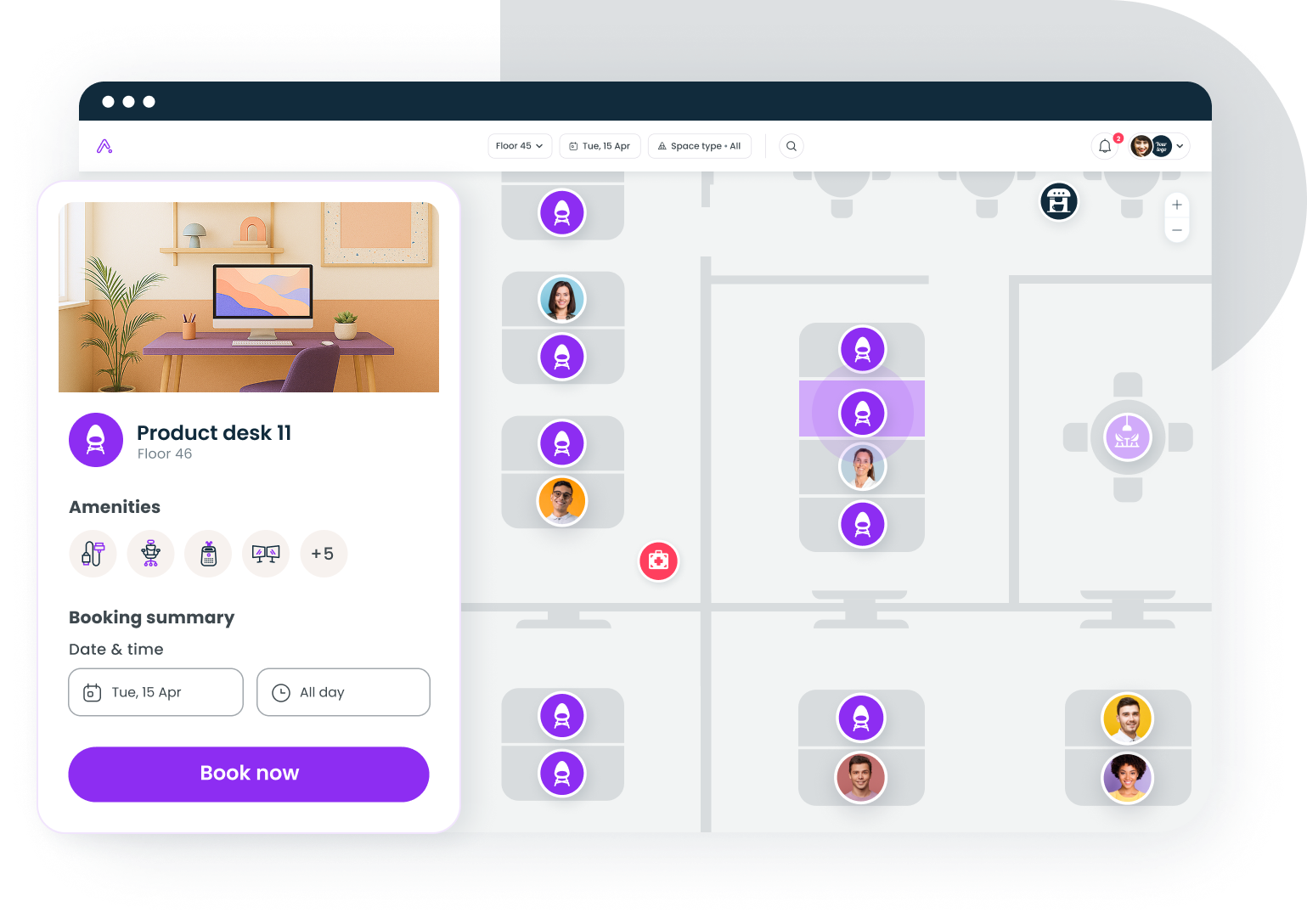
How we selected these tools
Workplace parking runs from a small lot behind the building to multi-level garages shared with other tenants, so every tool here met the same bar:
- Built for workplaces: employee and guest parking, with self-service booking plus real admin controls (assignments, limits, auto-release)
- Pricing verified on vendor sites in July 2026; where it's not public, we say so
- Current G2 ratings and recurring review themes, rather than cherry-picked testimonials
- Integrations with the broader workplace stack: desk booking, access control, HR, and SSO
The 8 best office parking management software tools in 2026
| Tool | Best for | G2 rating | Pricing |
|---|---|---|---|
| Gable | Parking built into desk booking | 4.4/5 (243 reviews) | From $2.50 per user/month |
| Wayleadr | Enterprise, multi-site arrival management | 4.9/5 | Custom; Flex plan from $49/month |
| Parkable | Shared and tenant parking | 4.9/5 (80 reviews) | Custom |
| Ronspot | Fair allocation with credits | 4.5/5 | Custom, per space (20-space minimum) |
| Sharvy | Multi-vehicle-type lots on a budget | Too few reviews | Free up to 5 spaces; EUR 2-4.20/space/month |
| deskbird | Parking inside hybrid scheduling | 4.5/5 (279 reviews) | From ~$3.75 per user/month |
| Envoy | Audit-ready workplace suites | 4.4/5 | $5 per resource/month plus platform fee |
| Skedda | Fast per-space setup | 4.8/5 (281 reviews) | From $249/month (35 spaces) |
1. Gable
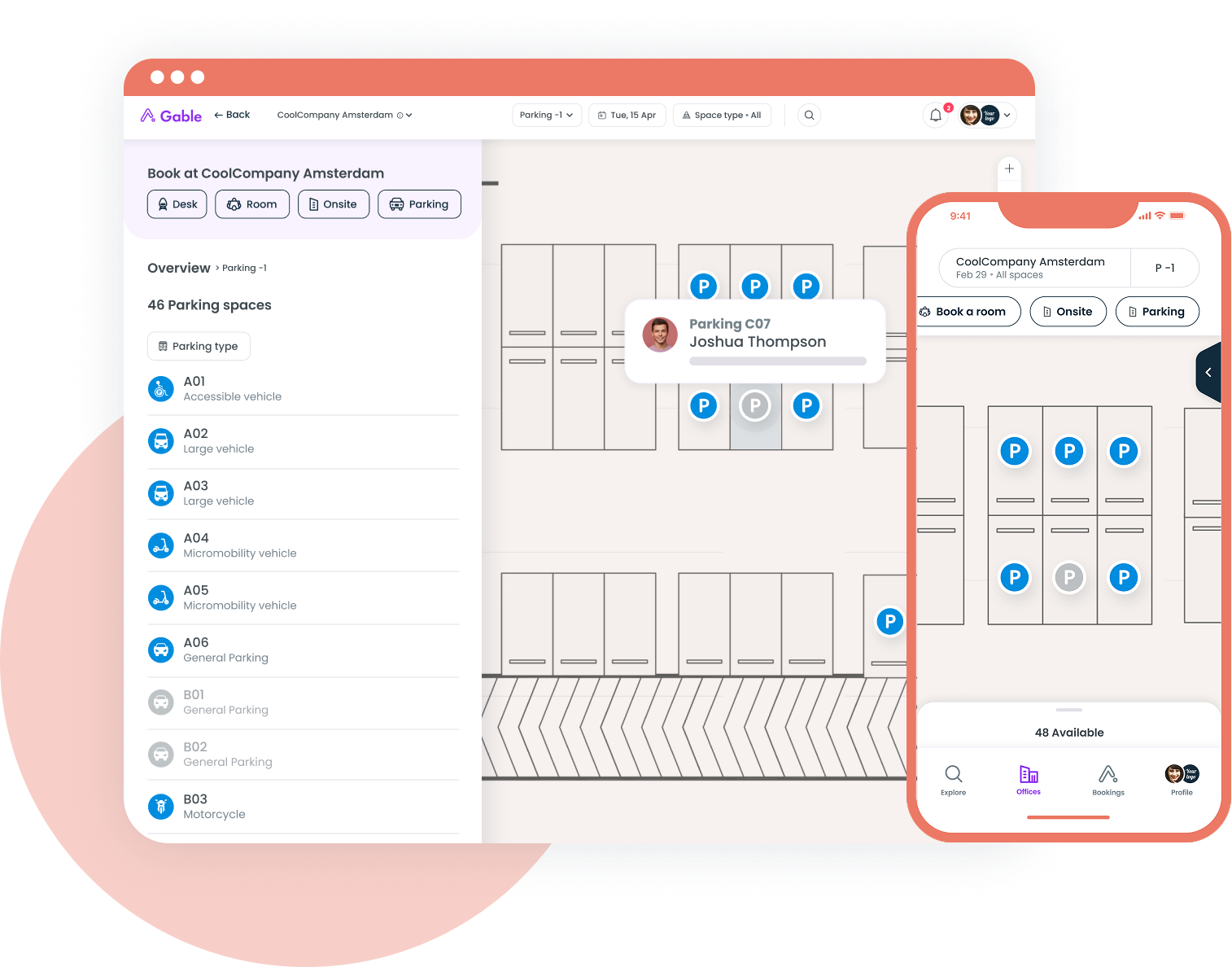
Gable folds parking into the daily office experience instead of treating it as a separate system. Its parking management software lives in the same booking flow as desks and meeting rooms: employees reserve a spot for their office days, and one reservation covers where they sit and where they park. Admins manage inventory on interactive floor plans, with zones for EVs, accessible spots, guests, and motorcycles.
- Spot assignments by employee, team, or department, alongside shared pools
- Booking windows, daily limits, and auto-release rules that return unclaimed spots to the pool
- Check-in by mobile or web, with reports on no-show rates, peak days, and usage by team and site
Pricing: Parking comes with Gable's Office Management plans, from $2.50 per user per month.
G2 rating: 4.4/5 (243 reviews)
2. Wayleadr
Wayleadr calls itself an arrival management platform, and the label fits: it combines parking allocation with digital access, EV charging management, carpool coordination, and shuttle scheduling for corporate campuses. Uber, OpenAI, and Sanofi are among its clients, which says something about the scale of infrastructure it handles. AI-based spot allocation follows the rules you set, and digital lot maps guide drivers to their assigned spot. Smaller companies with a few hundred employees may find it more platform than they need.
- Gate entry by phone, license plate recognition, or badge, with no manual logs
- Charging rotation that cycles EVs through available chargers fairly
- Live occupancy tracking with cost and sustainability reporting
Pricing: Custom for the Work plan; the Flex plan covers up to 20 spaces at $49 per month.
G2 rating: 4.9/5
3. Parkable
Parkable is strongest where parking is messy: multiple sites, shared tenant garages, and fluctuating capacity. Its fair-allocation engine spreads spots across the team instead of rewarding the fastest bookers. The standout feature is that unused bays can be reallocated between tenants or monetized automatically, so a half-empty garage earns its keep. Visitor parking runs through the same allocation logic. Reviewers consistently praise the support team. You can run it software-only or with sensors and RFID hardware.
- Automatic reallocation and monetization of unused bays
- Fair allocation across staff and tenant groups
- One admin dashboard for payments, permits, and tenant management
Pricing: Custom; not listed publicly, so budget a vendor call.
G2 rating: 4.9/5 (80 reviews)
4. Ronspot
Ronspot manages desks, rooms, and parking on a credits system instead of a standard booking queue. Admins give employees weekly or monthly points to spend on reservations, which spreads high-demand days fairly. Its Teams app keeps booking inside the tools people already use, and its security posture appeals to regulated enterprises like American Express, Allianz, and Eli Lilly. Vehicle matching pairs drivers with suitable spots by size, emissions type, and accessibility needs.
- Credit allowances and booking windows that balance peak-day access
- Waitlists that auto-assign freed spots to the next person in line
- Barrier and license-plate camera integrations via the Connect add-on
Pricing: Custom per space; 20-space minimum, billed annually.
G2 rating: 4.5/5
Gable Offices puts parking in the same reservation as the desk, with the utilization data to plan around peak days.
Learn more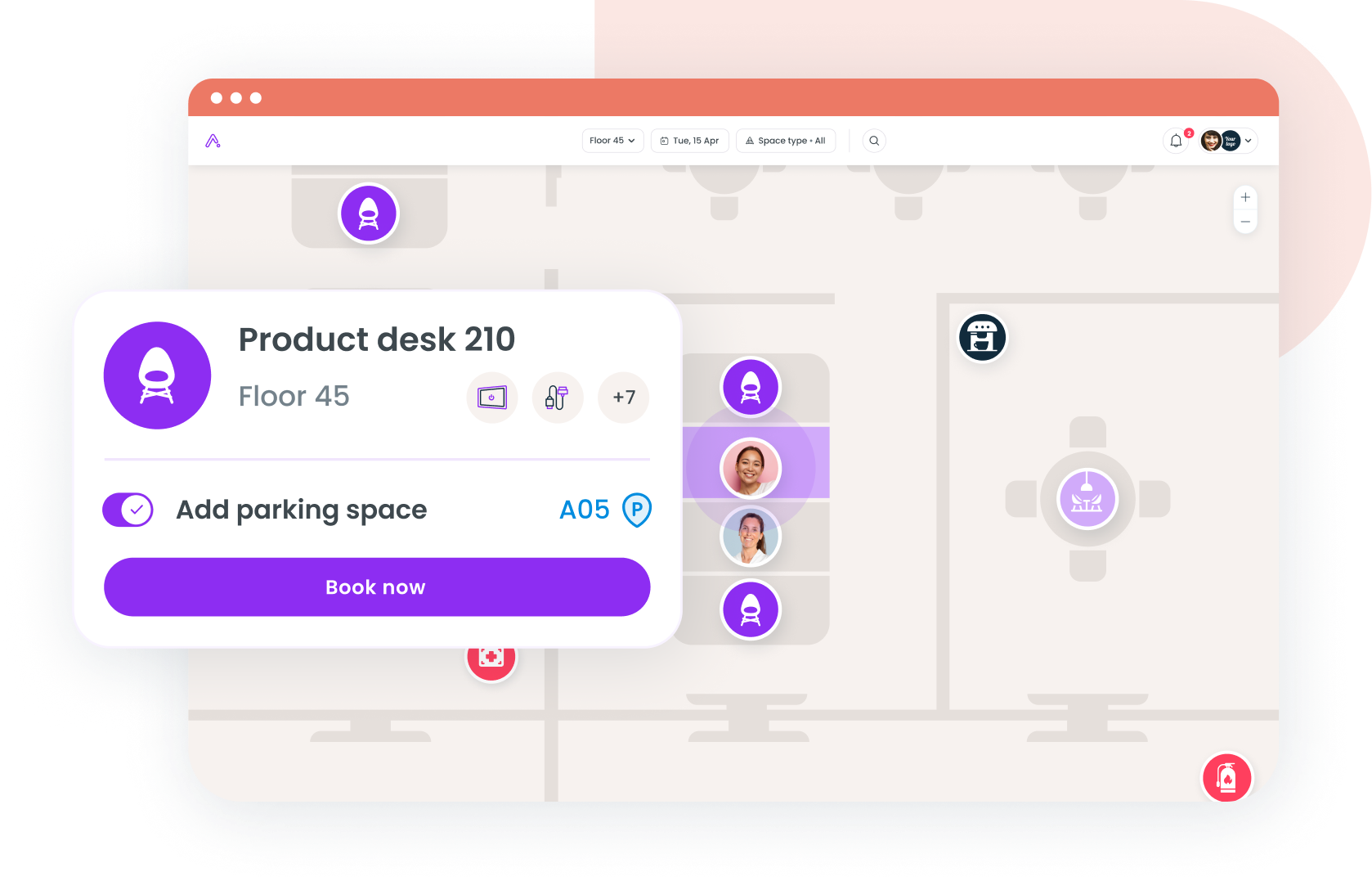
5. Sharvy
Sharvy, a French platform, covers more space types than anything else on this list: cars, bicycles, motorbikes, EV charging points, accessible spaces, and carpooling all live in one system. It can also bill employees automatically for the spots they use, which suits companies recovering the cost of leased garages. License plate recognition handles gate access in supported setups, and Nestlé and Burger King are among its customers. The catch for US buyers: support and documentation are EU-first.
- Free LITE plan covers up to 5 parking spaces
- Fair and first-in-first-out allocation algorithms
- Automatic employee billing for parking and charging use
Pricing: Free up to 5 spaces; the Flex plan runs EUR 2 to EUR 4.20 per space per month by resource type and volume.
G2 rating: Too few reviews for a score yet.
6. deskbird
deskbird comes at parking from the desk booking side. It's a hybrid-work platform where employees plan office days, book desks, and reserve a parking spot in the same mobile app, so it shines when parking is one part of a broader flexible-office rollout. Employees set weekly schedules, see colleagues' plans, and grab a spot for the days they picked. The company is European, GDPR compliance is a selling point, and the Teams and Slack integrations are strong.
- Parking booking tied to weekly office-day planning
- Interactive floor plans covering desks, rooms, and spots
- HRIS, calendar, and SSO integrations
Pricing: From about $3.75 per active user per month, billed annually.
G2 rating: 4.5/5 (279 reviews)
7. Envoy
Envoy started in visitor management and grew into a full workplace suite; parking is one of the resources employees can reserve alongside desks and rooms. Booking rules control who can use which spots and when, and detailed usage records make employee parking auditable, which compliance-minded facilities teams will appreciate. The trade-off is the cost structure: resource-based pricing plus a platform fee stacks up as you add bookable spots, and reviewers note that key features sit in higher tiers.
- Rules that decide who can book which spots, and when
- Real-time visibility with audit-ready usage records
- Ties into Envoy's visitor, desk, and delivery products
Pricing: Reservations cost $5 per resource per month billed annually, plus a platform fee.
G2 rating: 4.4/5 (Envoy Workplace)
8. Skedda
Skedda is a per-space booking platform: desks, rooms, lockers, and parking spots are all configurable "spaces" with rules, quotas, and visual maps. That model makes it fast to set up a lot without vendor hand-holding, and its 2026 G2 awards for support and ease of setup back that up. The same model is the cost catch: every bookable desk and spot counts toward your plan's space limit, so combined desk-plus-parking deployments climb pricing tiers quickly.
- Visual maps with self-service booking rules and quotas
- Conditional booking policies by user group and time
- Unlimited users on every plan; you pay per space rather than per person
Pricing: From $249 per month on the Plus plan, which includes 35 spaces.
G2 rating: 4.8/5 (281 reviews)
How to choose parking management software for your office
Start from your parking problem, then check five things before any demo.
- Match the tool to the problem. A single crowded lot: Sharvy's free tier or a per-space tool like Skedda gets you off the spreadsheet fast. Garages across multiple sites with tenants and paid parking: Wayleadr and Parkable are built for that. Parking as one symptom of a wider coordination problem (desks empty while the lot overflows): pick a platform that manages the whole office day, which is where Gable sits.
- Check the allocation model. First-come booking, credits, waitlists, or admin assignment each produce different fairness outcomes. Pick the one your culture will accept on a full Tuesday.
- Insist on auto-release. No-show reclamation is the single feature that recovers the most capacity; without check-in enforcement, your "full" lot is 15 to 20% empty.
- Test the integrations. Booking should live where people plan their week, next to workplace scheduling software and desk booking, with badge or gate data confirming arrivals.
- Model the pricing at your real numbers. Per-user, per-space, and per-resource models diverge sharply at scale. A 300-person office with 80 spots pays differently under each; run all three before shortlisting.
How parking data connects to broader workplace planning
Parking occupancy is attendance data wearing a different badge, and it complements desk utilization in ways planning teams underuse. Lot check-ins confirm physical arrivals, so pairing them with your office occupancy rate separates real attendance from booked-but-absent noise. The two datasets also fail in opposite directions: desks undercount people in meetings all day, and parking undercounts transit riders, so together they bracket the truth.
The planning payoff shows up at the peaks. With global office utilization at 53% per CBRE and attendance concentrated midweek, Tuesday's parking crunch stays invisible in Monday's average. Watching lot occupancy by day of week tells you whether to stagger team anchor days before it tells you to lease more spaces. It also feeds arrival infrastructure: badge access control systems and desk booking software complete the picture of who's on-site, and hybrid attendance is a durable planning input given Stanford found hybrid schedules cut resignations by 33% with no productivity cost.
The lot is part of the workplace now
Office parking management stopped being a facilities afterthought the moment attendance turned spiky. The eight tools here solve the same core problem with different centers of gravity: arrival infrastructure (Wayleadr), messy multi-tenant capacity (Parkable), fairness mechanics (Ronspot, Sharvy), per-space simplicity (Skedda), suite add-ons (Envoy, deskbird), and parking as part of one office booking flow (Gable). Pick for the problem you have this quarter, and let the usage data argue about next year.
See how Gable handles parking, desk booking, and attendance data in a single platform for hybrid offices.
Get a demo