.svg)


.svg)
- Global office utilization averages 53%, but most organizations target 79%, meaning there's significant room to cut costs without losing productive space.
- Dynamic desk-sharing ratios based on job function (not headcount) can reduce your required square footage by 30-50%.
- 92% of CRE teams have launched AI pilots, but only 5% have hit their goals; focusing on 1-2 high-ROI use cases delivers faster savings.
- Elastic portfolios that combine core offices with on-demand flex space convert fixed real estate costs into variable expenses.
- Utilization data (not badge swipes) gives you the negotiation leverage to renegotiate leases, consolidate floors, and sublease excess space.
Corporate real estate typically accounts for 10-25% of total operating expenses, making it one of the largest controllable line items on your balance sheet. With global office utilization at 53% and most organizations targeting 79%, the gap between what companies pay for and what they use represents millions in recoverable costs. The pressure to reduce real estate costs has never been more specific or more solvable.
This guide walks through seven data-backed strategies to reduce corporate real estate costs in 2026, from measuring true space utilization to building elastic portfolios that flex with your workforce.
Why reducing real estate costs is a 2026 priority
Market conditions have shifted from pandemic-era panic to a more nuanced challenge. 57% of organizations expect portfolio contraction over the next three years, with 67% citing "less space needed due to hybrid work" as the primary driver. At the same time, occupancy rates have hit 111% globally, meaning more people are allocated to buildings than there are physical seats. Hybrid work didn't eliminate the need for offices; it changed how and when people use them.
Three forces are converging to make real estate cost reduction both urgent and achievable:
- Hybrid occupancy patterns are now measurable. Companies have 3+ years of post-pandemic attendance data. The guesswork phase is over, and the optimization phase has begun.
- AI and sensor technology have matured. 92% of CRE teams launched AI pilots in 2025, giving organizations new tools to forecast demand, optimize energy use, and model portfolio scenarios.
- ESG and employee experience expectations overlap. Energy-efficient buildings cost less to operate and score higher on sustainability metrics. Investments in sustainable office design deliver both financial and environmental returns.
Measure true utilization, not nominal capacity
The single biggest mistake companies make when trying to reduce real estate costs is relying on the wrong data. 90% of organizations use badge swipe data as their primary occupancy metric. Badge data tells you whether someone entered the building. It doesn't tell you whether they used a desk, sat in a meeting room, or spent the day in the café.
Why badge data overstates utilization
A CBRE sensor-based study found that peak utilization was 59% when measured by sensors compared to 85% when measured by badge swipes. That 26-point gap enabled the organization to consolidate from eight floors to six, saving £240K annually. If you're making real estate decisions based on badge data alone, you're likely overestimating how much space you need.
How to measure what matters
Accurate utilization measurement requires layering multiple data sources:
- Sensor data captures whether desks and rooms are physically occupied, not whether someone badged in.
- Wi-Fi connection logs show where people spend time within a building, revealing dead zones and hotspots.
- Booking system data tracks reservation-to-attendance ratios, exposing ghost bookings that inflate perceived demand.
For a deeper look at the metrics that drive real estate decisions, see this guide on space utilization metrics. If you're evaluating sensor options, this overview of workplace sensors and privacy covers how to collect occupancy data without overstepping.
Gable's Workplace Intelligence dashboard integrates HR, access control, and Wi-Fi data into a single view, so you can see actual utilization across your entire portfolio rather than relying on a single imperfect signal.

Learn how four pillars of workplace analytics ROI translate utilization data into measurable cost savings and better real estate decisions.
Read the guide
Set dynamic sharing ratios by work style and function
Once you have accurate utilization data, the next step is to right-size your desk-to-employee ratio. Static 1:1 seat assignments waste space in hybrid environments. But aggressive sharing ratios without data backing create booking conflicts and employee frustration.
Match ratios to how teams work
CBRE's 2026 benchmarking data shows that sharing ratios are now informed by job function (83%), utilization data (78%), and supply/demand data (68%). A one-size-fits-all ratio doesn't work because different roles have different in-office patterns.
Here's a framework based on industry benchmarks:
- Assigned seating (1:1): Finance, healthcare, government, and roles requiring specialized equipment or security clearance.
- Hybrid sharing (1:0.7 to 1:0.8): Mixed remote/office roles with 2-3 scheduled in-office days per week. This is the sweet spot for most knowledge workers.
- Heavy flex (1:0.5 or lower): Sales, consulting, and client-facing roles where employees spend 30% or less of their time on-site.
- Industry-specific ranges: Tech companies typically run 2:1 to 3:1 ratios (lower daily attendance), financial services 1.5:1 to 2:1 (regulatory needs), and professional services 2.5:1 to 3.5:1 (heavy client time).
Run the numbers for your organization
If your peak in-office day sees 75% of 200 employees, you need roughly 165 desks, a 1.2:1 ratio, with a 10-15% buffer for flexibility. That's 35 fewer desks than a 1:1 model, which translates directly to reduced square footage, lower rent, and fewer operating costs.
Desk sharing and hot desking are the operational models that make dynamic ratios work. The key is pairing them with a booking system that gives employees visibility into who's coming in and where they can sit.
Use AI to optimize your portfolio, not as a science project
AI is the most talked-about tool in corporate real estate right now, and also the most misapplied. While 92% of CRE teams have initiated AI programs, only 5% have achieved their program goals. The gap comes from trying to do too much at once; organizations are pursuing an average of five AI use cases simultaneously, and 55% cite data quality issues as their top barrier.
Focus on 1-2 high-roi use cases first
For reducing real estate costs, two AI applications deliver the fastest payback:
- Space utilization and demand forecasting. AI models can analyze booking patterns, badge data, calendar signals, and seasonal trends to predict how much space you'll need 6-12 months out. This turns annual real estate planning into a continuous optimization cycle.
- Energy management. Industry analysis shows AI-based HVAC optimization can achieve 20-30% reductions in electricity consumption, and mid-sized portfolios have seen 35% year-one utility cost savings after deploying IoT sensors and automation.
Shift from annual planning to monthly scenario modeling
JLL's 2026 outlook recommends treating portfolio optimization as a continuous platform, not a once-a-year project. Monthly scenario planning should integrate utilization data, booking patterns, and business drivers like headcount changes or policy shifts.
A practical cadence looks like this:
- Establish baseline utilization metrics from sensor and booking data.
- Run quarterly "what-if" scenarios: headcount ±10%, hybrid policies shifting from 2 to 3 to 4 required days.
- Use AI to forecast space demand for the next 6-12 months.
- Adjust lease, flex, and assignment strategies monthly based on updated projections.
For a broader look at how AI fits into workplace operations, see this guide on workplace AI adoption.
Gable's Workplace Intelligence and AI Copilot turn complex utilization data into clear insights and exec-ready reports, so you can act fast and plan smart.
Learn more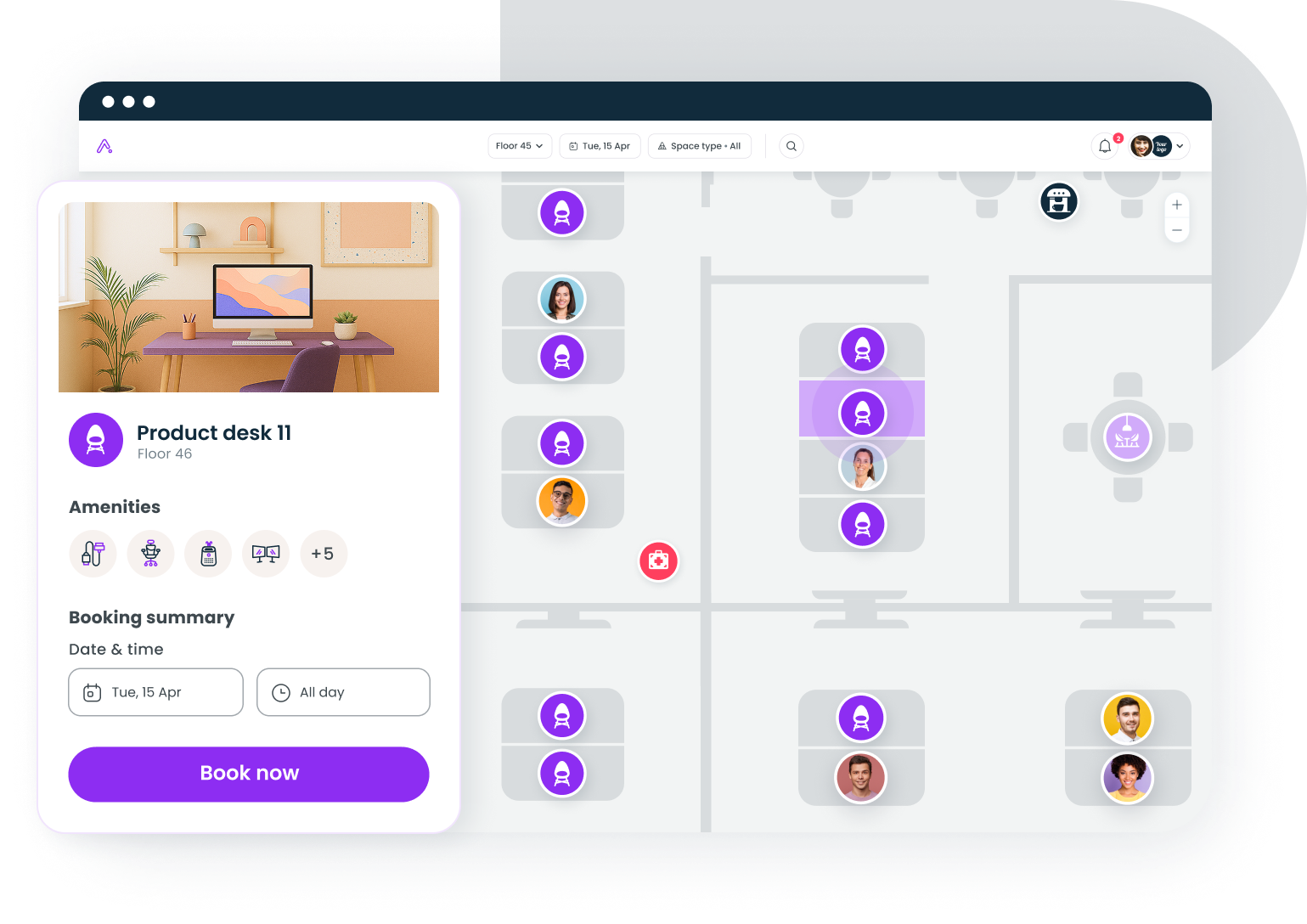
Renegotiate leases with utilization data as leverage
With vacancy rates elevated across most markets, landlords are motivated to retain paying tenants. That gives you negotiation leverage, but only if you bring data to the table.
Use real utilization to justify consolidation
The CBRE sensor study mentioned earlier is a blueprint: by proving that actual peak utilization was 59% (not the 85% badge data suggested), the organization consolidated two floors and saved £240K per year. Your utilization data from Step 1 becomes your strongest negotiation asset.
When approaching lease renegotiations, come prepared with:
- Peak and average utilization rates by floor, zone, and day of week. Recent industry benchmarks show Tuesdays see the highest global occupancy at around 59%, while Fridays drop to 34.5%.
- Cost-per-desk calculations that show the true expense of underutilized space. This cost per desk guide walks through the math.
- Scenario models showing how much space you'd need under different hybrid policies.
For detailed tactics on getting better lease terms, this guide on office lease negotiation covers 15 specific strategies.
Consider sale-leasebacks for owned properties
If you own office space, sale-leaseback arrangements let you convert property equity into working capital while maintaining operational control. You avoid ongoing property tax, insurance, and major maintenance obligations. The trade-off is a lease payment, but for many organizations, the freed capital and reduced management burden make the math work.
Sublease excess space
Subletting floors or sections you don't need turns a cost center into a revenue source. Even partial subleases offset rent while you work toward a right-sized portfolio at your next lease renewal.
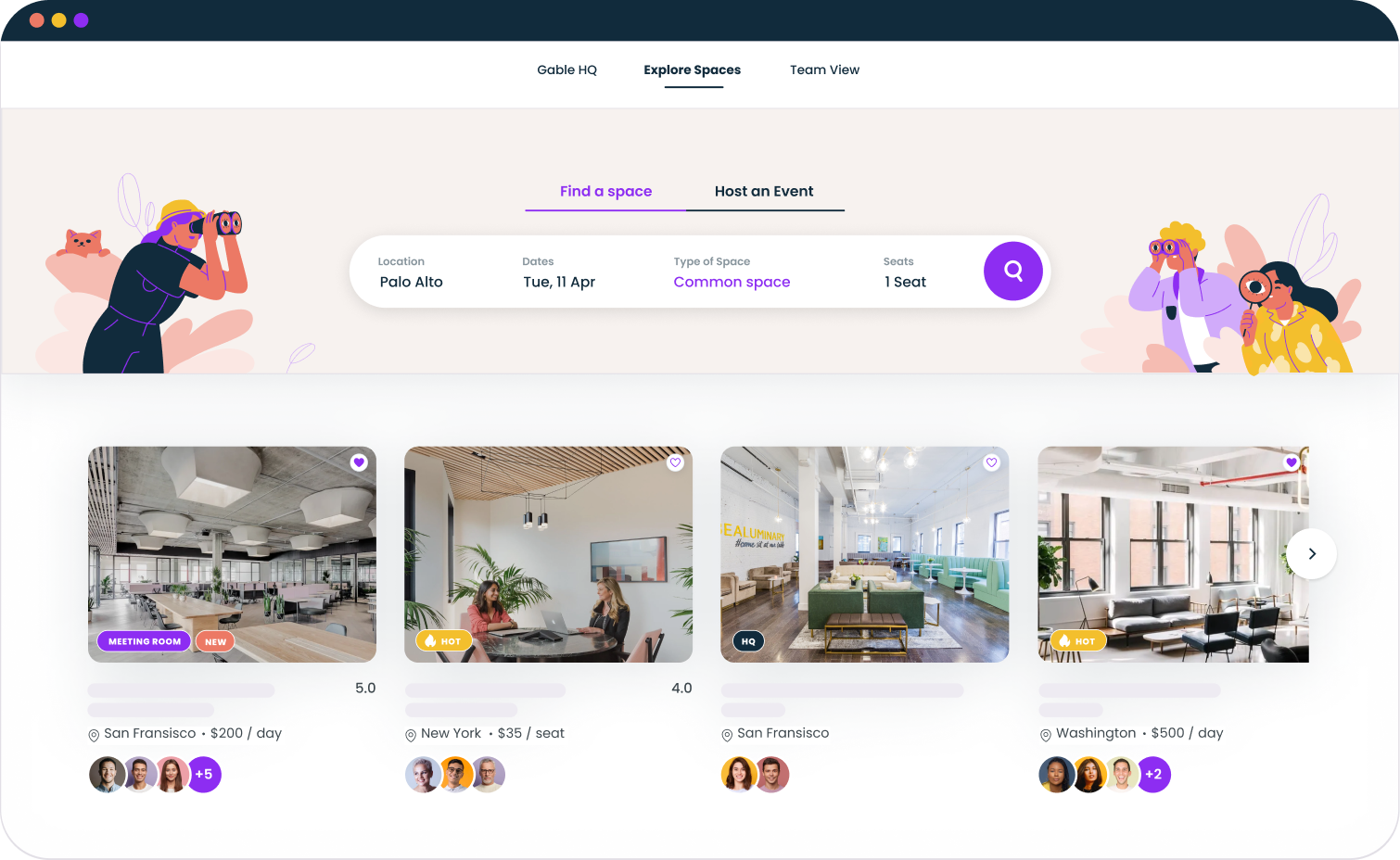
Build an elastic portfolio with on-demand flex space
The traditional model of sizing your office for peak demand locks you into paying for space that sits empty most of the time. An elastic portfolio combines a right-sized core office with on-demand flex space that scales up or down based on actual need.
How the core-plus-flex model works
- Core office: Sized for your average daily attendance (not peak), focused on collaboration spaces, team neighborhoods, and cultural anchors. CBRE notes a 40% increase in collaboration space globally since 2021, reflecting how the purpose of core offices has shifted.
- On-demand flex: Covers peak weeks, project-based surges, distributed team meetups, and client hosting. You pay per use rather than per month.
If you have 200 employees but only 60-70% come in on a given day, you need 120-140 desks in your core office instead of 200. The savings on rent, utilities, cleaning, and maintenance compound quickly. For the days or weeks when attendance spikes, on-demand workspaces absorb the overflow without requiring permanent square footage.
This approach also supports distributed teams. Instead of maintaining satellite offices in every city where you have employees, you give team members access to flex workspaces near where they live. For a detailed cost comparison, see this breakdown of flexible spaces vs. office leases.
Why elastic beats static
Static portfolios force you to predict the future. Elastic portfolios let you respond to it. When headcount grows, you add flex bookings. When a team consolidates, you scale back. Real estate becomes a variable expense rather than a fixed one, which is exactly what CFOs want to see on the balance sheet.
Reduce energy costs through smart building optimization
Energy consumption typically accounts for one-third of operating costs in commercial office buildings. Smart building technology and occupancy-aware systems can cut that significantly.
Automate based on actual occupancy
When your building systems know which floors and zones are occupied in real time, they can adjust heating, cooling, and lighting accordingly. Instead of running HVAC at full capacity for a building that's 53% used, automated systems match energy output to actual demand.
LED lighting, smart thermostats, and occupancy-triggered controls deliver immediate savings. Combined with AI-based HVAC optimization, mid-sized portfolios can achieve 20-30% reductions in electricity consumption.
Align energy savings with ESG goals
62% of organizations cite energy performance as their top sustainability driver. Investments in energy efficiency don't operate in isolation; they contribute to ESG reporting metrics that employees and investors increasingly expect. The financial case and the sustainability case point in the same direction.
Implement predictive maintenance
Sensors that detect early signs of equipment degradation prevent small issues from becoming expensive emergencies. Predictive maintenance extends equipment lifespan, reduces unplanned downtime, and lowers the total cost of building operations. Regular energy audits identify underperforming systems before they drive up utility bills.
Bring it all together with a continuous optimization cycle
Reducing real estate costs isn't a one-time project. The organizations seeing the largest savings treat it as an ongoing discipline: measure utilization, set data-informed ratios, model scenarios monthly, renegotiate leases with evidence, supplement core space with flex, and optimize energy consumption continuously.
The common thread across all seven strategies is data. Without accurate utilization data, you're guessing. With it, every decision, from how many desks to keep to whether to renew a lease, becomes defensible and measurable.
Start with the strategy that addresses your biggest cost driver. For most organizations, that's measuring true utilization (not badge swipes) and adjusting sharing ratios accordingly. The savings from that single step often fund everything else.
Gable helps workplace teams measure utilization, optimize space, and manage on-demand workspaces across 20,000+ locations, all from one platform.
Get a demo